
 BVM Insights Team
A plastic surgery SEO launch plan should follow the authority your practice already has. A new practice must build surgeon proof, procedure relevance, and regional trust from zero. A relocating or rebranding practice must first decide which assets to preserve, update, reconnect, or rebuild, all before patients finish their shortlist.
Though the opening date is set, the gallery awaits approvals, the surgeon bio is undergoing edits, and priority procedure pages still hold placeholder copy.
After the readiness checklist, a harder question follows. Do we launch like a brand-new practice, or does our name change the plan? Answer it wrong, and patients may finish their shortlist before your proof is findable.
Plastic surgery SEO launch sequencing is a phased approach for preparing the search, trust, and conversion assets a new, relocating, or rebranding Texas practice needs around market entry. Think of it as building the runway before the practice takes off. The clinical practice may be ready, but patients can still form their shortlist before procedure pages, surgeon proof, galleries, and regional signals become discoverable.
The desired outcome is to open with the highest-priority patient-discovery pathways already connected, while reserving lower-priority expansion for later. Dependencies and existing authority should drive the sequence. A generic launch-now-and-optimize-later approach can fail when no established visibility carries the practice through the early comparison period.
The Core Difference: Build Authority vs. Preserve and Reconnect Authority
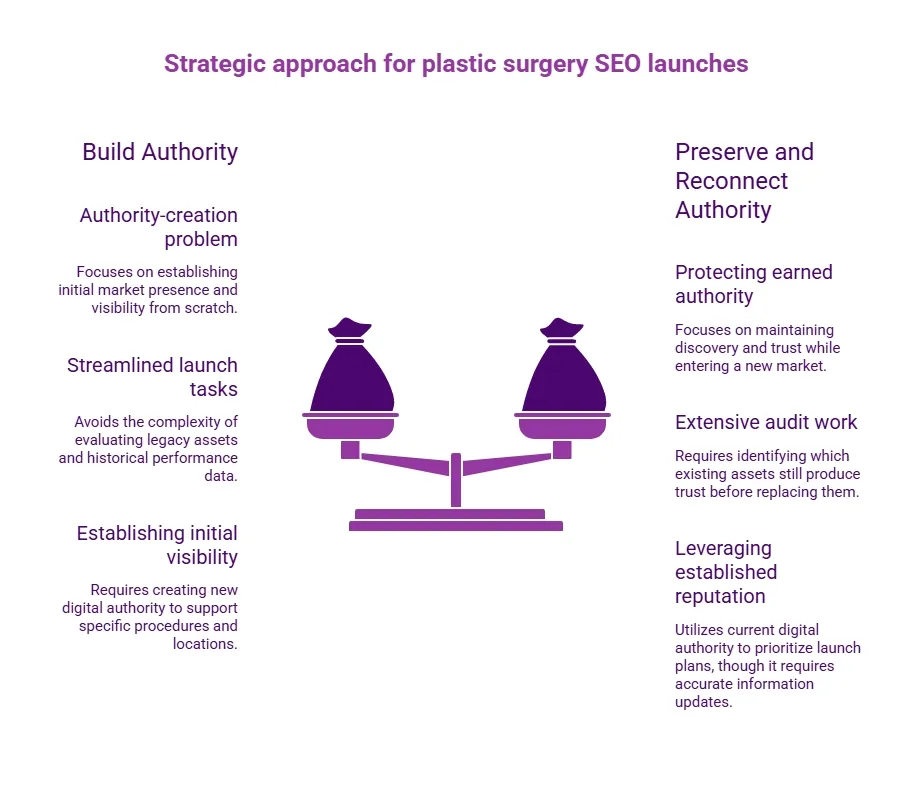
A net-new practice faces an authority-creation problem. A relocating or rebranding practice faces two problems: entering a new market and protecting the authority it has already earned.
Neither approach automatically produces faster rankings.
A relocation is not a new launch with fewer tasks. It frequently carries more audit work, because you must learn which assets still produce discovery and trust before replacing anything.
An established surgeon’s reputation may provide a head start, but it does not establish visibility for every procedure or every geographic market. An established website still needs accurate information about the new practice. Existing digital authority changes the priorities in your plastic surgery SEO launch plan, but it does not supply a migration sequence that fits every practice.
The deciding factor is useful existing authority, not the age of the practice or its website.
What a Net-New Practice Must Build From Zero
For a completely new clinic, the immediate technical priority is laying a verifiable baseline of clinical expertise, structured treatment pages, and accurate local entity data. Coherence beats volume. Patients should quickly learn who the surgeon is, which procedures are the focus, what the gallery shows, and how to book a consultation.
Credentials deserve particular weight. Board certification, clinical experience, aesthetic philosophy, and facility information should all be accurate and verifiable, so patients can judge professional fit instead of sorting through promotional claims. The American Society of Plastic Surgeons advises patients that choosing a board-certified plastic surgeon is the first and most important decision. Your pages should make that signal easy to find.
Procedure pages come next, and they should answer real patient questions. A breast augmentation page, for example, should explain the procedure, the evaluation considerations, and the consultation process without implying that online information determines candidacy. Approved galleries then belong on the procedures they illustrate, with image descriptions that give context without promising comparable outcomes.
That order reflects Google’s guidance on helpful, reliable, people-first content, which emphasizes usefulness, trust, and demonstrable expertise. A small set of complete, clinically reviewed pages gives patients more to evaluate than a large set of unfinished ones.
A common pitfall is that approvals slip and the team publishes generic posts because they feel like progress. The real bottleneck is weak procedure-to-surgeon mapping.
What a Relocating Practice Should Audit Before Rebuilding
Inventory comes before replacement. Ask which assets still reflect the surgeon’s aesthetic philosophy, which are tied to the old location or brand, and which already support non-branded discovery.
Preserve useful information before making irreversible technical changes.
If URL structures must change during a rebrand, strictly map and implement 301 redirects to pass the earned authority from the old procedure pages to the new ones. These are audit questions, not migration instructions. Google’s guidance on site moves with URL changes describes a planned, page-by-page process, including URL mapping and redirects, that depends on the site involved. It applies to genuine website moves, not to every practice relocation.
Listings follow separate rules. Google’s Business Profile guidelines call for one profile per business that reflects its real-world location. Its guidance on relocation and duplicate profiles makes the correct treatment depend on whether the business remains the same entity. How these rules apply varies by situation, so an expert should confirm the approach.
Picture a surgeon-owner relocating under a new name, ready to retire the old site at launch. No one has checked which old procedure pages still attract non-branded searches. If those pages disappear unreviewed, the practice loses discovery it had already earned.
Where Existing Authority Does Not Eliminate Launch Work
Surgeon-name rankings are not procedure discovery. Reviews do not replace clear procedure information. Established backlinks do not ensure patients understand a changed identity or location.
Galleries follow the same rule. Even strong examples need accurate procedure context and appropriate authorization before they support a new practice.
Launching first and improving later is defensible when existing authority already keeps the practice discoverable. It becomes risky when the practice needs non-branded discovery at launch while procedure pages, surgeon proof, or gallery context remain incomplete. In practice, these foundational assets are launch-critical, along with accurate location details and a working consultation path. Broader educational content can follow.
Business Impact
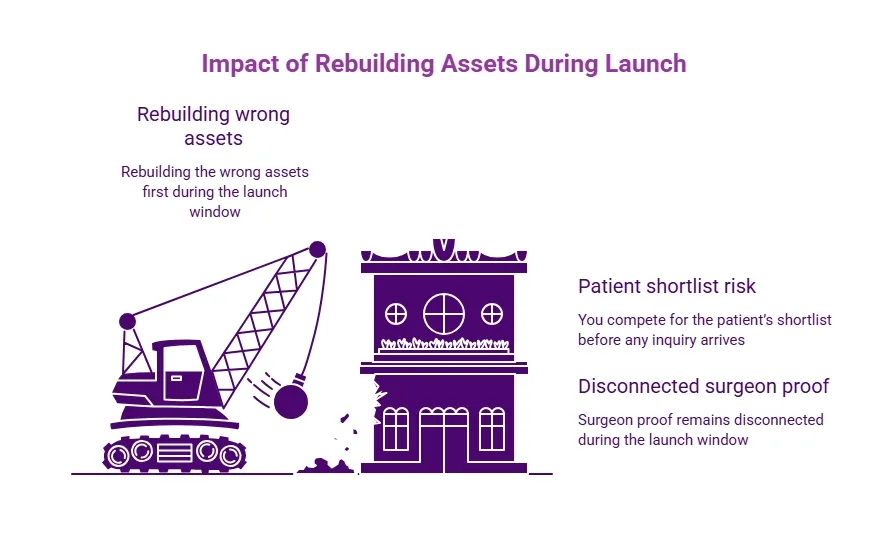
You compete for the patient’s shortlist before any inquiry arrives. Rebuilding the wrong assets first can leave surgeon proof disconnected during the launch window. A new practice with incomplete proof faces the same risk from a different starting point.
Judge progress by consult quality and patient fit, not traffic. Early indicators include priority pages appearing for procedure searches in Google Search Console, though timing varies by market. The Avere Beauty case study shows improved visibility changing discovery for an aesthetics business. It is adjacent evidence, not a relocation result. However, it demonstrates a core principle applicable here: aligning specific procedure pages with local search intent accelerated patient acquisition faster than relying on brand name alone.
How to Choose Your Starting Path
Three questions decide your starting path:
- Does meaningful authority already exist? Look at relevant organic visibility, established content, backlinks, and reputation signals.
- Does that authority still support the current practice? Check whether existing assets represent the intended surgeons, procedures, business identity, and market.
- Can patients complete the evaluation journey? Confirm a prospective patient can move from procedure discovery to surgeon proof to consultation access.
The answers point to one of three paths.
Build from zero when little authority exists. You get a clean structure, but nothing carries discovery while new assets mature.
Preserve and reconnect when useful pages, proof, or links already exist. You protect what patients already find, at the cost of more audit work before launch.
Audit with an expert first when transferability is unclear, when a rebrand and relocation happen at the same time, or when continuity of the legal entity, domain, brand, or business profile is uncertain.
What to Validate With an SEO or Subject-Matter Expert
Assign clear ownership and review gates for these questions before technical work begins. The gates keep unapproved clinical claims and technical changes off the live site.
- Which content, URLs, and entity relationships should be preserved or changed?
- Which reviews or profiles can appropriately support the new practice?
- Which technical migration actions fit your website?
- What must be live before launch?
Then confirm the essentials:
- Separate branded from non-branded procedure visibility.
- Keep surgeon proof tied to current practice information.
- Verify gallery permissions and procedure context.
- Identify former location references and outdated practice details.
- Test consultation forms, phone numbers, and scheduling destinations.
- Do not assume reviews, links, or rankings transfer automatically.
- Finish critical patient-discovery pathways before lower-priority content.
Any audit should give you plain answers and transparent reporting. BVM’s Plastic Surgery SEO Services center on procedure visibility, surgeon credibility, gallery context, and consultation quality.
Enter the Market Already on the Shortlist
The gallery approvals will clear. What matters is whether patients can find, evaluate, and trust the practice from its first public day.
You now know your starting path and which launch dependencies come first. Know what you have. Protect what works. Build what is missing.
Need help auditing the starting position? Schedule Your Free Strategy Session with BVM to assess your current search foundation and set priorities for your opening, relocation, or rebrand.
Disclaimer: Website migrations, business-profile continuity, and search performance depend on individual circumstances. Qualified professionals should review technical changes, and clinical content requires appropriate medical review.
Our Editorial Process: Our expert team uses AI tools to help organize and structure our initial drafts. Every piece is then extensively rewritten, fact-checked, and enriched with first-hand insights and experiences by expert humans on our Insights Team to ensure accuracy and clarity.
About the BVM Insights Team
The BVM Insights Team is our dedicated engine for synthesizing complex topics into clear, helpful guides. While our content is thoroughly reviewed for clarity and accuracy, it is for informational purposes and should not replace professional advice.