
 BVM Insights Team
The rhinoplasty page loads. Three hundred words about surgical technique, then a contact form. The patient still has seven questions: what recovery looks like, whether this surgeon's aesthetic matches theirs, what credentials are on file. None of those answers sit one click away.
The tab closes.
You already did the hard part. The page ranks, the traffic report looks healthy, and the keyword targets are met. Page one, and the consultation calendar still has gaps. The proof that would fill those gaps probably already exists on your site. It just isn't where the patient is looking.
When Keyword Visibility Captures the Query but Loses the Patient
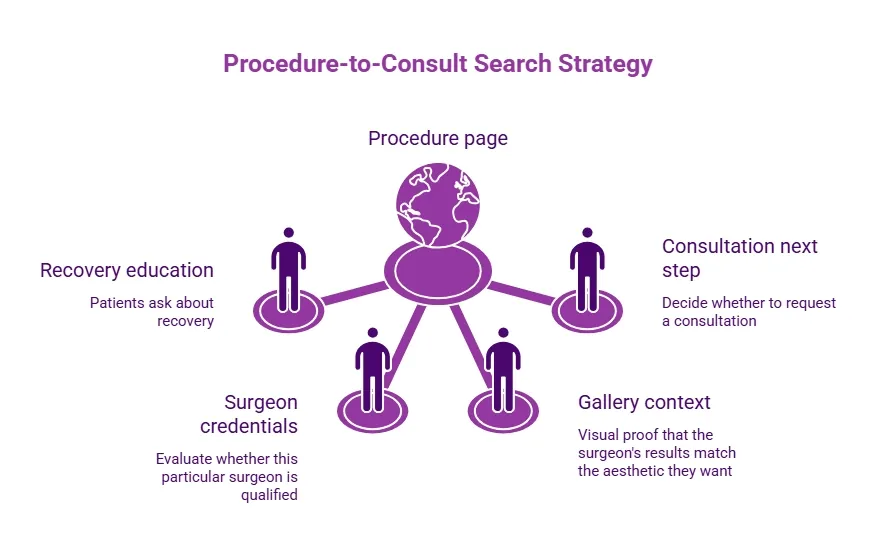
A procedure search pathway connects each procedure page to recovery education, verified surgeon credentials, relevant gallery context, and a clear next step. Without it, keyword visibility captures the query but loses the patient.
The standard playbook says to build procedure pages around procedure keywords and point every visitor to a contact button. That advice works for discovery. It stops working once patients start weighing recovery expectations, surgeon fit, aesthetic style, verified credentials, gallery examples, and regional options before they commit to a consultation.
This is the core of a Procedure-to-Consult Search Strategy. Keyword visibility is the first layer. The architecture you build behind it carries procedure intent toward surgeon credibility, and that second layer is where consultations are won or lost.
One useful question applies to every procedure page on your site: what is the patient asking now, what evidence helps answer it, and what question follows?
Plastic surgery research tends to move through a recognizable set of concerns. Patients ask about the procedure itself, then shift to recovery, then evaluate whether this particular surgeon is qualified and focused on what they need, then look for visual proof that the surgeon's results match the aesthetic they want, and finally decide whether to request a consultation. This sequence describes information architecture, not a fixed route. Real patients enter through a gallery, leave for a review site, and return through a bio page. The pathway has to work from any entry point, and effective internal navigation should accommodate those movements without forcing a predetermined sequence.
Why More Content Rarely Fixes a Fragmented Pathway
Most practices don't lack proof. They lack connected proof.
Consider a marketing lead at a mid-sized aesthetic practice with a quarterly review on Thursday. The breast augmentation pages rank well, but consultation requests from those pages are flat. The surgeon's board certification sits on a bio page that no procedure page links to, and the gallery lives under a separate menu with no explanatory context. The team had planned to publish four more procedure articles. The real fix was two links and a paragraph of context on the page that already ranked.
Four content states help you classify what you actually have:
| Content State | What It Means for the Patient | Editorial Response |
|---|---|---|
| Proof absent | The practice does not yet have the relevant approved evidence. | Identify the missing information and assign a responsible owner. |
| Proof present but isolated | Evidence exists, but patients must locate it on their own. | Connect it to the appropriate patient question. |
| Proof linked but unexplained | A path exists, but the relationship to the patient's question is unclear. | Add meaningful context around the link. |
| Proof contextualized | The patient understands why the evidence matters and where to go next. | Maintain accuracy, relevance, and accessibility. |
Most procedure pages sit in the second or third state. Publishing new articles only addresses the first state. If patients can't find your proof, it does them no more good than proof you don't have.
This four-state framework is an editorial planning method, not a validated predictor of consultation conversion rates. Its value is diagnostic: it tells you where to act before you commission new content.
Place Each Proof Signal Where the Question Appears
Recovery education belongs inside the procedure pathway, not in a separate resources folder. Link it directly from the procedure page with a sentence explaining what the patient will learn there. Recovery details must come from approved practice information and pass qualified clinical review. Don't fill gaps with general recovery timelines. Specific recovery durations should appear only when supported by appropriate clinical evidence and review. A dedicated recovery article can provide greater detail, while the procedure page clarifies why that information matters and preserves the distinction between educational content and individualized medical guidance.
Surgeon credentials need to appear close to the procedure explanation. Verified board certification where applicable, relevant training, and procedure focus are the signals patients look for. A short credential summary on the procedure page, linked to the full bio, answers the fit question while the patient is still on your site. Every credential must be current and verifiable before it goes live. For U.S. plastic surgery credentials, the American Board of Plastic Surgery certification verification service provides a primary source for checking ABPS certification status. Certification, professional membership, experience, and facility accreditation should not be presented as interchangeable qualifications, and the surgeon-owner should confirm clinical relevance and accuracy before publication.
Gallery context does its job when it explains what the patient is seeing. A standalone gallery page works for patients who already trust the surgeon. A gallery excerpt placed beside the procedure explanation works better for patients still deciding who to trust. In both placements, present the gallery as a tool for understanding the surgeon's work, not as a forecast of any individual's result. The American Society of Plastic Surgeons' guidance on evaluating before-and-after photographs discusses the importance of consistent angles, lighting, positioning, and individual patient differences — principles that support responsible gallery presentation. Use only images authorized for publication, and avoid unsupported descriptions of results or claims that photographs establish treatment suitability.
The consultation step should follow the trust-building information rather than replace it. If patients are still evaluating fit, place the consultation action after the credential and gallery context, where the decision actually happens. Explain the consultation process using approved practice information, and allow visitors to examine credentials, relevant examples, and educational resources before deciding to contact the practice.
Structured data can make the relationships between surgeons, procedures, credentials, and facilities easier for search systems and AI tools to interpret. For example, implementing MedicalBusiness or Physician schema allows search engines to directly connect the surgeon’s entity to the clinic's location and the procedures offered. Google's structured data guidelines require markup to represent accurate, visible page information. Structured data should mirror only what appears visibly and accurately on the page, and it should not be used to imply unverified surgeon credentials, affiliations, or services. Clear architecture improves information accessibility, though it does not guarantee rankings or citations.
The Proof-Placement Worksheet
Use this worksheet on one procedure page at a time. Each row starts with a real patient question and ends with a named owner. That keeps unverified claims from reaching the page.
| Patient Question | Proof Element | Source or Status | Placement | Reviewer or Owner |
|---|---|---|---|---|
| What is recovery like for this procedure? | Recovery education content | Approved practice content, or mark "unavailable" | Required: linked from procedure page with one line of context | Surgeon or qualified clinical reviewer |
| Is this surgeon qualified for this procedure? | Board certification, training, procedure focus | Verified credential record | Required: summary near procedure explanation, linked to full bio | Surgeon-owner |
| Do this surgeon's results match the look I want? | Relevant before-and-after gallery set | Approved, consented gallery images | Required: contextual gallery link. Optional: embedded excerpt | Surgeon-owner |
| How does this surgeon approach aesthetics? | Aesthetic philosophy statement | Surgeon-approved wording | Optional enhancement | Surgeon-owner |
| What is the facility like? | Facility details | Verified practice facts | Optional enhancement | Marketing lead |
| What happens at a consultation? | Consultation next-step explanation | Practice-approved process description | Required: clear action placed after proof | Marketing lead |
Before you mark a row complete, check these rules:
- Every proof element has a source. If the asset doesn't exist yet, mark it unavailable rather than writing around the gap.
- Placement separates required context from optional enhancement.
- Every clinical or credential claim has an appropriate reviewer or owner.
- Every link points to a real, existing page on your site. A planned page is not a destination.
- A missing proof asset must not be disguised as approved content.
The surgeon-owner and the marketing lead see this worksheet from different angles, and that's by design. The surgeon-owner cares about reputation accuracy, clinical expertise, aesthetic philosophy, and patient fit. The marketing lead cares about procedure-intent search, page relationships, and the consultation pathway. The worksheet gives both groups a shared, auditable record.
For deeper work on evidence ownership and verification, How to Support Specialist-Relevance Claims With Verifiable Practice Evidence provides a related approach to structuring proof responsibilities across clinical and marketing teams.
From Scattered Proof to a Pathway Patients Can Follow
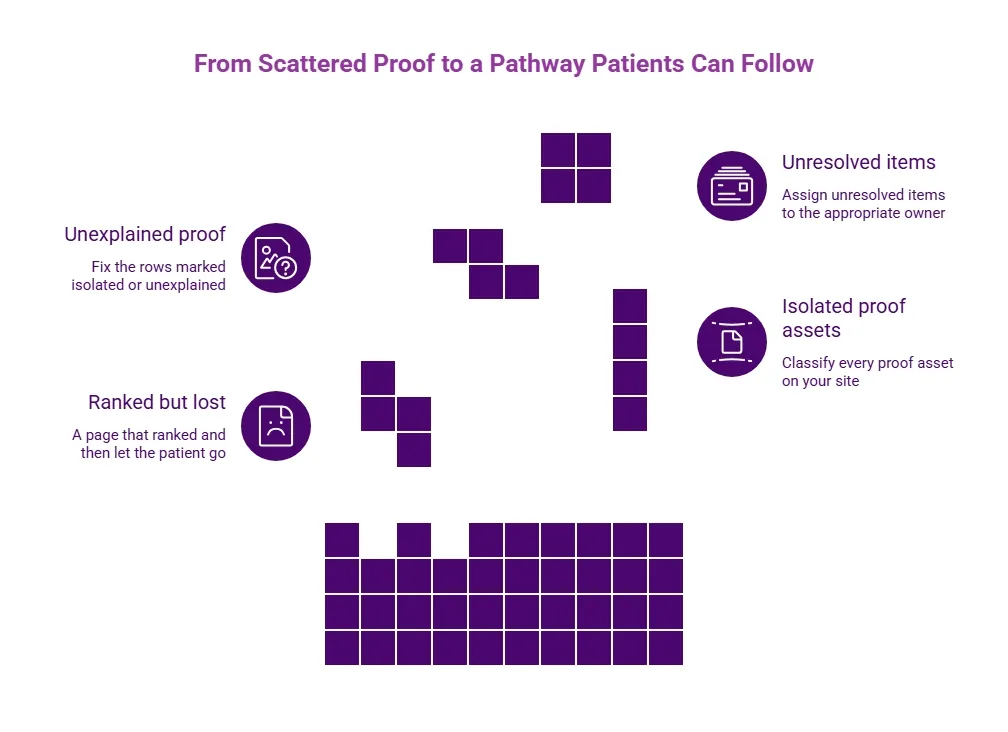
Go back to that rhinoplasty patient. This time, the procedure page links to approved recovery education, a credential summary sits beside the technique description, and a gallery set appears with a sentence explaining what it shows. The consultation step comes last, after the questions are answered. The tab stays open.
You started with a page that ranked and then let the patient go. Now you have a way to classify every proof asset on your site and a worksheet that puts each one where a patient's question actually comes up. That is how a ranking page starts producing consultations.
Pick your highest-traffic procedure page this week. Fill in one worksheet row for each question a patient asks there, and fix the rows marked isolated or unexplained first. Before you mark a connection complete, confirm three things: the evidence is approved, its relevance is explained, and the destination works. Assign unresolved items to the appropriate owner before publication.
Find the question. Place the proof. Build the hallway.
Disclaimer: This article explains search-marketing and website-architecture practices for plastic surgery practices. It is not medical advice and does not address individual treatment candidacy, recovery, or results. Clinical claims, surgeon credentials, and gallery content should be verified by appropriately qualified professionals before publication.
Our Editorial Process: This article was developed by the BVM Insights Team using BVM's approved strategy documents and website materials. Claims are limited to verified source material, and no statistics, recovery durations, or outcome figures have been added without approved evidence.
By: BVM Insights Team. The BVM Insights Team writes about search architecture and content strategy for high-trust industries, including Plastic Surgery SEO.