
 BVM Insights Team
Waiting until opening day to start search work weakens a plastic surgery launch. Prospective patients compare surgeons, procedures, galleries, credentials, and reviews before they contact any practice. The risk of waiting is not slower rankings. It is opening after the patient shortlist has already started to form.
Most launch plans still put search last. The treatment rooms are nearly finished. Gallery approvals are on their third revision, and the photographer arrives Thursday morning. Search can wait until we open.
That decision feels sensible, which is exactly why it deserves a second look.
Plastic surgery SEO launch sequencing is a phased approach for preparing the search, trust, and conversion assets a new, relocating, or rebranding Texas practice needs around market entry. Think of it as building the runway before the practice takes off. The clinical practice may be ready, but patients can still form their shortlist before procedure pages, surgeon proof, galleries, and regional signals become discoverable. The goal is to open with the highest-priority patient-discovery pathways already connected, while reserving lower-priority expansion for later.
Dependencies and existing authority should drive that sequence. A generic launch-now-and-optimize-later approach can fail when the practice has no established visibility to carry it through the early comparison period.
The Myth: SEO Can Wait Until the Practice Opens
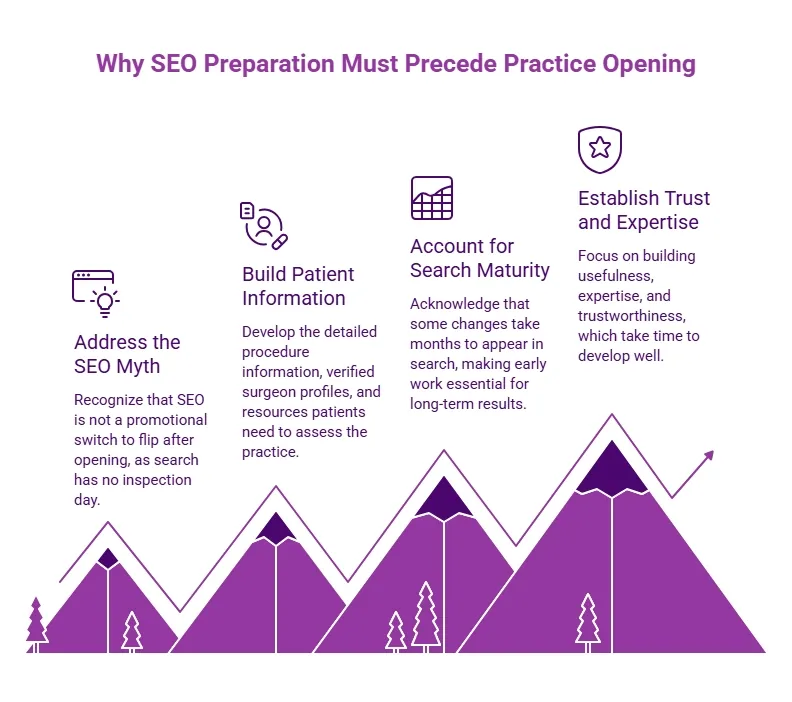
The myth treats SEO as a promotional switch to flip after opening. Staffing, equipment, clinical approvals, and photography all carry visible deadlines. Search has no inspection day.
The myth confuses operational readiness with search readiness. A practice can be fully prepared to perform consultations while its website still lacks detailed procedure information, verified surgeon profiles, and the resources patients use to evaluate a surgeon. Starting early does not mean chasing appointments before the doors open. It means building the information patients will need to assess the practice once they find it.
The myth also borrows a true premise. Google’s SEO Starter Guide confirms that some changes take hours to appear in search while others take months. That premise supports the opposite conclusion: work that matures slowly is the work most harmed by a late start.
Google’s guidance on creating helpful, reliable content points the same way. It rewards usefulness, expertise, and trustworthiness, not page volume. Those qualities take time to build well.
The Reality: Patient Shortlisting Can Start Before the First Inquiry
Patient research happens before the inquiry. The American Society of Plastic Surgeons describes prospective patients working through surgeon websites, reviews, and before-and-after photos. Its guidance on choosing a surgeon treats board certification and photo review as central to that search.
Consider a patient researching rhinoplasty. She may start by learning about the procedure, then move on to surgeons, qualifications, photographic examples, reviews, and consultation expectations. By the time she requests an appointment, several practices may already have been evaluated or excluded.
BVM’s plastic surgery SEO strategy reaches the same conclusion from the marketing side. Thin procedure pages, surgeon profiles, or gallery context can send those comparison searches to another practice.
A practice can lose a place on the shortlist before its front desk ever receives a call. That is a strategic risk, not a prediction that every patient follows an identical journey.
More traffic does not solve this. Credibility at the moment of comparison does, along with attracting patients whose expectations align with the practice’s expertise.
Starting points differ. A brand-new practice may have little search history, while a relocating surgeon may carry name recognition. That creates a subtler trap: ranking for a surgeon’s name is not the same as being found by a patient who has not heard it.
Consider an illustrative case. A relocating surgeon-owner opens with two procedure pages, no gallery, and a biography copied from her previous site. Patients researching her primary procedure in the new city meet competitors with complete proof first.
What Becomes Harder When Search Preparation Starts Late
A late start leaves several connected trust assets unfinished at once, and each belongs to a different member of the launch team.
Priority Procedure Pages Are Still Thin or Disconnected
For the marketing lead, a placeholder procedure page is a missed entry point. It earns its place only when it connects to the surgeon who performs the procedure, the proof behind it, and a clear next step. Connected procedure and surgeon pages help both patients and search systems understand what the practice offers and who delivers it.
Surgeon Expertise Is Harder to Evaluate
The surgeon-owner’s reputation is the asset at stake. Patients look for credentials, procedure focus, aesthetic philosophy, and signals of fit, which is why specialist bios that skip treatment-intent questions underperform. A biography that lists qualifications without naming the procedures that surgeon performs leaves patients to assemble the connection themselves, and many won’t.
Describing the trust signals patients evaluate is general guidance. Claiming a specific credential, or implying a clinical outcome, requires verification by a qualified reviewer before publication.
Galleries and Proof Are Not Yet Doing Search Work
Galleries belong to the trust architecture, not the decoration. For the practice administrator, they are also an approval dependency, since consent, image review, and procedure context all take time. A delayed schedule compresses those approvals into the final days before opening. Missing or unapproved photographs should never be replaced with misleading representations. A gallery is useful only when its material accurately supports the procedure and surgeon information around it.
The Technical Base Is Unverified
Publication does not guarantee visibility. Google’s guide to how Search works treats crawling, indexing, and serving results as separate processes, so a page can be live and still absent from search. For the marketing lead, that makes technical verification a launch task. Priority pages need to be checked for accessibility and suitability for indexing well before patients start looking.
Regional Discovery Starts Later Than It Should
Cosmetic patients may look beyond the closest office, weighing city, region, and style. If regional relevance builds only after opening, non-branded discovery trails behind branded searches.
Relocations add a housekeeping risk, because Google’s Business Profile guidelines call for one accurate profile per business at its real-world location. A relocating or rebranding practice may also hold established search visibility worth preserving through the transition. A brand-new practice, by contrast, is building its footprint from the start.
For qualifying businesses preparing to open, Google’s Business Profile opening-date guidance offers a way to represent a future opening accurately. Neither situation justifies presenting an unopened practice as already operational.
Consultation Pathways Exist but Feel Disconnected
A contact form is not a pathway. The patient’s route runs from a procedure question to confidence in a surgeon, through proof, to a consultation. The COO owns the handoffs that keep that route intact.
Often, the problem is not the website. It is the launch calendar, where surgeon review, gallery readiness, and site production compete for the same overloaded weeks. Publishing more generic content looks like progress. The real bottleneck is usually weak procedure-to-surgeon mapping, missing proof, or an unclear consultation route.
What Waiting Does Not Mean: SEO Is Not an Instant-Results Lever
Starting before opening does not secure first-page visibility on launch day. BVM’s plastic surgery service page openly acknowledges an initial build period while rankings, pages, and authority develop.
Indexing follows no fixed schedule. Google’s crawling and indexing guidance states that indexing cannot be predicted or guaranteed on a set timeline. No validated evidence establishes a universal number of weeks a plastic surgery practice should begin before opening. The right timing depends on competition, existing authority, content relevance, technical accessibility, approvals, website readiness, and available proof.
What earlier preparation offers is narrower and more honest: fewer avoidable gaps when patients first encounter the practice. BVM’s Avere Beauty case study comes from an adjacent aesthetics market. In that engagement, building targeted procedure and treatment visibility helped an established practice move from position #62 to #1 for core terms, securing 12 #1 rankings and a 287% increase in organic traffic. It shows that stronger search visibility can materially change discovery, although it does not establish a launch timeline for plastic surgeons.
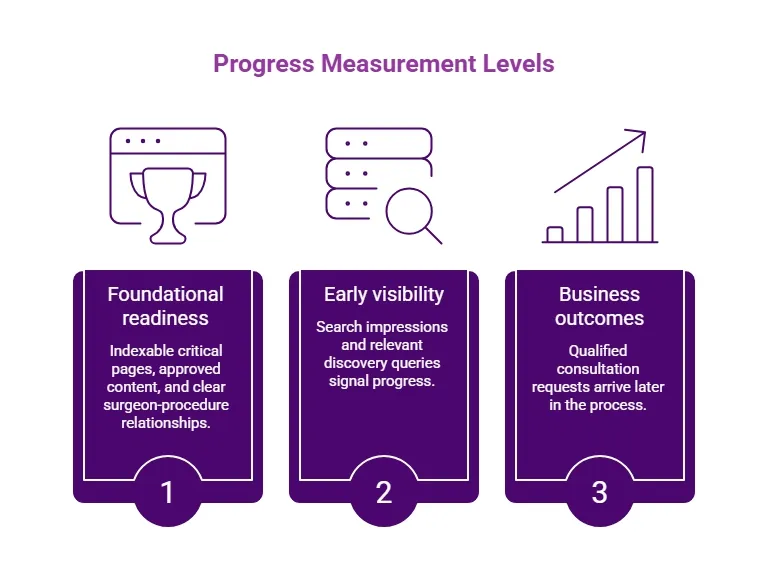
BVM’s client feedback repeatedly values realistic expectations over speed. Progress should be judged at three distinct levels:
- Foundational readiness. Indexable critical pages, approved content, and clear surgeon-procedure relationships show this first.
- Early visibility. Search impressions and relevant discovery queries signal it next.
- Business outcomes. Qualified consultation requests arrive later.
These measures answer different questions, and treating them as interchangeable distorts the picture.
What Can Wait Versus What Creates a Readiness Gap
| The Myth | The Reality |
|---|---|
| SEO can wait until opening because rankings take time anyway. | Patient comparison can begin while procedure, surgeon, proof, and consultation assets are still in progress. |
| A homepage and the surgeon’s name are enough. | Unfamiliar patients need priority procedure information, verified surgeon expertise, and supporting proof to evaluate the practice. |
| Publishing pages means the search foundation is complete. | Technical accessibility, page connections, and accurate practice information also require attention. |
| Creates a Readiness Gap if Missing | Can Reasonably Follow Launch |
|---|---|
| Priority procedure pathways | Secondary topic clusters |
| Surgeon profiles and credibility signals | Additional educational articles |
| Core gallery and proof context | Extended visual-content programs |
| Clear location and consultation route | Broader regional content |
| Consistent business details and an indexable technical base | Ongoing improvements based on early performance |
Evidence-backed: Cosmetic patients compare surgeons, procedures, galleries, and reviews before making contact.
Planning judgment: Which pages go live first, and how far ahead of opening, varies by practice.
Timing note: These categories are general planning principles, not a universal schedule. Sequence should follow the authority, assets, proof, and approvals that already exist.
That distinction supports a manageable order of work. Start by identifying the principal procedures and the verified surgeons who perform them, then connect those pages to approved proof and clear consultation steps. Next, confirm the priority pages are technically accessible and the practice’s location and operating details are accurate. Broader content expansion can follow without forcing every educational topic into the launch workload.
Build the Runway Before Takeoff
Your surgeons, facility, and team are the aircraft. Search readiness is the runway.
Plastic surgery SEO launch sequencing for new Texas practices is not about finishing every task before opening day. It is about opening discoverable, credible, and ready when patients begin their research. For a relocating or rebranding practice, protecting the visibility it already holds may matter as much as building new.
Plan your content strategy around the research patients do before they ever call. If you want help identifying those priorities, schedule a free strategy session. The next question sits at the center of protecting the patient shortlist: which assets truly need to be live before the doors open?
Prepare the runway. Protect the shortlist. Then take off.
Our Editorial Process: Our expert team uses AI tools to help organize and structure our initial drafts. Every piece is then extensively rewritten, fact-checked, and enriched with first-hand insights and experiences by expert humans on our Insights Team to ensure accuracy and clarity.
About the BVM Insights Team
The BVM Insights Team is our dedicated engine for synthesizing complex topics into clear, helpful guides. While our content is thoroughly reviewed for clarity and accuracy, it is for informational purposes and should not replace professional advice.