
 BVM Insights Team
Your proof is not the problem.
The problem starts when a BD manager opens a traffic chart at 7:43 a.m. and still cannot point to one serious due diligence inquiry that came from search. The visits are there. The rankings may even look respectable. So why does none of this feel connected to pipeline?
For environmental and geotechnical engineering firms, the answer is often hiding in plain sight. The firm has Phase I ESA experience, Phase II ESA process knowledge, lender-support context, PE credentials, project examples, and technical judgment. But that proof may be trapped in PDF brochures, qualification packets, proposal archives, or generic service pages where buyers cannot connect it to the exact service claim they are evaluating.
The issue is not that PDFs are useless. PDFs can still support formal documents, proposals, and detailed materials. The issue is relying on PDFs as the only place where proof lives. If the proof is disconnected from service-line pages, it may not help buyers or AI systems recognize firm fit early in the research process.
The Myth: Having Proof Somewhere on Your Site Is Enough
The common assumption sounds reasonable: “Our credentials and project examples are already on the site, so we are covered.”
That assumption breaks down when proof sits too far away from the claim it supports. A buyer researching environmental site investigation support should not have to dig through an old capability PDF to confirm whether the firm understands the service, risk context, and project type. An AI system may also have less clear structure to work with when the relationship between the organization, service, credential, expertise area, and outcome is scattered.
This is a discoverability problem.
It is also a trust problem. Search does not replace referrals, reputation, or relationships. It often validates them before a buyer reaches out. When a referred buyer searches your firm after a conference conversation, the site should make technical fit easy to confirm.
The Reality: AI-Readable Proof Must Be Connected to Service Claims
AI-readable proof assets are structured credentials, process explanations, project evidence, service definitions, and outcome proof placed where buyers can verify firm fit. They connect the organization, service, credential, expertise area, project context, and outcome so the proof supports the exact claim being evaluated.
Think of it like a stamped exhibit in an appendix. The exhibit only helps if the reviewer can connect it to the issue under review. A resume, case example, or process note buried 13 clicks away may still be accurate, but it does not function as strong proof at the point of decision.
This is where structured content matters. Google describes structured data as a standardized format for providing information about a page and classifying page content, which supports the broader principle that machine-readable clarity depends on how information is organized, not merely whether it exists somewhere online. (Google for Developers)
For engineering firms, the practical version is simple: attach proof to the service claim it validates.
Why Buried PDF Proof Weakens Engineering Search Visibility
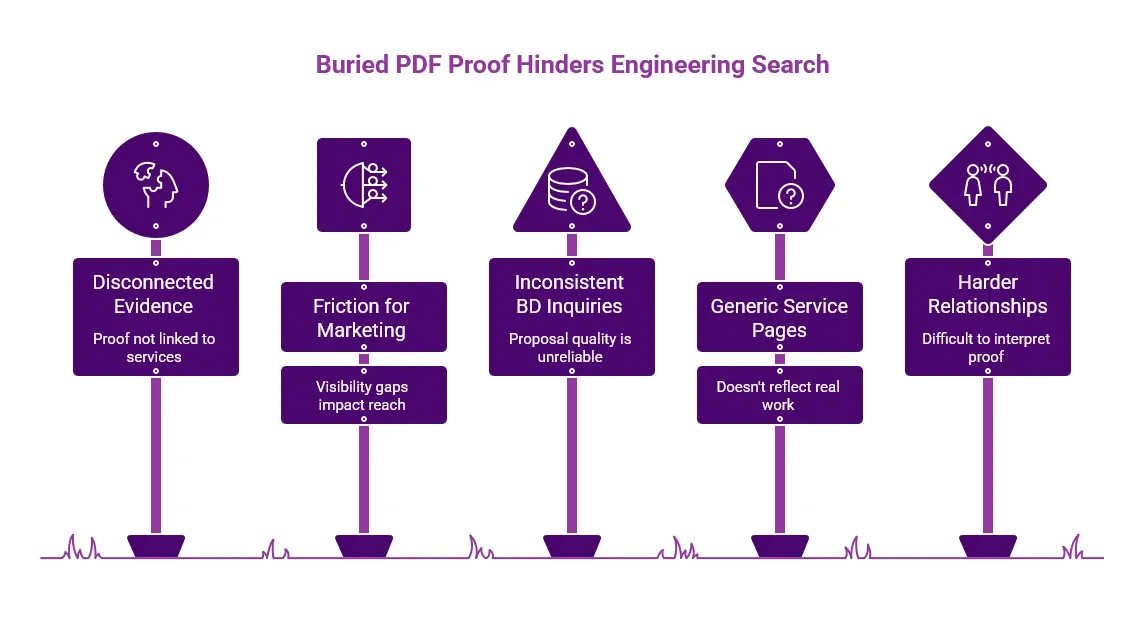
Proof buried in PDFs may weaken search visibility because it can separate evidence from buyer intent. The PDF may describe a project. The service page may describe Phase II ESA support. The credential page may show professional qualifications. Yet none of those pieces may clearly explain how the firm’s technical judgment supports a specific due diligence need.
That gap creates friction for both marketing and BD. Marketing sees visibility gaps. BD sees proposal-quality inquiries arriving inconsistently. Environmental PMs see service pages that sound too generic to reflect the firm’s real work.
The safer claim is not “AI cannot read PDFs.” That would overstate the issue. The more accurate claim is that disconnected proof can make relationships harder to interpret. Proof has more value when it is structured near the relevant service, written in buyer language, and safe for public use.
For Phase I-related context, the U.S. EPA defines All Appropriate Inquiries (AAI) as the process of evaluating a property’s environmental conditions and assessing potential liability. To establish protection from CERCLA liability—including the innocent landowner, bona fide prospective purchaser, and contiguous property owner defenses—environmental site assessments must comply with the AAI Final Rule (40 CFR Part 312). This requirement applies broadly to parties seeking liability protection, including recipients of EPA Brownfields Assessment Grant funds. That kind of regulatory context should be handled carefully and verified by qualified SMEs before publication.
The Buried Proof Audit
Start with a focused audit. Do not ask PMs to rewrite the website. Ask them to validate small proof blocks.
| Proof category | Where it may be buried | What to extract |
|---|---|---|
| Credentials | Staff resumes, qualification packets | PE licensure, certifications, discipline expertise |
| Project evidence | Proposal archives, PDF portfolios | Safe summaries of project type, scope, and context |
| Process proof | Internal SOPs, service decks | Review steps, investigation sequence, QA/QC checkpoints |
| Service definitions | Generic service pages | Clear Phase I ESA, Phase II ESA, site assessment, or lender due diligence distinctions |
| Buyer context | Old proposals, BD notes | Project type, risk context, site condition, geography, or compliance need |
| Outcome proof | Case summaries, closeout notes | Non-confidential results, lessons, and decision-support value |
A useful audit question is: What claim does this proof support?
If the answer is unclear, the proof is probably floating. If the proof supports a service-line claim, move a safe summary closer to that page. If the proof contains confidential details, keep those details private and publish a sanitized version only after SME review.
Where to Move Proof So It Supports Buyer Confidence
Proof should sit near the claim it validates.
A Phase II ESA page should not merely say the firm has experience. It should connect the service to relevant process steps, technical judgment, credentials, and safe project-context examples. A lender due diligence page should show that the firm understands the evaluation moment, not just that it offers environmental consulting.
This is where practice-area architecture matters. Broad service pages often blur distinctions that buyers care about. Environmental due diligence, remediation planning, geotechnical investigation, and permitting-linked work may share expertise, but they do not always share the same buyer intent.
BVM’s Deep Content Architecture™ and High-Intent Keyword Mapping concepts fit this problem because the goal is not broader traffic. The goal is clearer service-line fit before buyers build a shortlist. Internal resources on technical content for ChatGPT and Perplexity citations, deep content architecture for engineering topical authority, and knowledge graph optimization for environmental consulting extend that same logic.
When It Is Not Just a PDF Problem
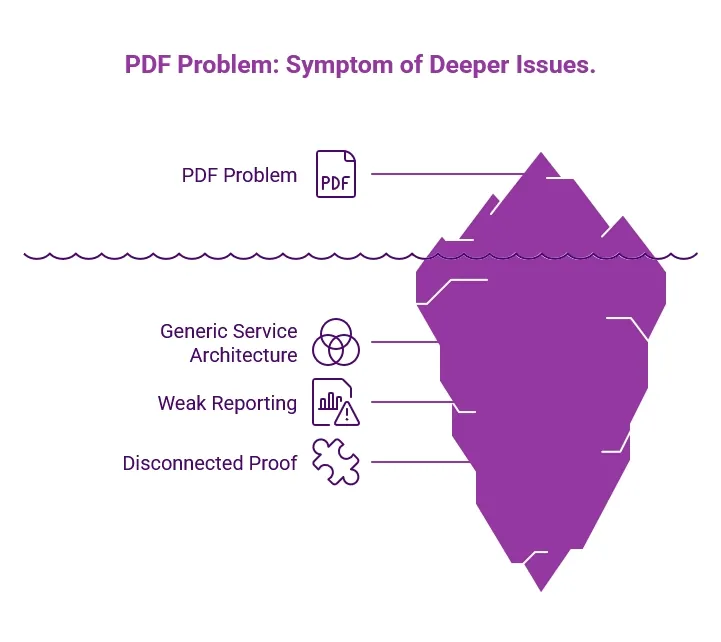
Sometimes the PDF is only a symptom.
The deeper issue may be a generic service architecture. One page may try to cover Phase I ESA, Phase II ESA, remediation support, geotechnical investigation, and permitting context at the same time. That structure forces proof into broad claims because the page has no clear place for service-specific evidence.
Another warning sign is weak reporting. If organic traffic cannot be connected to qualified RFQs, shortlist visibility, or proposal-quality inquiries, the firm may be measuring attention instead of commercial intent.
Publishing more content will not fix that by itself. More blogs can still miss the buyer if proof remains disconnected from service-line pages. The better move is to map buyer-language searches to technical capabilities, then attach proof where the buyer needs confidence.
For teams working on broader page structure, BVM’s Engineering Services SEO framework provides the relevant service context without replacing the audit work.
Myth & Reality Summary for Engineering Search Teams
| Myth | Reality | What to do instead |
|---|---|---|
| Our credentials and project examples are already on the site. | Proof that is buried, disconnected, or vague may not support the service claim buyers are evaluating. | Move proof closer to service-line and intent-mapped pages. |
| A PDF portfolio is enough evidence. | A PDF may contain useful proof, but the relationships between service, credential, expertise, and outcome may remain unclear. | Extract publishable proof into structured summaries and proof blocks. |
| The problem is that we need more blogs. | More content can still fail if proof remains disconnected. | Audit proof location, proof purpose, and proof placement. |
| Relationships make search irrelevant. | Search often validates referrals before buyers reach out. | Make proof easy to find so referred buyers can confirm fit faster. |
Frequently Asked Questions About Proof Buried in PDFs
Resources
Relevant external references for general editorial context include Google’s guidance on structured data, Schema.org’s definition of FAQPage, EPA’s page on All Appropriate Inquiries, and W3C’s Web Content Accessibility Guidelines. These sources support general background only; topic-specific Phase I/II claims still need SME review before publication. (Google for Developers)
Make Proof Visible Before Buyers Ask for It
Return to the traffic chart. The problem is not the chart itself. The problem is that the chart cannot show whether the right buyer found the right proof at the right moment.
When proof stays buried, the firm starts from explanation. When proof is structured, the buyer starts from recognition. That shift matters for marketing directors, BD managers, due diligence practice leads, and PMs who need search to support real evaluation, not just pageviews.
Revolutionize Your Content Strategy by starting with the Buried Proof Audit. Find the proof that already exists. Attach it to the claims it supports. Make technical credibility easier to verify before the shortlist forms.
Clear proof. Clearer fit. Better search conversations.
Editorial process:
Our expert team uses AI tools to help organize and structure initial drafts. Every piece is then extensively rewritten, fact-checked, and enriched with first-hand insights and experiences by expert humans on our Insights Team to ensure accuracy and clarity.
About the BVM Insights Team
The BVM Insights Team is our dedicated engine for synthesizing complex topics into clear, helpful guides. While our content is thoroughly reviewed for clarity and accuracy, it is for informational purposes and should not replace professional advice.