
 BVM Insights Team
Not every SEO task must be finished before a plastic surgery practice opens. Six connected assets cannot wait: priority procedure pages, a factual surgeon profile, honest gallery and proof context, consistent local identity, clear regional relevance, and a working consultation path. Everything else can mature after launch.
The construction punch list is still taped to the reception desk. Paint touch-ups, signage, shelving for the recovery suite. Halfway down, one line has no checkmark: website. We open soon, and nobody can say what has to be live first.
Your team has invested heavily in the physical and clinical launch, while search visibility still feels unfinished. That gap carries a cost. Prospective patients do not wait for a ribbon cutting. They are already researching procedures and building shortlists around practices that are easy to find and evaluate.
A plastic surgery SEO launch checklist prioritizes the minimum search, trust, proof, and consultation assets needed before opening. For a new or relocating Texas practice, the checklist below separates what must be live on opening day from what can grow afterward.
The Minimum Plastic Surgery SEO Footprint to Have Ready Before Opening
Plastic surgery SEO launch sequencing means preparing assets in the order patients need them. Picture the practice as the aircraft and search as the runway. Not every airport upgrade has to be finished before takeoff. The runway cannot wait.
Classify each asset below using three statuses:
- Ready means verified, approved, and functional.
- Needs Review means essential work remains. A live page whose credentials or clinical statements the practice has not confirmed belongs here.
- Can Mature After Opening marks expansion that can wait without compromising the patient’s core research journey.
| Asset | Ready before opening means | Ready | Needs Review | Can Mature After Opening |
|---|---|---|---|---|
| Priority procedure pages | Patients understand the key launch procedures and find the surgeon who performs them. | ☐ | ☐ | ☐ |
| Surgeon profile | Identity, credentials, procedure focus, and positioning are factual and approved. | ☐ | ☐ | ☐ |
| Gallery and proof context | Available proof is presented honestly and tied to a procedure and surgeon. | ☐ | ☐ | ☐ |
| Local identity signals | The website and listings agree on name, address, phone, and practice identity. | ☐ | ☐ | ☐ |
| Regional relevance | Patients in the wider region see where the practice operates. | ☐ | ☐ | ☐ |
| Consultation pathway | A qualified patient can reach a clear next step without hunting for contact details. | ☐ | ☐ | ☐ |
This checklist measures search and trust readiness only. It does not indicate that a practice is clinically, operationally, or legally ready to open.
Priority Procedure Pages Must Explain What the Practice Actually Wants to Be Found For
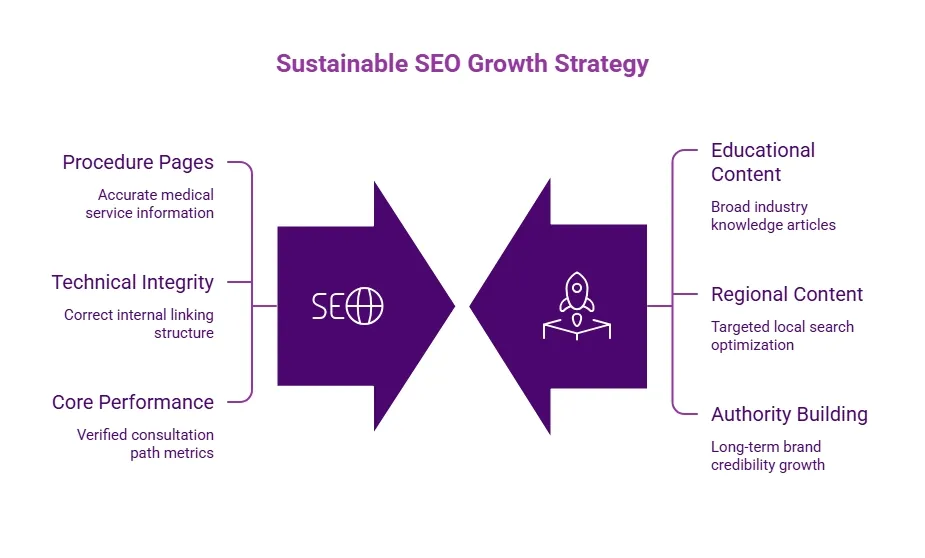
Build credible pages for the procedures that matter most at launch before attempting full coverage. BVM’s Plastic Surgery SEO Services material documents how cosmetic patients research. They move between procedure, surgeon, gallery, credential, recovery, and location information before making contact.
Do all procedure pages need to be complete before opening? No. If facelift and eyelid surgery are the procedures the surgeon most wants to be known for, those pages earn the depth and review time first.
That depth means explaining each procedure’s purpose, the considerations a patient should weigh, and how to arrange an evaluation with the right surgeon. Each page should also link to the surgeon who performs the procedure. That link establishes procedure relevance for patients and search systems alike.
A common pitfall is publishing thin placeholder pages for the entire menu. Generic copy weakens premium positioning and can attract poor-fit inquiries. It also creates review work without building a trustworthy foundation. Start with services that are confirmed, clinically reviewed, and central to the opening practice. Fewer pages, done properly.
Surgeon Profiles Must Make Credentials, Focus, and Patient Fit Easy to Evaluate
A surgeon profile carries the trust burden that a procedure page cannot carry alone. Patients need a factual profile covering:
- The surgeon’s name, professional identity, education, and training.
- Credentials the practice can document.
- Procedure focus, linked to priority pages.
- Relevant experience, approved aesthetic positioning, and factual facility details.
Picture the draft bio with a highlighted note: credentials: confirm. Under launch pressure, notes like that get approved away. They should not.
If the profile references board certification, confirm the credential with the certifying body before publishing. For ABPS certification, the American Board of Plastic Surgery’s certification verification tool covers that board’s own records. Skip superlatives that no independent source supports.
The profile’s job is to support an informed consultation decision, not to determine whether an individual patient is a candidate.
Gallery and Proof Context Must Support the Patient’s Evaluation Process
Proof should help patients understand the surgeon’s work, not decorate the site. Gallery images, reviews, facility details, and credentials each carry more weight when linked to a specific procedure and surgeon.
Before-and-after images need appropriate patient permissions and accurate procedure associations. Their descriptions should never imply that a result is typical, guaranteed, or predictive of an individual outcome.
Limited gallery or review depth is normal for a new practice. Publish what is accurate and available, but never fill the gaps with unrelated photographs or unsupported testimonials.
The real distinction is between evidence that exists and evidence approved for publication. Proof still awaiting clinical review or permission belongs under Needs Review, and that is exactly where launch pressure tends to surface. Sometimes the problem is not a shortage of content at all. The gallery sits in consent review, approvals get rushed, and the team publishes generic blog posts because new pages feel like progress. Traffic may rise. The weakness remains.
Local and Regional Signals Must Agree on Who the Practice Is and Where It Operates
The website, Google Business Profile (the listing shown in Google Maps and local results), and other legitimate listings should tell one factual story. Google’s guidelines for representing your business require the real business name, an accurate address or service area, appropriate categories, and generally one profile per business. Keyword-stuffed names and listings for nonexistent locations fall outside those rules.
Eligibility and verification are controlled by Google, so confirm the requirements early instead of assuming the profile will be live on opening day. Begin by claiming the profile via Google Business Profile Manager, completing video or postcard verification, and ensuring the primary category is set exactly to 'Plastic Surgeon.'
If the site uses LocalBusiness structured data, a widely accepted practice is keeping it identical to the visible business details, as Google’s documentation describes. Organization structured data reinforces a consistent organizational identity the same way. In both cases, markup mirrors verified content. It does not replace it.
Regional relevance is separate. A patient looking for a nearby clinic searches with different geographic terms than one comparing surgeons across a wider area. Cosmetic patients also often evaluate surgeons beyond their own city. Explain where the practice genuinely operates without implying every Texas patient will travel, inventing additional offices, or creating repetitive city pages. For example, stating 'serving patients across the Dallas-Fort Worth metroplex' is helpful; creating 15 identical service pages for every surrounding suburb is a spam signal.
Every Search Path Needs a Clear Consultation Next Step
Every priority page needs a visible route to consultation, so patients never have to return to the homepage to find contact details. Before launch, walk four paths manually:
- Procedure page to surgeon.
- Surgeon page to related procedures and proof.
- Gallery set to the procedure it shows.
- Every major landing page to the consultation request.
Test each path on desktop and mobile. Confirm that forms submit, phone links dial, and scheduling instructions reflect actual availability. Make clear whether a patient is requesting a consultation or booking a confirmed appointment. Ordinary marketing forms should collect only what the initial inquiry requires.
Consider a practice administrator three days before a soft opening. The pages look polished. But the contact form routes to a placeholder inbox nobody monitors. The first inquiries go unanswered, and those patients move to the next name on their shortlist.
What Can Mature After Opening
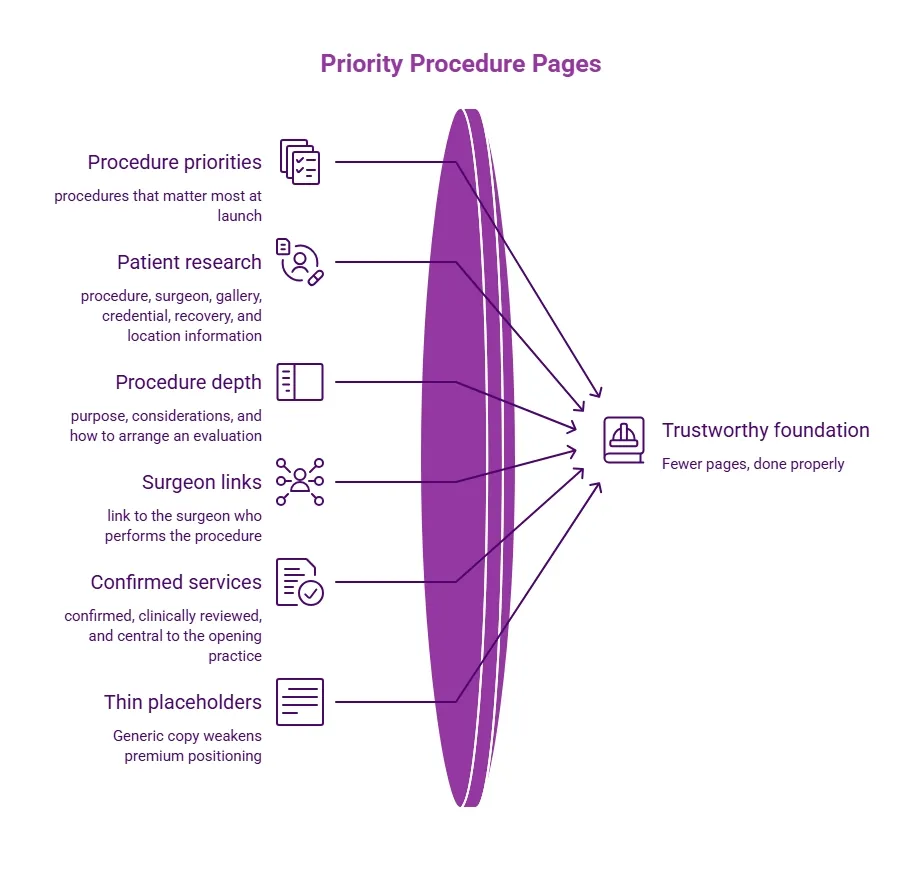
Launch readiness is not the same as total SEO completion. Broader educational content, lower-priority procedure pages, deeper regional content, authority building, and gallery expansion can grow after opening.
This is not permission to start SEO after launch. The foundation comes first; expansion follows. A new article about recovery, for instance, matters far less than correcting a procedure page that links to the wrong surgeon.
Measurement requires patience too. Early search data is hard to read, so review search visibility, page engagement, and consultation-path performance together rather than in isolation. Consultation quality usually reveals more than visit counts, and more traffic does not automatically mean success.
When the Checklist Changes for a Relocating Surgeon
Existing authority changes the starting point. A relocating surgeon may bring brand demand, links, reviews, and search history that a net-new practice must build from the ground up.
With that authority in place, the immediate priority is often preserving those assets while updating location details. After that, progressive post-launch improvement can be reasonable.
Ranking for the surgeon’s name helps, but it only reaches patients who already know the name. A practice needing non-branded discovery with thin proof needs a stronger pre-opening foundation. The deciding factor is not relocation itself but how much relevant authority and approved trust information already exists.
How much stronger that foundation must be varies, which is the next question: New Practice or Relocation? Adjust the Plastic Surgery SEO Launch Plan to Existing Authority.
Use Readiness, Not an Invented Calendar, to Sequence the Launch
Return to the punch list. The website line was not a single task. It was six connected assets, and priority matters more than volume.
Those assets follow dependencies rather than dates:
- Confirm the opening procedure mix.
- Obtain surgeon approval of clinical information.
- Establish accurate business details.
- Connect supporting proof.
- Test the consultation routes.
No documented, universal rule sets how many weeks before opening each asset must start. The time required varies with existing authority, review capacity, and operational readiness. Treat any precise countdown as a hypothesis until someone with direct evidence for your situation confirms it.
Resolve every essential Needs Review item before treating the foundation as ready. After that, let real patient research and consultation patterns guide what comes next.
Now picture opening week done well. A patient searches a procedure, finds your surgeon, reviews honest proof, and requests a consultation without friction. Mark every row in the matrix, and the runway is ready.
Found. Trusted. Shortlisted.
Our Editorial Process: Our expert team uses AI tools to help organize and structure our initial drafts. Every piece is then extensively rewritten, fact-checked, and enriched with first-hand insights and experiences by expert humans on our Insights Team to ensure accuracy and clarity.
About the BVM Insights Team
The BVM Insights Team is our dedicated engine for synthesizing complex topics into clear, helpful guides. While our content is thoroughly reviewed for clarity and accuracy, it is for informational purposes and should not replace professional advice.