
 BVM Insights Team
A procedure-to-consult search strategy turns procedure rankings into better-fit consultations. It connects each priority procedure page to the surgeon, proof, recovery context and next step a patient needs before deciding to book. Without those connections, a page can rank well and still send patients elsewhere to finish their research.
The ranking climbed. The calendar didn’t.
The monthly report arrives at 7:42 on a Tuesday morning. The breast augmentation page moved up four positions, and organic sessions are higher than last month. Then you open next week’s consult schedule and find the same three empty afternoon slots. All that visibility, and nothing to show for it.
If your practice is opening, relocating or rebranding, this gap has a predictable cause. Clinical preparation moves quickly while the digital trust pathway stays uneven. Patients find a procedure page, then leave to judge the surgeon somewhere else. Meanwhile they are building shortlists around practices that make that judgment easy. Done well, a procedure-to-consult strategy helps the right patients reach your consult pipeline already confident that your surgeon is worth meeting.
What a Procedure-to-Consult Search Strategy Actually Connects
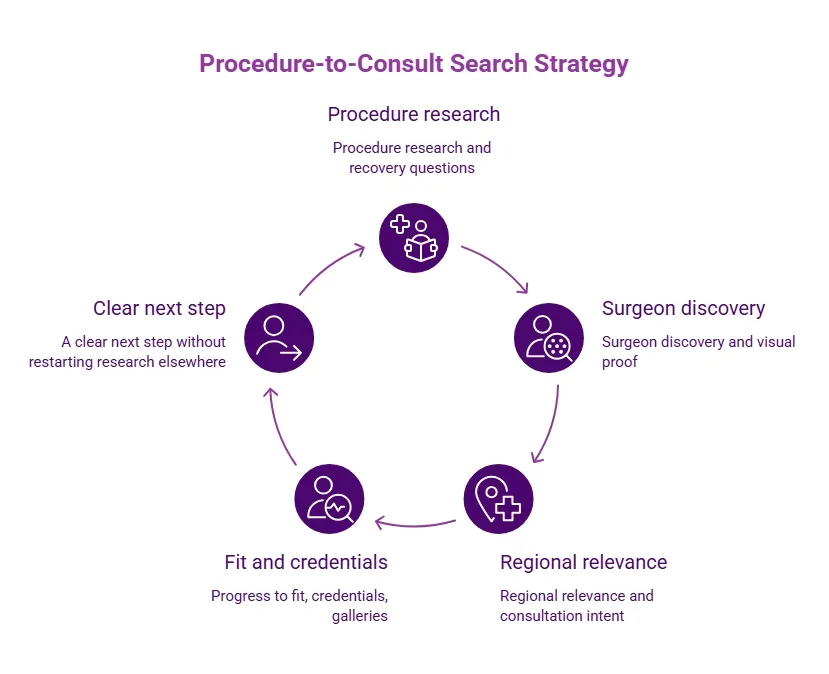
A procedure-to-consult search strategy is a search architecture that connects procedure research, recovery questions, surgeon discovery, visual proof, regional relevance and consultation intent. It treats search as a connected patient route rather than a keyword list. The strategy works when a patient can progress from a concern or procedure question to fit, credentials, galleries and a clear next step without restarting research elsewhere. Generic procedure-keyword targeting can attract traffic and still lose the patient during comparison, so the practical requirement is to build connected procedure and surgeon pathways around the practice’s most important launch services.
A route is the right image because patients don’t move in a straight line. Someone researching rhinoplasty might read about recovery, open a gallery, check a review profile and come back two days later. A funnel assumes a tidy slide toward a form. A route accepts the detours and makes sure each one leads back to your surgeon. The order varies from patient to patient. The connections are what you control.
This strategy is one component of a wider launch plan for a new or relocating plastic surgery practice. Its specific job is to make sure a launch doesn’t happen with an incomplete search-and-trust footprint, where pages exist but don’t yet work together.
Why Procedure Rankings Alone Can Still Lose the Patient
Procedure rankings create an opportunity, not a decision. The standard advice is to optimize each procedure page for its keyword, add a contact button and let rankings do the work. For a patient who has already chosen a surgeon, that can be enough.
Most cosmetic patients aren’t there yet when they search. BVM’s plastic surgery service framework identifies what they are still weighing: recovery, surgeon fit, aesthetic style, credentials, before-and-after context, reviews, facility quality and regional options. A keyword-only page captures the visit. It does little to support the trust decision that determines whether your surgeon makes the shortlist.
The failure that matters most is the one the service framework names directly: procedure searches that never lead the patient back to the practice’s actual surgeons. The patient reads your rhinoplasty page, then finds credentials on a third-party profile, galleries on another practice’s site and recovery answers in a forum thread. By the time they’re ready to book, the practice that ranked first may be the one they barely remember.
That’s the counterintuitive part. A procedure page can rank well, attract steady traffic and still fail the patient whenever the reader has to leave your site to evaluate surgeon fit, credentials, recovery, galleries or regional choices. Rising traffic doesn’t prove rising demand, either. Some visitors are doing general research, and some are looking for procedures your practice doesn’t offer. Pageviews alone can’t tell these groups apart.
Branded search won’t rescue this. Ranking for your surgeon’s name helps patients who already know the name. It does nothing for the larger group who start with a procedure and have never heard of your practice. For a new or relocating practice, that non-branded group is where competitors gain ground first.
Search visibility measures whether patients can find a page. Evaluation readiness measures whether they can use what they find to decide your practice deserves a closer look. A useful test for any procedure page follows from that distinction: after landing here, can a patient tell who provides the service, what credible information supports that relationship and where to continue? If not, better rankings won’t close the gap. Treat traffic success and pathway success as different measures from the first report.
Map the Patient’s Questions From Procedure Research to Surgeon Evaluation
Every patient question needs a page that owns the answer. Start with a single priority procedure and write down the questions a patient tends to ask after the first search. The sequence below is a tool for organizing content, not a claim that every patient follows this exact order.
- What procedure addresses the concern I’m researching?
- What does recovery or evaluation involve?
- Which surgeon at this practice is relevant?
- Why should I trust that surgeon for this procedure?
- What visual or credential proof supports that fit?
- Is this practice worth considering if I’m outside the immediate area?
- What’s the appropriate next step if I want to evaluate further?
Next, assign every question an owner. That could be a procedure page, a surgeon profile, a gallery section or a contextual link between them. Any question without an owner marks a place where the patient has to restart research somewhere else.
A common mistake is trying to answer all seven on one long procedure page. The page becomes slow to scan and starts duplicating the surgeon profile instead of feeding it. A generally accepted approach in site architecture is to give each page one clear job and connect pages in the order patients need them. The procedure page explains the treatment and names the relevant surgeon. The surgeon profile establishes identity, verifiable qualifications and clinical focus. Supporting education handles detailed questions that would bloat the main page, galleries provide approved examples with enough context to avoid misleading comparisons, and consultation information explains the practice’s actual intake process.
Sequencing protects the investment. When the core connections exist first, later recovery articles and procedure comparisons strengthen established pathways instead of becoming isolated destinations. If your team needs help with the earliest research stage, the BVM guide on procedure-driven symptom-to-evaluation content paths covers it in depth.
This mapping is also where your marketing lead’s keyword strategy belongs. Procedure intent tells you which page should rank. The question map tells you where that page should send the patient next.
Place Surgeon Proof Where the Patient Needs It
Proof works best right next to the doubt.
Most practices keep surgeon proof on the biography page alone. That’s tidy for a site map but inconvenient for a patient, whose doubt shows up while reading about a procedure. A short, verified surgeon section on each priority procedure page gives that patient an early reason to trust you, and a clear link to the full profile handles the depth. That association should reflect the practice’s actual staffing and service arrangements, because a patient who books expecting one surgeon and meets another has been misled by the architecture itself.
The trust inputs patients look for are the ones your surgeon-owner already values: board certification, surgeon reputation, procedure focus, aesthetic philosophy, facility quality and honest patient-fit language. Board certification deserves precise wording because patients can check it. The American Board of Plastic Surgery offers a public search tool for verifying a surgeon’s certification, and it describes certification as a voluntary credential showing the surgeon completed the appropriate training and passed comprehensive written and oral examinations covering all plastic surgery procedures. The practical rule follows: whatever your site says about certification should match what a patient finds when they look it up.
This protects premium positioning too. Generic copy that could describe any surgeon blurs differentiation, while specific, verifiable proof about procedure focus and aesthetic philosophy sharpens it. For the full biography review, BVM’s article on specialist biography relevance goes further than this hub should.
What Marketing Can Structure and What Must Stay Clinical
This boundary matters enough to state plainly, so the three responsibilities are set out separately here.
What marketing can structure. Your marketing team can decide page roles, internal links, navigation, search intent targeting and measurement. That is architecture work.
What must be verified first. Some facts need verification against approved practice material before they appear anywhere. These include surgeon qualifications, training, procedure availability, patient-fit statements, recovery claims, facility credentials and visual proof.
What the content cannot decide. Content cannot determine an individual’s candidacy, treatment suitability or expected outcome. Those decisions belong to the surgeon in consultation.
Each pathway also needs named owners. The marketing lead manages search intent, page roles, internal links and reporting. The surgeon or another qualified reviewer approves clinical claims and professional information. The practice administrator or operations lead confirms scheduling details, service availability and consultation routing. Repeat that review whenever surgeons, procedures, locations or scheduling arrangements change.
When the business case for better content starts to sound like a medical recommendation, one of these lines has been crossed.
Connect Recovery Questions and Gallery Context to the Same Journey
Recovery content and galleries do far more work when they’re connected. Too often they sit on separate islands. A patient reads a helpful recovery article and hits a dead end, with no surgeon link and no path to relevant examples. Galleries have the reverse problem: rows of images with no procedure label, no surgeon attribution and no route back to the educational content.
Recovery content answers what the experience might involve. A good recovery page explains topics commonly discussed during clinical evaluation and the questions worth asking, without presenting individual expectations as universal predictions. Galleries answer what this surgeon’s work looks like. Patients ask both questions in the same session, so the site should keep the answers near each other. Label each gallery example with its procedure and, where verified, its surgeon. Link recovery pages back to the procedure page and the surgeon who performs it.
Gallery language needs particular care. An image shows one patient’s experience. It doesn’t show what the next patient can expect, and nearby copy shouldn’t suggest otherwise. This is a widely held principle in health marketing. The Federal Trade Commission’s Health Products Compliance Guidance is written for health products, but its foundation applies broadly: advertising must be truthful and not misleading, and advertisers must hold adequate substantiation for their claims. The American Society of Plastic Surgeons’ patient-safety resources point the same way, emphasizing informed surgeon selection, professional qualifications and an understanding of the facilities involved. Galleries should complement credible clinical information, not replace it.
Patient permission and clinical approval are publication dependencies. During a launch, publish only the material that is ready and keep the rest of the pathway accurate. A shorter, well-supported gallery serves patients better than an extensive collection with unclear or unapproved claims.
Requirements for cosmetic surgery advertising, testimonials and before-and-after images vary by practice and jurisdiction. Route recovery statements and gallery material through your clinical review workflows, which BVM’s article on clinical review workflows for specialty SEO content covers in more detail, and confirm the specifics with qualified legal and clinical professionals.
Account for Regional Evaluation Without Reducing the Strategy to Map-Pack SEO
Cosmetic patients may travel for the right surgeon, so regional visibility has to rest on proof rather than proximity. BVM’s service framework treats this willingness to travel as a defining trait of the category.
A primary care clinic can reasonably focus on the local map results around its address. A plastic surgery practice usually can’t stop there. When a procedure is elective and personal, patients may weigh surgeons well beyond their immediate area, and confidence can matter more than distance.
Regional authority draws on the same evidence as the rest of the route: documented procedure expertise, surgeon credibility, gallery depth, reviews tied to priority procedures, and professional associations and facility standards where they can be verified. Regional demand mapping helps your marketing lead see where interest in each procedure comes from. The strength of the proof determines whether those distant patients stay.
The basics still have to be right. A patient needs to know which procedure the practice offers, which surgeon provides it and where that surgeon is available for consultation, and those three relationships should match across procedure pages, physician profiles, location information and scheduling instructions. For a relocating practice, an outdated address or conflicting access details can undo good proof. Regional content should describe genuine locations and never imply a physical presence where none exists.
Map visibility still has value as one input. A practice can hold a strong local listing and still lose a patient who drove past three closer offices looking for a better fit. Texas may be your launch market, but the patients evaluating your surgeons respond to evidence rather than geography. Only cite memberships and listings that can be verified for your specific practice.
Build a Clear Consultation Path Without Forcing the Decision Too Early
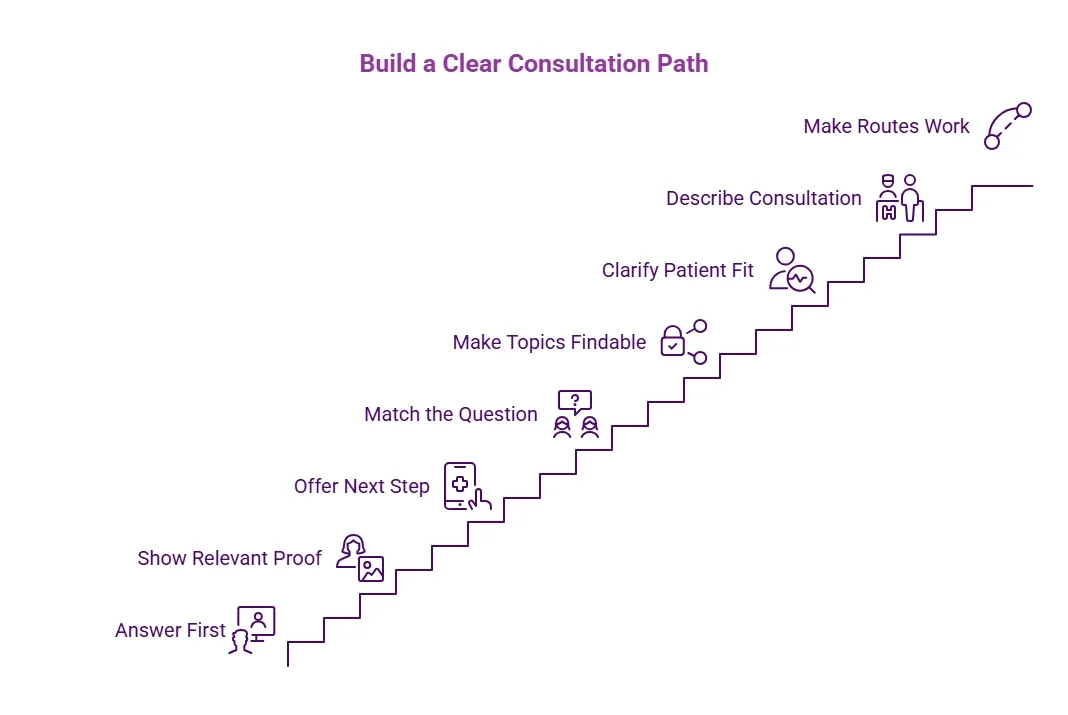
The consultation is the end of the route, not its entrance.
Two paths show the difference. In the weak version, a procedure keyword leads straight to a generic contact button. In the stronger version, a procedure question leads to a contextual answer, then the relevant surgeon, then supporting proof, then a clear next step. The first asks for commitment before giving a reason. The second earns the request.
The right next step depends on the question the patient is holding. A visitor reading a procedure overview benefits most from a link to the surgeon’s profile. Someone reviewing credentials may want gallery examples or a clear picture of what a consultation involves. A patient ready to reach out needs an obvious way to do it. The American Society of Plastic Surgeons’ consultation checklist shows how much patients want to investigate, covering credentials, procedural experience, facilities, complications, recovery and photographs. Your site can make those topics easy to find without trying to resolve individual clinical questions online.
Timing also shapes who reaches out. BVM’s service framework emphasizes patient-fit signals that help prospective patients recognize a practice’s procedure focus and credibility before they inquire. Some readers will decide your practice isn’t right for them, and that’s a useful outcome. It filters out poor-fit and price-driven inquiries before they reach your front desk, so the patients who do call arrive better informed and better matched to what your surgeons actually do.
In practice, place consultation language after the trust questions are answered rather than at the top of every page, and describe plainly what happens during a consultation. That description has to match reality. If the form, phone line or scheduling route doesn’t work as the page promises, a well-connected site loses credibility at the final step, which makes the consultation path a shared responsibility between marketing and operations. A patient who feels pushed keeps researching. A patient who feels informed often books.
Use Consultation Quality to Find Breaks in the Search Path
Traffic shows who arrived. Consultation quality shows whether the route worked.
When visibility rises but inquiry quality stays flat, the cause is rarely a shortage of keywords. It’s usually a break somewhere along the path. Look first for weak surgeon connections, proof that is hard to find and contact prompts that appear before patients have the answers they need.
Keeping reporting layers separate helps leadership read them correctly:
| Signal | What it indicates |
|---|---|
| Traffic and rankings | Visibility |
| Surgeon and procedure discovery | Relevance |
| Connected proof and next-step paths | Content readiness |
| Consultation quality | A downstream business signal |
| Intake staff fielding repeated basic questions | Information the site isn’t answering accessibly |
The first three layers come from your analytics. The last two come from the front desk and the surgeon’s own sense of whether consults match the practice’s procedure focus. A simple classification of inquiries by general service interest and whether the requested service is offered is usually enough. Clinical details and suitability determinations should stay inside appropriately protected operational systems, because the aim is to test the pathway, not to turn patient information into marketing data.
Treat movement in these layers as a reason to investigate, not as proof of cause and effect. Low engagement with a surgeon profile, for example, doesn’t automatically mean a broken link. Visitors may already have what they need, or they may be finishing their research elsewhere. There’s no universal benchmark for this, and the meaningful trend is the one inside your own practice.
For example, a marketing lead at a recently relocated practice might have eight days before a leadership review. Facelift traffic is up, yet the surgeon-owner reports that most new inquiries involve procedures the practice rarely performs. Under deadline pressure, the team publishes six new blog posts. The real break was simpler: the facelift page had no surgeon section and no gallery link, so well-suited visitors found no reason to stay.
Launch conditions make this pattern common. Website production, surgeon review, gallery approvals and operational setup all compete for the same weeks. Teams rush approvals, publish placeholder pages and promise to add proof later. More generic content looks like progress in that environment, but it can’t fix a missing connection.
Procedure-to-Consult Pathway Map
This map is the core planning tool. Read each row from left to right. A blank cell on your own site marks a point where the patient would have to leave to keep researching. The rows are a planning model, not a required page structure for every practice.
| Patient Question | Primary Content Owner | Proof or Context Needed | Next-Step Signal | Potential Failure Point |
|---|---|---|---|---|
| What procedure addresses the concern I’m researching? | Procedure page | Clear procedure scope and educational context | Link to the relevant surgeon | Generic page with no surgeon connection |
| Which surgeon is relevant? | Procedure page plus surgeon profile | Procedure focus, credentials, aesthetic philosophy | Path to supporting proof | Outdated or unclear surgeon association |
| What supports the practice’s credibility? | Surgeon profile and proof sections | Verified credentials, facility context, reviews, gallery context | Path to reviewed educational content | Unsupported claims or disconnected proof |
| What does recovery or evaluation involve? | Procedure or supporting content | Clinically reviewed education | Path back to surgeon and proof | Missing education or implied individual advice |
| Where is the surgeon available? | Location and access information | Actual service location and verified scheduling details | Path to consultation access | Inconsistent location or availability details |
| Is this surgeon worth a consultation? | The connected pathway | Relevant proof already encountered | Clear consultation path | Broken form or mismatched intake instructions |
Clear connections between procedures, surgeons, credentials, facilities and galleries also help with AI readiness. Modern search systems interpret those relationships more easily when the site states them explicitly through clear headings, consistent entity names, accurate internal links and visible professional information. Structured data, where used, should reflect only what visitors can see and verify. Google’s guidance on creating helpful, reliable, people-first content reinforces the same priority: SEO helps when applied to people-first content, and accuracy and trust carry heightened weight on health topics. No page structure can promise placement in AI-generated answers. BVM’s piece on AI-readable specialty-practice content examines that relationship further.
Frequently Asked Questions
What to Audit Next
Don’t start by building more. Start by walking one route.
Choose your most important launch procedure and search for it the way a patient would. Follow the path through your own site, and stop at the first moment you’d need another website to continue. That first break is where the work begins. It might be a procedure page that never names the surgeon, a gallery without labels, a recovery article with no way back to the procedure or a contact button that appears too soon. It might also be a consultation form whose service or location details contradict other pages, which means the problem reaches past design into operational accuracy. Fix it, then walk the route again.
That discipline reflects what BVM’s clients consistently say they value: clear explanations, realistic expectations and accountable reporting. Adjacent work outside plastic surgery points the same way. The Avere Beauty search case evidence shows how stronger search visibility can change discovery in an aesthetics market. It is not a plastic surgery consultation case study, and its results shouldn’t be read as a forecast. For context on how these routes fit into a full launch program, see BVM’s plastic surgery SEO framework.
Once one pathway holds, repeat the process for each priority service. A planned BVM guide, Build a Procedure Search Pathway That Leads Patients to the Right Surgeon, will take that next step in detail.
Go back to that Tuesday report. The ranking still matters, but now you can see what should sit behind it: a procedure question, a surgeon worth meeting, proof where doubt appears and a next step that feels natural. A practice built this way doesn’t simply open its doors. It enters the market ready to be found, trusted and shortlisted.
Resources
- BVM Plastic Surgery SEO Services. The broader strategy connecting procedure visibility, surgeon authority and relevant consultation demand.
- Avere Beauty Search Case Evidence. An adjacent aesthetics-market example, not evidence of plastic surgery consultation outcomes.
- American Board of Plastic Surgery Certification Verification. An official resource for checking surgeon certification.
- American Society of Plastic Surgeons Patient Safety. Information on surgeon selection and patient safety.
- Google Search Central: Creating Helpful, Reliable, People-First Content. Guidance on useful, trustworthy search content.
Disclaimer: This article provides general information about procedure-to-consult search strategy for educational purposes. Individual circumstances vary significantly based on factors such as existing website architecture, surgeon and proof-asset readiness, and clinical or advertising review requirements. Search recommendations do not establish individual treatment suitability or guarantee marketing outcomes. For personalized guidance tailored to a practice’s search, clinical-review or compliance needs, consult appropriately qualified professionals.
Our Editorial Process: Our expert team uses AI tools to help organize and structure our initial drafts. Every piece is then extensively rewritten, fact-checked and enriched with first-hand insights and experiences by expert humans on our Insights Team to ensure accuracy and clarity.
By: The BVM Insights Team
About the BVM Insights Team
The BVM Insights Team is our dedicated engine for synthesizing complex topics into clear, helpful guides. While our content is thoroughly reviewed for clarity and accuracy, it is for informational purposes and should not replace professional advice.