
 BVM Insights Team
Traffic is up.
The BD manager stares at the chart, coffee cooling beside the laptop, while leadership asks the question the report cannot answer: Did this help us reach the right due diligence buyers?
That question exposes the RFQ language gap. Standard search reports can show rankings, impressions, and traffic while missing whether the search language reflects a real due-diligence need, a service-line fit, a proof requirement, or a proposal-quality inquiry. For environmental and geotechnical firms, the issue is not visibility alone. It is whether visibility connects to qualified RFQs.
A better report gives marketing, BD, and technical staff shared language. It helps the team see whether buyers are searching for Phase I ESA support, Phase II ESA investigation, lender due diligence, site assessment, remediation planning, or another specific service need before they build a shortlist.
Why Standard Search Reports Miss RFQ Buyer Readiness
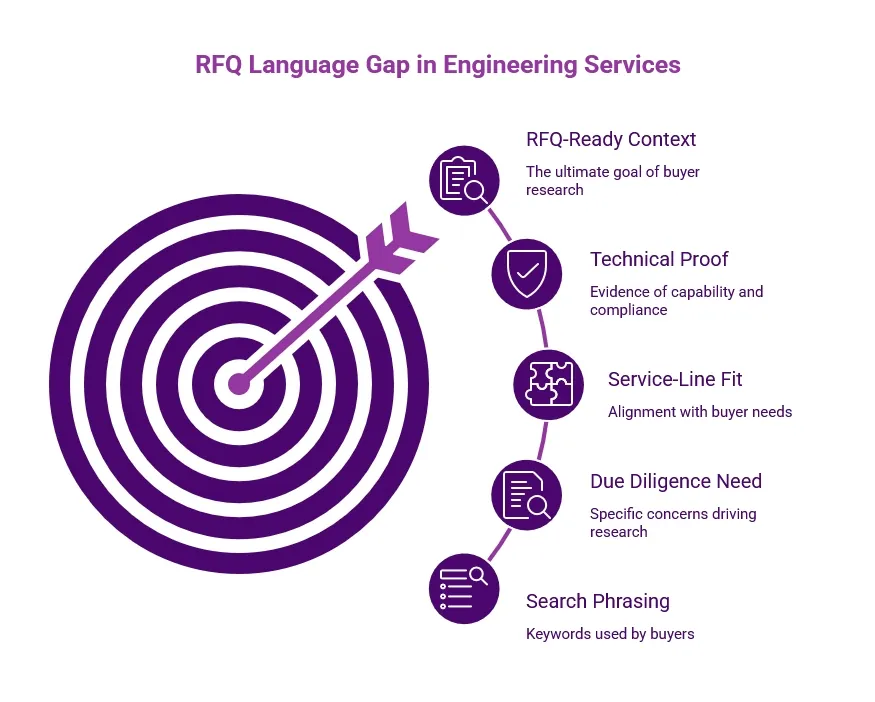
Standard ranking reports isolate visibility, measuring only page position, while traffic and impressions merely confirm exposure. Those are useful signals, but they do not show whether the searcher had a due diligence scope, a lender concern, a technical need, a timeline, a proof requirement, or RFQ-ready context.
That is the RFQ language gap: the missing link between search phrasing, due diligence need, service-line fit, and technical proof.
This gap matters because engineering-service buyers often research by capability, compliance need, project type, geography, and qualifications before a formal RFP or RFQ exists. A buyer may not search for a broad phrase like “environmental consultant.” They may search for a more specific need tied to a property transaction, redevelopment site, lender requirement, contamination concern, or site investigation question.
Relationships still matter in engineering services. Search does not replace referrals, BD conversations, or technical reputation. It supports earlier validation. When a facility director, lender-related stakeholder, municipal team, owner-side engineer, or technical evaluator reviews potential firms, search-visible proof can help them decide who belongs on the first conversation list.
What Buyer-Ready Due Diligence Searches Sound Like
Buyer-ready searches tend to carry more context than broad category terms. They may include the due diligence phase, project type, site condition, location, qualification need, or standards context.
For example, “environmental consultant” is broad. “Phase I ESA for commercial property transaction” carries more intent. “Phase II ESA investigation for suspected contamination” carries a different type of intent. “Lender due diligence environmental site assessment” points to another review path.
These phrases do not promise qualified RFQs. They can help reveal stronger commercial context when reviewed alongside service fit and proof needs.
Common buyer-readiness clues include:
| Search-language signal | What it may indicate | Review prompt |
|---|---|---|
| Due diligence phase language | The searcher may understand whether the need is Phase I ESA, Phase II ESA, or follow-up investigation. | Does this query point to a specific due diligence phase? |
| Lender or transaction context | The searcher may be working through financing, acquisition, refinance, or property-transfer requirements. | Does the page explain the firm’s lender-support or transaction-support experience without overclaiming? |
| Site condition or risk language | The searcher may be evaluating contamination, remediation, geotechnical risk, or site constraints. | Does the page show enough technical judgment to establish fit? |
| Property type or project context | The searcher may be narrowing by commercial, industrial, municipal, healthcare, redevelopment, brownfield, or property-transaction context. | Can the firm show relevant experience without breaching confidentiality? |
| Capability + geography wording | The searcher may be evaluating firms that can serve a specific market, site, or jurisdictional context. | Does this search need a location-aware service page, proof example, or internal qualifier? |
| Qualification or technical-credential wording | The searcher may be checking professional credibility, discipline expertise, licenses, methodology, or technical certifications. | Which credentials, methodology notes, or proof assets should support the page? |
| Proof-seeking language | The searcher may need standards context, turnaround expectations, methodology notes, or project examples. | Which proof asset should support this query cluster? |
| Bad-fit or non-commercial clues | The searcher may be a student, homeowner, job seeker, or low-value inquiry. | Should this query be excluded, deprioritized, or routed to a different content type? |
For Phase I ESA standards context, the EPA’s All Appropriate Inquiries (AAI) rule and the ASTM E1527-21 Standard Practice act as the governing federal frameworks for establishing CERCLA liability protections. Because site-specific legal, environmental, and transaction requirements vary, these standards must be applied carefully and should not replace professional environmental or legal review.
Myth & Fact: Better Rankings Do Not Automatically Mean Better RFQs
Myth: If rankings and traffic improve, RFQ quality must be improving too.
Fact: Rankings and traffic can improve while buyer readiness remains invisible. To evaluate RFQ quality, the report needs to show how search language maps to service-line fit, proof need, and proposal context.
This is where technical service pages need to act like shortlist evidence, not brochure copy. A generic page may say the firm provides environmental due diligence. A stronger page helps the reader connect a specific query to the right service, the right evidence, and the right next internal conversation.
The same caution applies to buyer-readiness signals. They are indicators, not promises. They can help teams interpret search behavior more intelligently, but they do not promise RFQs, rankings, lead volume, or ROI.
Diagnosing the System: When It Is Not a Ranking Problem
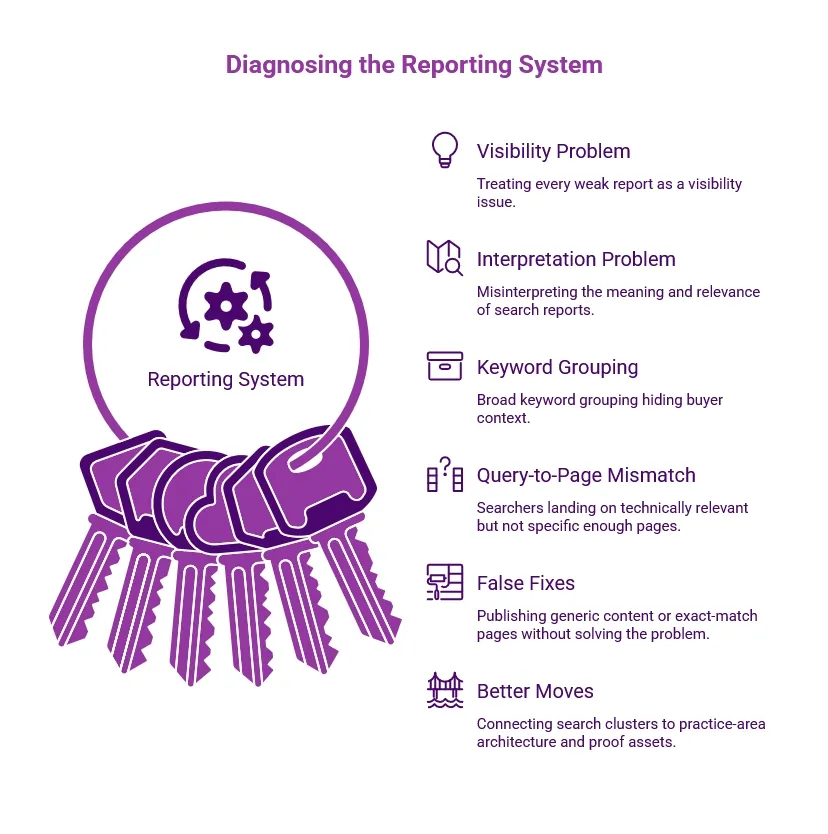
A common pitfall is treating every weak report as a visibility problem. Sometimes the real problem is interpretation.
Marketing may report what SEO tools make easy to report. BD may care about whether the inquiry fits the firm’s RFQ profile. Environmental PMs may care whether the content accurately reflects technical judgment. Practice leads may care whether service pages represent actual due diligence work.
Those concerns are not in conflict. They are different parts of the same reporting system.
If the report is organized around ranking movement alone, it can miss the buyer-language signals that matter to BD and technical staff. Broad keyword grouping may hide buyer context. That can create query-to-page mismatch, where a searcher lands on a page that is technically relevant but not specific enough to support shortlist confidence.
The false fix is publishing more generic blogs or building exact-match keyword pages. That may create activity without solving the reporting gap. The better move is to connect search clusters to practice-area architecture, proof assets, and review fields.
For more context on that structure, BVM’s resource on building deep content architecture for engineering topical authority explains how scattered expertise can become a clearer content hierarchy. The article on why exact-match keywords will not help you win geotechnical contracts also supports the same point: specificity matters more than broad keyword repetition
How to Rebuild Reporting Around Qualified RFQ Signals
You do not need a large reporting overhaul to start. Add a buyer-readiness layer to the next organic search report.
The goal is simple: help marketing, BD, PMs, and practice leads review the same search data through the same commercial and technical lens.
| Reporting field | Why it matters |
|---|---|
| Query cluster | Groups similar search language by due diligence need, not just keyword volume. |
| Due diligence phase | Shows whether the query appears tied to Phase I ESA, Phase II ESA, or related investigation needs. |
| Service-line fit | Connects the query to a real service page or exposes a missing page. |
| Proof requirement | Identifies what the buyer may need before shortlisting the firm. |
| Disqualification risk | Flags educational, student, homeowner, job-seeker, or otherwise weak-fit intent. |
| Next review step | Assigns the query to marketing, BD, PM, or practice lead for review. |
| Capability + geography match | Shows where location, project type, and capability need to align. |
| Qualification or proof gap | Identifies missing credentials, methodology notes, or supporting proof assets. |
This reporting layer helps separate broad visibility wins from proposal-quality indicators. It also gives BD and technical staff a concrete way to participate without asking them to rewrite every page.
For firms trying to connect search behavior to proposal activity, BVM’s guide on connecting organic search data to engineering proposals is a useful next read. The resource on engineering firm SEO metrics for BD goals can also help shift reporting from raw traffic toward pipeline influence.
Resources
Use these resources to continue building a practical reporting and content framework:
What to Change Before the Next Report
Before the next organic report goes to leadership, add buyer-readiness fields to the review. Ask BD and PMs to review the highest-context search clusters. Separate broad visibility wins from proposal-quality indicators. Identify which query clusters need stronger proof-backed service pages.
That shift gives the report a different job. It no longer just says whether search visibility moved. It helps the team see whether organic search is moving closer to the conversations that matter.
By structuring reports around these readiness signals, marketing and technical teams can finally evaluate search performance through the same commercial lens.
Disclaimer:
This article provides general information about RFQ readiness, search reporting, and environmental due diligence content for educational purposes. Individual circumstances vary based on project scope, property condition, lender requirements, jurisdiction, report purpose, and internal review standards. For site-specific environmental, legal, or transaction guidance, consult a qualified environmental professional, attorney, or appropriate authority.
Our Editorial Process:
Our expert team uses AI tools to help organize and structure our initial drafts. Every piece is then extensively rewritten, fact-checked, and enriched with first-hand insights and experiences by expert humans on our Insights Team to ensure accuracy and clarity.
About the Brazos Valley Marketing Insights Team:
The BVM Insights Team is our dedicated engine for synthesizing complex topics into clear, helpful guides. While our content is thoroughly reviewed for clarity and accuracy, it is for informational purposes and should not replace professional advice.