
 BVM Insights Team
Exact-match keyword strategies attract traffic that looks productive on a report but fails to generate the qualified inquiries that win geotechnical contracts. This is not really a keyword argument — it is a buyer-fit argument. Visibility in this market depends on structuring content around methods, regulations, problem types, and entity relationships, not on ranking for generic keyword phrases.
The Myth: Why Exact-Match Keywords Feel Like the Safe Bet
The report lands in your inbox. Fourteen keywords tracked. Eight on page one. Green arrows everywhere.
So why isn't the phone ringing with the right work?
It is easy to see why engineering firms default to exact-match keyword reports. They look measurable. They are tidy. When someone asks "what is our SEO doing for us," a spreadsheet of ranked phrases feels like a concrete answer — especially when every marketing dollar needs a defensible outcome.
At the surface level, exact-match language does matter. If a firm specializes in Phase II environmental site assessments, it makes sense to want that phrase on the website. But treating phrase matching as the primary strategy misreads how geotechnical buyers search, evaluate, and shortlist. Keyword reports surface activity — rankings, impressions, clicks — while missing the buyer signals that lead to qualified work. A firm can rank for a dozen phrases and still attract homeowners, students, or companies shopping for a completely different scope.
That measurement model can quietly distort the entire content strategy. If success is defined by exact-match rankings, the site usually ends up with broad pages, shallow relevance, and reporting that celebrates movement without proving commercial fit. The wrong reporting model drives the wrong content model.
The Reality: Geotechnical Buyers Search in Technical, Multi-Variable Ways
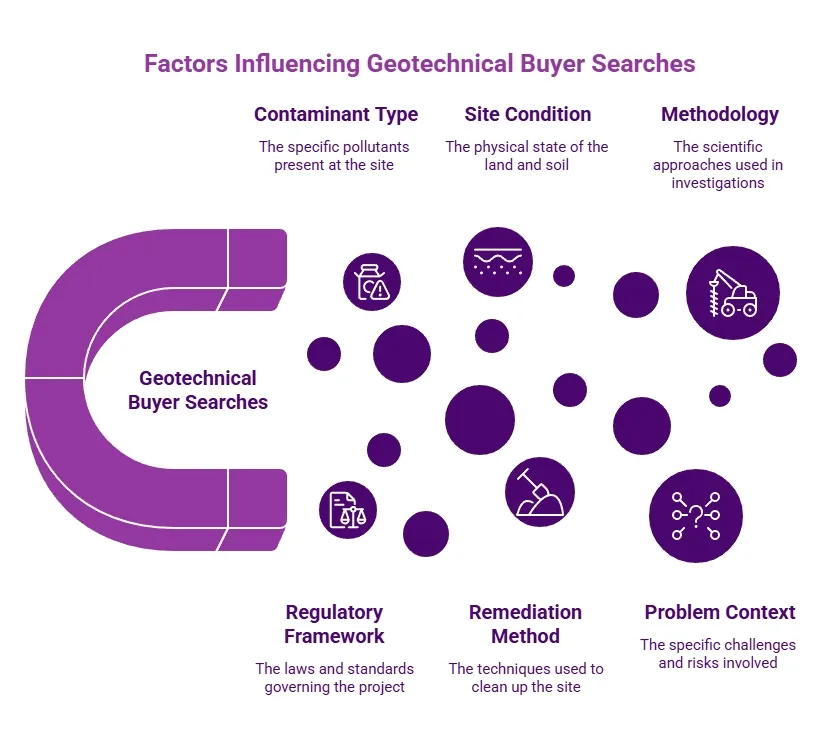
A program manager evaluating firms for a PFAS remediation project on a former industrial site is not searching "environmental consulting." They are searching with a combination of contaminant type, regulatory framework, site condition, and method — something like "monitored natural attenuation PFAS compliance" or "in-situ remediation permitting for industrial brownfield."
This is how technical buyers think. They search by methodology (cone penetration testing, vapor intrusion assessment), by regulation (ASTM E1527-21, CERCLA Phase I requirements), and by problem context (contaminated groundwater in karst geology, settlement risk for clay soils under load). A search is shaped by the site condition, the risk profile, the compliance burden, the investigation method, or the remediation need. Those specifics are what make a search commercially meaningful. Exact-match keyword strategies are not built to intercept that complexity.
A buyer looking for support with due diligence, remediation, subsurface investigation, or compliance-sensitive work is not just looking for a page that repeats a service label. That buyer is trying to assess whether the firm understands the exact class of problem in front of them.
What Exact-Match Keyword Strategies Miss
When a firm's content model is built around ranking for exact-match phrases — "geotechnical engineering services," "environmental consulting firm," "site assessment company" — the pages end up broad. They target category labels rather than specific buyer needs, attracting researchers, students, and companies with scopes that do not match. BD wastes weeks qualifying leads that were never a fit.
The deeper issue is structural. A keyword-first strategy often leads to pages that describe a service broadly but do not show how that service changes across methods, regulations, project conditions, risk types, and problem contexts. When that happens, the site may attract visibility, but not the right kind of visibility. Poor-fit inquiries rise. Lead quality weakens. Budget defensibility gets harder. Marketing reports become difficult to connect to RFQs, shortlist inclusion, or contract outcomes.
The reporting model reinforces the wrong content model. If the success metric is "did we rank for this phrase," the natural response is more pages targeting more phrases — thin, duplicative content that fails to demonstrate the technical depth buyers evaluate. Google's guidance on helpful content is explicit: search systems prioritize content built to help people, not content built to manipulate rankings. Google's spam policies reinforce the same principle from the enforcement side.
Meanwhile, the firm underinvests in what would actually differentiate it: detailed method pages, regulation-specific guidance, problem-type explainers, and project-condition case studies. This is not a traffic problem. It is a commercial fit problem — compounding over every sales cycle spent chasing inquiries that were never going to convert.
Myth vs Reality — Exact-Match SEO vs Entity-Based Technical Authority
| Dimension | Exact-Match Keyword SEO | Entity-Based Technical Authority |
|---|---|---|
| Reporting focus | Phrase rankings and traffic volume | Inquiry quality, RFQ fit, and shortlist inclusion |
| Page structure | Broad category pages targeting generic terms | Method-specific, regulation-specific, and problem-type pages |
| Buyer fit | Attracts mixed traffic including non-commercial visitors | Filters for buyers searching with technical specificity |
| AI readability | Keyword-stuffed pages that AI systems deprioritize | Structured, entity-rich content that AI systems can cite and reference |
| Likely inquiry quality | High volume, low conversion, long qualification cycles | Lower volume, higher fit, faster path to proposal |
Exact-match strategies optimize for visibility on a report. Entity-based strategies optimize for visibility to the buyers actually evaluating firms.
What Better Search Architecture Looks Like for a Geotechnical Firm
The alternative is not "no keywords." It is organizing content around the entities, methods, and problem types that reflect how technical buyers actually search. The fix is structural, not cosmetic.
In practice, a firm performing cone penetration testing, direct-push soil sampling, and geophysical surveys should have distinct, technically detailed content for each. A firm working under ASTM, OSHA, EPA, and state-level regulatory frameworks should structure those distinctions clearly. This is what entity-based optimization for geotechnical engineering looks like: content organized by methods, regulations, problem types, and service-line ownership, where each page answers a buyer question that a broad category page never could.
A better model starts with content architecture that mirrors how buyers actually evaluate technical firms — service-line specificity, technical approaches, compliance contexts, risk conditions, and proof signals that support shortlist confidence. That is the foundation of BVM's engineering services SEO strategy, built around High-Intent Keyword Mapping, The Perfect Page Blueprint™, Deep Content Architecture™, and a broader Dual Search Dominance model that connects traditional visibility with AI-readable structure and measurable business growth.
This structured approach is why firms working with BVM see improvements in inquiry quality — as Emmie Pence, Marketing Manager in engineering manufacturing, put it: "Our traffic has increased significantly ever since using Dustin and his team."
Google states that structured data helps its systems understand page content, and its Organization structured data documentation emphasizes clearer machine-readable understanding of site information. That does not guarantee better performance on its own, but it supports the broader logic behind clearer entity structure and technical organization.
Why This Also Matters for AI Search Visibility
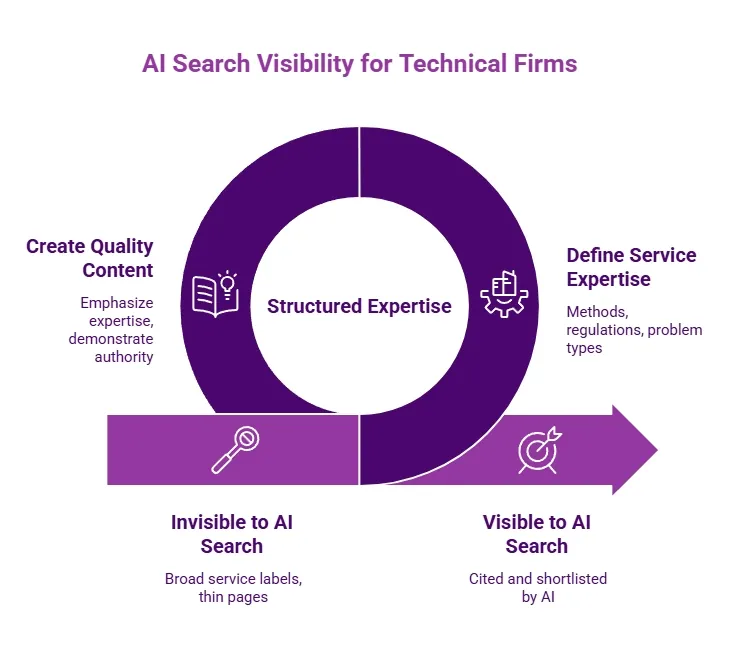
Technical buyers increasingly use AI-assisted research tools during early-stage evaluation. When a procurement lead asks ChatGPT or Perplexity "which firms specialize in vapor intrusion assessment for brownfield redevelopment," the AI synthesizes answers based on entity relationships and demonstrated authority — not exact-match keywords.
Firms with broad service labels and thin pages are functionally invisible to these tools. Firms with structured expertise across methods, regulations, and problem types are getting cited and shortlisted. Google's search essentials emphasize quality and expertise as foundational — AI-powered search follows similar logic with even less tolerance for shallow content. In long-cycle markets where shortlist inclusion determines who proposes, this visibility layer is no longer optional.
What to Change First
The shift does not require rebuilding a website overnight. It starts with four changes:
Stop judging success by exact-match keyword reports alone. Replace "Did this phrase move?" with questions that tie directly to commercial outcomes: Did this page attract a more qualified inquiry? Did the content reflect how a real buyer defines the problem? Did the page show method, regulation, and project-context relevance? Did reporting improve confidence in conversion rate and lead quality?
Audit current service pages for shallow category targeting. If the top pages read like brochure copy — broad capabilities, no technical depth — they are not built for how technical buyers evaluate. Each core capability deserves its own substantive page.
Identify where buyer intent is method-led, regulation-led, or problem-led. Ask the BD team what questions prospects raise on the first call. Those questions reveal the search intent the content should target.
Restructure future content around technical entities and buying stages. This is the foundation of Deep Content Architecture™ — organizing content so it builds real topical authority rather than chasing disconnected keyword targets.
Exact-match keywords are not useless. They are just not enough. In a market where a single qualified RFQ is worth more than a thousand generic clicks, the firms that win contracts are the ones whose content reflects what technical buyers need to see. Not exact-match phrases. Technical credibility, structured for the way people — and AI — actually search.
Stop chasing phrases. Start building authority.
For a deeper look at related strategies, read Why Broad Keywords Destroy Pipeline Quality (and How Intent-Mapped Technical SEO Fixes It) and The Failure of Category Keywords: Using Technical Intent Mapping to Capture Commercial Engineering RFQs.
Our expert team uses AI tools to help organize and structure our initial drafts. Every piece is then extensively rewritten, fact-checked, and enriched with first-hand insights and experiences by expert humans on our Insights Team to ensure accuracy and clarity.
Disclaimer: This article is for educational purposes only. Specific implementation choices can vary by firm structure, service mix, and market conditions.
Our Editorial Process: Our expert team uses AI tools to help organize and structure our initial drafts. Every piece is then extensively rewritten, fact-checked, and enriched with first-hand insights and experiences by expert humans on our Insights Team to ensure accuracy and clarity.
About the BVM Insights Team: The BVM Insights Team researches and publishes practical guidance on AI-powered SEO, Generative Engine Optimization, Deep Content Architecture, and commercial search strategy for technical and high-stakes B2B markets.