
 Dustin Ogle
- Broad Keywords Attract Bad Fits: Generic terms like "environmental consulting" pull in students and homeowners alongside real buyers, wasting your sales team's time.
- Technical Buyers Search Differently: Engineers and compliance officers search for exact capabilities ("PFAS in-situ remediation"), not broad categories - your pages need to match how they actually look for help.
- Build Pages Around Specific Problems: Instead of one "services" page, create dedicated pages for each specialty so the right buyers find exactly what they need and low-fit visitors filter themselves out.
- Track Qualified Leads, Not Traffic: A site with 500 visits and 10 real inquiries beats one with 5,000 visits and 3 real inquiries - measure what matters to revenue.
- Structure Your Site as a Filter: Clear internal links and specific page titles help search engines and buyers alike route to the right content, protecting your team from noise.
The goal isn't more clicks - it's attracting buyers ready to sign contracts.
Marketing directors and practice leads at engineering firms will find a practical framework for restructuring SEO around pipeline quality, preparing them for the detailed strategy guide that follows.
Are Broad Keywords Quietly Damaging Your Pipeline?
Are leads asking for the wrong project size? Are technical staff fielding irrelevant inquiries? Are rankings rising while RFQ quality stays flat? Is the sales team starting to distrust marketing reports?
If any of these sound familiar, you likely do not have a visibility problem. You have an intent-alignment problem.
The dashboard looks promising. Sessions are up. Impressions doubled this quarter. Your "top keywords" report is full of terms that feel relevant. And yet your technical director spent half of Tuesday fielding questions from someone looking for backyard soil testing. Your sales team is quietly dreading the inbox. Another inquiry came in asking about "basic environmental consulting" from a grad student writing a thesis.
We're getting traffic. So why does the pipeline feel worse than it did six months ago?
Marketing directors and practice leads at environmental and geotechnical engineering firms face a specific problem: search visibility that looks strong on paper but delivers the wrong prospects to your pipeline. The issue is not traffic volume. The issue is that broad, high-volume keywords function like an open door rather than a qualified filter.
If you are the generic marketing generalist looking for a quick traffic spike without caring about lead quality, this approach is not for you. But if you want search to act as a commercial filter - attracting buyers with specific engineering needs instead of low-fit noise - keep reading.
Myth: More Engineering Traffic Means More Opportunity
The belief is seductive: more people finding your site means more chances to win work. And on the surface, the data seems to support it. Rankings improve for "environmental engineering firm." Organic sessions climb. Your marketing reports look healthier.
But here is what those reports obscure: raw traffic numbers do not distinguish between a facilities manager evaluating PFAS remediation vendors and a homeowner asking if their backyard drainage is safe. Both count as "sessions." Both inflate the metrics. Only one leads to a multi-million-dollar commercial contract.
The myth that more engineering traffic automatically creates more opportunity persists because it aligns with how most marketing tools measure success. Session counts, impressions, and keyword rankings are easy to track. Qualified RFQ volume, buyer fit, and pipeline quality require deeper attribution.
When traffic becomes the headline metric, every click looks like progress - even the ones that consume sales time without creating commercial value.
Reality: Broad Keywords Pull the Wrong Searchers Into the Funnel
You would not send a buyer looking for PFAS remediation to a general geotechnical drilling page any more than you would send a brain-surgery patient to a podiatrist. And yet, that is exactly what broad keyword targeting does at scale.
Generic terms like "environmental consulting" or "engineering firm near me" do not separate:
Residential from commercial intent. The homeowner worried about a basement leak searches alongside the developer evaluating site remediation options.
Student research from buyer research. Grad students gathering thesis material use the same terms as project managers comparing vendors.
Curiosity from project readiness. Someone exploring general definitions is not the same as someone with budget, timeline, and compliance pressure.
Broad targeting fails to capture the spec-level queries that sophisticated enterprise buyers actually use. A developer searching "PFAS in-situ remediation Texas" has a specific compliance problem and a real budget. That search does not look like "environmental engineering" in any keyword tool - but it converts at a dramatically higher rate.
When your SEO strategy chases volume rather than specificity, you end up with traffic that generates reporting wins but pipeline noise.
Why Technical Buyers Search by Capability, Specification, and Risk
Engineering buyers do not search the way consumer buyers search. They are not browsing. They are evaluating.
A facilities manager evaluating geotechnical consultants for a commercial foundation project searches terms like "load-bearing capacity analysis clayey soil" or "deep foundation recommendations commercial construction." A compliance officer facing PFAS contamination searches "in-situ PFAS remediation methods" or "bioremediation for perfluorinated compounds."
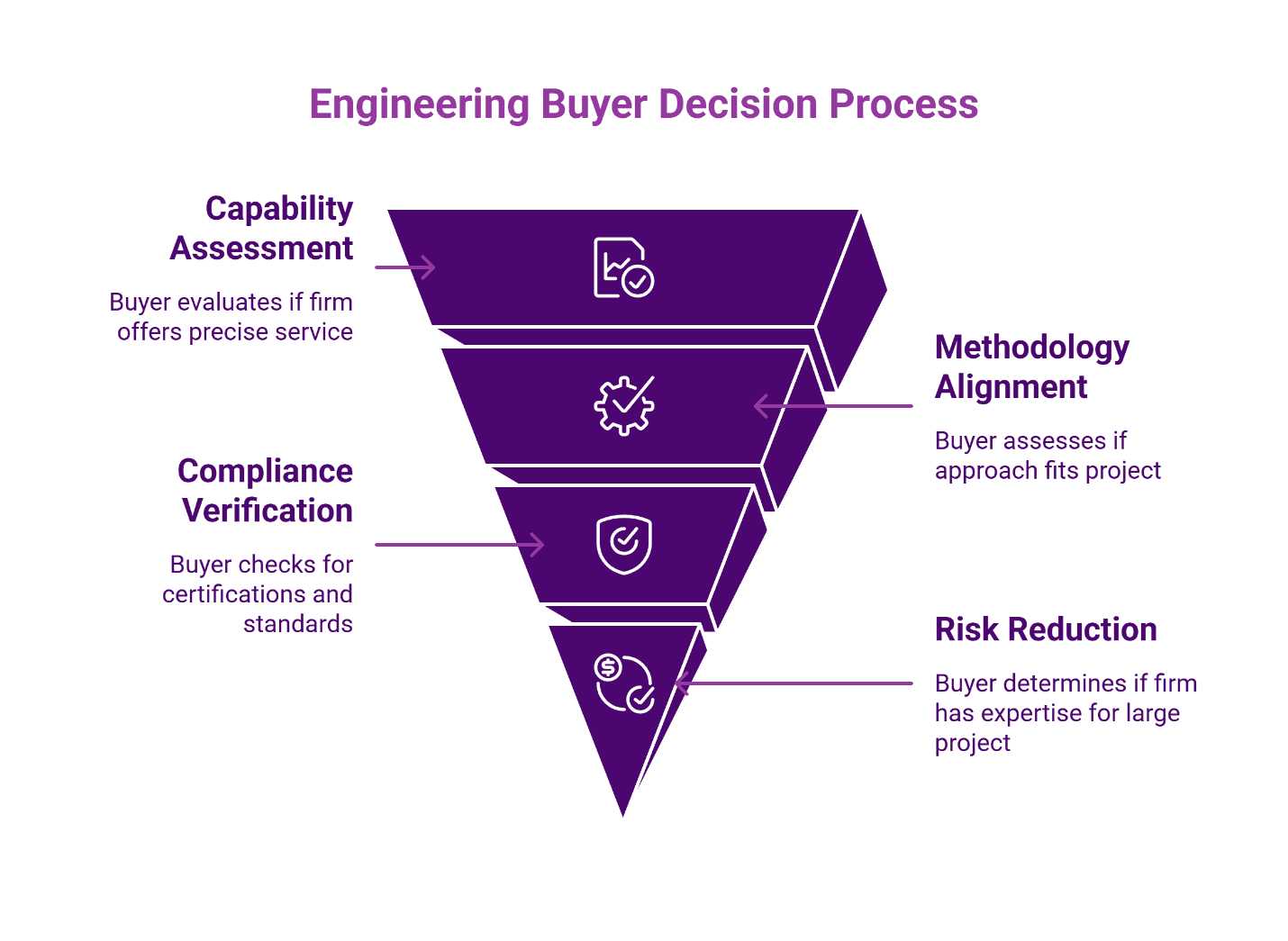
These searches are specific because the decisions are high-stakes. The buyer needs to verify:
Capability fit. Does this firm actually perform the precise service required?
Methodology alignment. Does the approach match the project constraints?
Compliance context. Are certifications, environmental standards, and regulatory requirements addressed?
Risk reduction. Does the content signal expertise deep enough to trust with a multi-year, multi-million-dollar engagement?
Generic category pages do not answer these questions. A page optimized for "geotechnical services" does not signal whether your firm handles subsurface investigation for commercial high-rises or residential additions. It treats both as equivalent, when the buyers are entirely different people with entirely different decision criteria.
This matters more than ever because buyers now complete significant research before engaging sales. Gartner research indicates that 33% of all B2B buyers - and 44% of millennials - desire a seller-free sales experience, and 6sense's 2025 buyer research confirmed that buyers often shape their shortlist before they ever speak to a seller. If your search presence does not match how buyers self-educate, you lose influence before sales ever enters the room.
Intent-Mapped Technical SEO aligns page structure to buyer search behavior - which means building pages that answer specific technical problems rather than generic service descriptions.
What Intent-Mapped Technical SEO Actually Changes
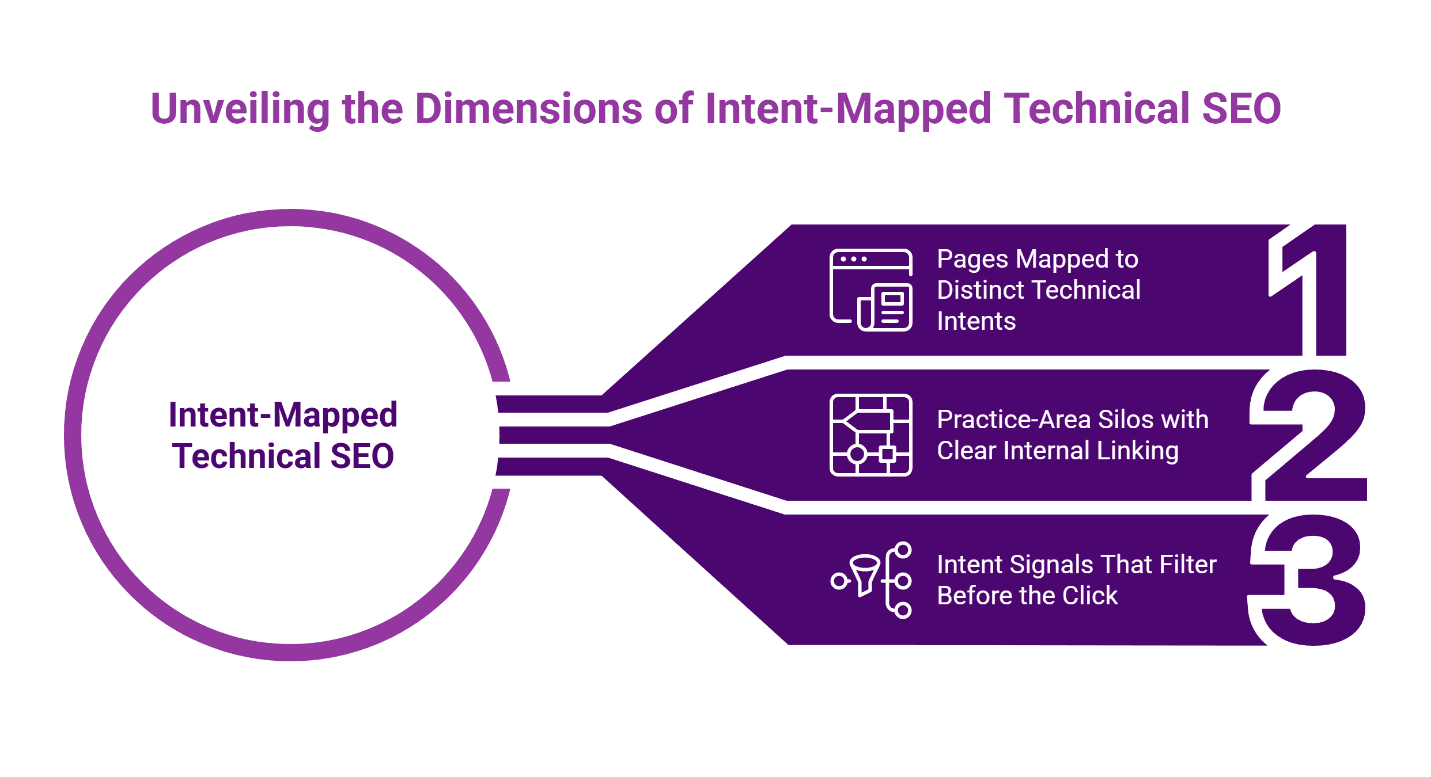
Intent-Mapped Technical SEO is not a rebranding of basic keyword optimization. It is a structural approach that reorganizes your digital presence around buyer search behavior. Instead of behaving like a general brochure, the site becomes a routing system.
Pages mapped to distinct technical intents. Instead of one "environmental services" page covering everything from due diligence to remediation, content is structured so each practice area - subsurface investigation, PFAS remediation, Phase I assessments - has dedicated, purpose-built pages that match the exact queries buyers use. Deep Content Architecture and The Perfect Page Blueprint provide the frameworks for this restructuring.
Practice-area silos with clear internal linking. Your geotechnical drilling expertise is distinct from your environmental compliance expertise. The architecture reflects this, with internal links guiding search engines and buyers to the right pages based on the problem they need solved. This is where Part, Spec, and Application Intent Mapping becomes essential - buyers in technical markets rarely search by broad category first. They search by what the thing must do, what standard it must meet, and what application it must solve.
Intent signals that filter before the click. When a buyer lands on a page explicitly addressing "commercial site remediation for industrial contamination," they self-qualify. The page title, the H1, the structured content all signal: this is for enterprise buyers with real compliance pressure - not for homeowners or students.
The outcome is a website that acts like a commercial filter. Bad-fit traffic never clicks because the content signals specificity. Good-fit buyers find exactly what they are searching for, which builds trust before the first conversation.
Differentiating Vanity Keywords from Revenue Keywords
BVM's approach to engineering services SEO applies this framework to help technical firms restructure visibility around qualified buyer intent rather than vanity volume.
Use the Traffic vs. Intent Scorecard
Not every keyword deserves the same investment. The difference between a vanity keyword and a revenue keyword often comes down to buyer specificity and commercial fit.
Use this evaluation framework to audit your current keyword targets:
| Keyword / Topic | Search Volume | Buyer Specificity | Commercial Fit | Technical Specificity | Risk of Low-Fit Traffic | Recommended Action |
|---|---|---|---|---|---|---|
| engineering firm | High | Low | Low | Low | High | Deprioritize as a pipeline KPI |
| geotechnical services | Medium | Medium | Medium | Medium | Medium | Only keep if routed to clear sub-service paths |
| environmental compliance consultant | Medium | Medium-High | High | Medium-High | Medium | Build a dedicated capability page |
| PFAS in-situ remediation | Lower | Very High | Very High | Very High | Low | Prioritize as a revenue keyword |
| geotechnical drilling | Medium | Medium | Medium | Medium | Medium-High | Split by project type and buyer intent |
| remediation for industrial site contamination | Lower | High | Very High | High | Low | Prioritize with proof-rich commercial page |
The pattern is what matters: the more a keyword signals exact capability, risk context, compliance need, or project type, the more likely it is to generate pipeline value.
"After about 3 months with BVM, our top 10 keywords went from not in the top 500 results on Google to the majority showing on page 1-2. This correlated with exponential growth in sales!"
That result reinforces the central point: better-fit visibility beats bigger visibility.
The Hidden Cost of Vanity Traffic
When the wrong searchers enter your funnel, the cost is not just a missed conversion. It is operational drag that compounds across the organization.
Sales time wasted. Every inquiry that does not convert still requires triage. When 40% of inbound requests come from homeowners or students, your sales team spends hours qualifying out bad fits instead of closing real opportunities.
Technical staff interrupted. Engineers and practice leads get pulled into "quick calls" with prospects who do not have commercial-scale projects. Those interruptions disrupt billable work and erode internal trust in marketing.
Reporting distortion. Traffic-first metrics create a false sense of progress. Leadership sees sessions climbing while pipeline quality stays flat - and eventually asks why investment in SEO has not translated to revenue.
Internal credibility loss. When sales stops trusting marketing reports, alignment breaks down. The sales team starts treating organic leads as noise, even when qualified prospects do arrive.
Vanity traffic does not just fail to convert. It actively damages your organization's ability to recognize and respond to real opportunities. Understanding why bad leads damage sales morale is the first step toward fixing the problem upstream.
What to Fix Next: Architecture, Internal Linking, and KPIs
Moving from vanity traffic to qualified pipeline requires structural changes, not just content tweaks.
Reclassify your existing pages. Audit your service pages and identify which ones are attracting broad, undifferentiated traffic. Flag these for restructuring into practice-area-specific pages that signal buyer intent clearly.
Map internal links to practice-area silos. Educational content and thought leadership should route to specific service pages based on the problem being discussed. A blog post about PFAS contamination trends should link to your PFAS remediation service page - not your generic environmental services overview. Internal linking functions as a qualification mechanism, not just a navigation aid. Google's own guidance confirms this: crawlable links help search engines discover pages and assess relevance, and structured data helps search engines understand page content and relationships.
Change your headline KPI. Traffic is not the right success metric for technical engineering firms. Track qualified RFQ volume, buyer-fit rate, and pipeline influence instead. A website generating 500 sessions and 10 qualified RFQs is outperforming a site generating 5,000 sessions and 3 qualified RFQs. Treat your website as digital infrastructure measured by pipeline contribution - not traffic volume.
Build filtering intent into your content. Your pages should signal who they are for before the click. When a technical director sees a title like "Commercial Subsurface Investigation for Pre-Construction Due Diligence," they know immediately whether it is relevant. The homeowner looking for backyard soil testing self-selects out.
The goal is a search presence that protects your sales team's bandwidth while surfacing the enterprise buyers who actually generate revenue.
Resources
See how to filter students and DIYers from your RFQs before they ever reach sales
Learn how part, spec, and application intent mapping turns technical searches into qualified RFQs
Understand why bad leads damage sales morale and how to stop the problem earlier in the funnel
Reframe your website as digital infrastructure measured by pipeline influence, not traffic volume
Read next: The Quality-First Pipeline
Explore: Engineering Services SEO
Our Editorial Process
Our expert team uses AI tools to help organize and structure our initial drafts. Every piece is then extensively rewritten, fact-checked, and enriched with first-hand insights and experiences by expert humans on our Insights Team to ensure accuracy and clarity.
About the BVM Insights Team
The BVM Insights Team is our dedicated engine for synthesizing complex topics into clear, helpful guides. While our content is thoroughly reviewed for clarity and accuracy, it is for informational purposes and should not replace professional advice.