
 BVM Insights Team
The quarterly review is tomorrow. The dashboard shows organic traffic is up. But when the principal asks which search activity led to the three proposals sitting in the CRM, the room goes quiet.
You can see the search data. You can see the proposals. What you don't have is a trusted bridge between the two — and without it, marketing stays an expense line instead of a revenue driver.
This isn't an SEO problem. It's an attribution-design problem. Organic search can influence proposals, but only when your firm carries intent and source data from the first technical search touchpoint into CRM-visible proposal records. That gap between a visitor researching "Phase II ESA requirements" and a signed remediation proposal 9 months later doesn't close itself. You need closed-loop reporting that connects organic discovery directly to CRM data — like installing a telemetry system in a long-haul vehicle, tracking precise performance from departure to destination. Attribution, in this context, is a chain of custody for commercial context. Every handoff between marketing and sales is an opportunity for that context to survive or disappear.
Where Search Data Should Enter the Proposal Pipeline
A geotechnical engineer at a prospective client firm searches for something specific. They land on your technical page. That visit carries two signals: source (organic search) and intent (spec-driven investigation). Those signals must travel with the contact record from identification through every CRM stage into the proposal record.
The full attribution path looks like this:
Search query or query theme → landing page → source/medium or tagged acquisition data → CRM lead/opportunity → proposal record → closed-loop review
That chain is the entire system in miniature. Every link matters because attribution is not a one-time analytics export — it is a sequence of data handoffs that either preserve or destroy the commercial story behind a prospect's first visit.
The handoff point — where marketing's data enters the sales pipeline — is where most firms lose the thread. If business development creates a proposal without carrying forward the original search context, attribution dies. Not because the data never existed, but because nobody preserved it.
A useful starting point is to review what Google Search Console's Performance report shows about queries and landing pages, then compare that with the acquisition view in GA4's Traffic acquisition report. Those tools won't prove proposal influence on their own, but they help identify where the first searchable evidence enters the system.
The Five Fields Every Engineering Firm Needs to Connect Search to Proposals
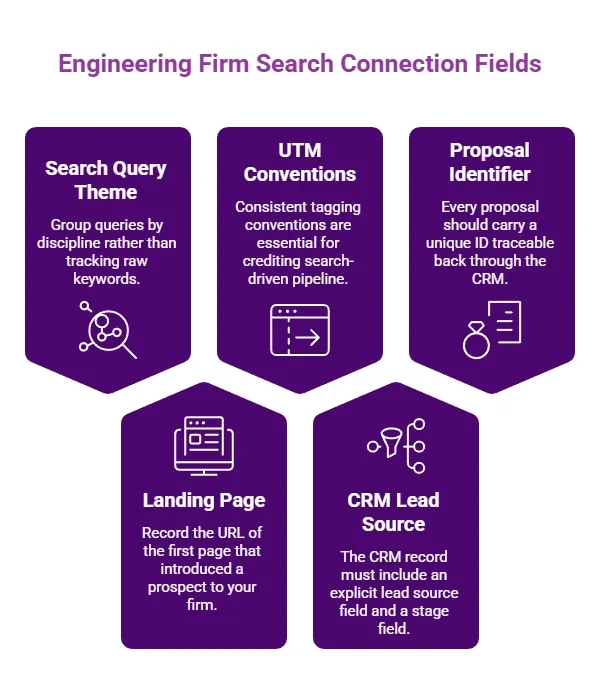
These five data points form your minimum viable attribution system.
- Search query theme or technical intent bucket. Group queries by discipline rather than tracking raw keywords. For environmental and geotechnical firms, useful categories include methodology terms (e.g., "remediation methodology"), contaminant or problem-type queries, compliance and due-diligence searches, and geography-specific permitting language. These categories map directly to services you actually propose on. Google Search Console shows which individual queries drive clicks to your technical pages, which you can then use regular expressions or external tools to group into thematic clusters.
- Landing page or entry page. A visit to your practice area page for environmental site assessments signals different intent than a visit to "About Us." Record the URL — not just "website." The first page that introduced a prospect to your firm often reveals which service line, capability, or problem framing initiated the commercial path.
- Source-medium and UTM conventions. Without consistent tagging conventions, downstream reports lump organic visitors with everything else, and you lose the ability to credit search-driven pipeline. If UTMs are used in supporting campaigns, naming rules should be fixed and documented before launch.
- CRM lead source and proposal-stage status. The CRM record must include an explicit lead source field and a stage field tracking progression from inquiry to active proposal. Establish a controlled vocabulary so "organic," "Google organic," and "website" don't scatter the same source across three labels. Required fields should also capture current owner and qualification notes.
- Proposal identifier or opportunity record. Every proposal should carry a unique ID traceable back through the CRM to its search-origin data. Without this link, you can report traffic and proposals separately but cannot prove the relationship. Reporting stops at the inquiry stage and never reaches proposal influence.
How to Map Technical Search Intent to Proposal-Stage Signals
Not all organic traffic carries equal commercial weight. A visitor searching "TCLP testing requirements for RCRA corrective action" signals deep project-level intent. Someone searching "environmental consulting firms" does not. Your attribution system should distinguish between these levels so BD knows which leads carry meaningful research context.
Intent categories for environmental and geotechnical firms map to specific buyer behaviors:
- A remediation methodology query often indicates a buyer comparing delivery approaches — someone already past the "do we need help?" stage.
- A due-diligence search typically reflects an active transaction or site review, where timing and scope are already in play.
- A contaminant or problem-type query points to a defined technical need, frequently tied to a specific project or site condition.
- Permitting and compliance phrasing may suggest urgency, regulatory exposure, or a project that has already reached a defined stage.
Each of these maps to a different service line — and often a different proposal type. The firm doesn't need perfect certainty about every query. It needs a disciplined way to bucket technical searches into commercially meaningful classes.
Engineering pursuits rarely involve one decision-maker. The project manager who searches for "slope stability analysis methods" may not be the person who requests a proposal. Your CRM must preserve original search context even as the opportunity passes between contacts. Keep the original search-path data attached to the account or opportunity record, even when new contacts enter the buying cycle later. The first technical discovery signal often still matters months into the pursuit.
Why Marketing Dashboards and Sales CRMs Usually Break the Connection
The real failure point is not the data — it's the organizational gap between the teams that own it.
Marketing calls it "organic search — environmental." Sales logs it as "website lead." The GA4 acquisition report uses one taxonomy; the CRM uses another. Without a shared vocabulary, reconciliation becomes guesswork.
The most common breakdowns are specific and predictable: naming conventions don't match across teams, required fields aren't enforced at the point of entry, source labels get overwritten by sales or proposal staff who don't realize they're erasing attribution data, nobody reviews source quality after handoff, and proposal teams receive context-free records with no visibility into how the prospect originally found the firm.
When those small inconsistencies compound, neither team trusts the other's numbers. This isn't a blame problem. It's a system-design gap — and it's why raw form counts are weak evidence in long-cycle pursuits. Firms that want stronger qualification logic should also review Beyond the Form Fill, which explains why lead quality and routing matter more than simple totals.
A Simple Closed-Loop Reporting Workflow
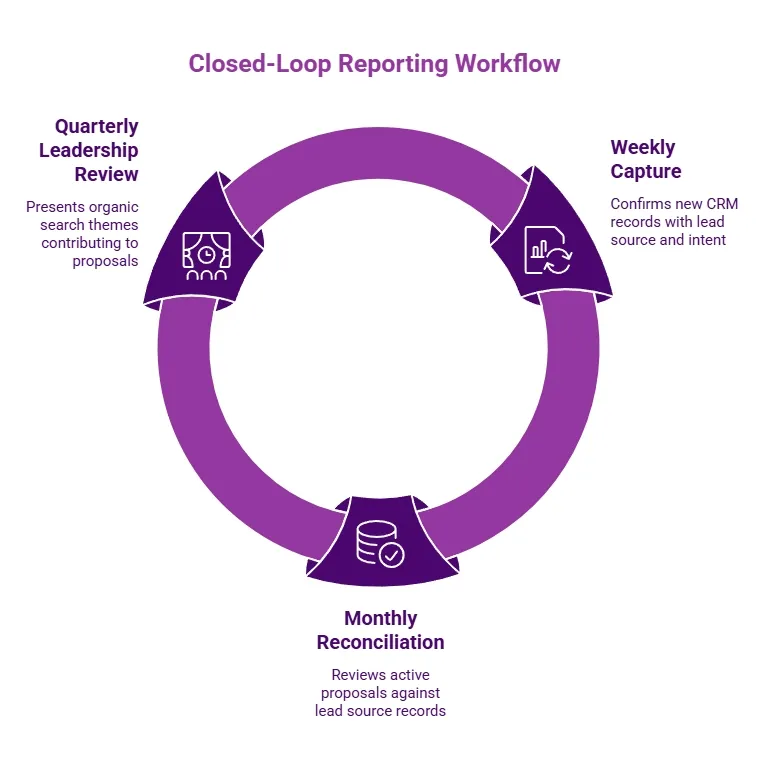
You don't need enterprise-grade marketing automation. A three-cadence system works for most growth-stage firms.
Weekly capture. Marketing confirms each new CRM record includes lead source, intent bucket, and entry page. Review new organic-origin leads while the context is still fresh — confirm the landing page, source/medium data, and opportunity owner. A brief, consistent weekly review of data hygiene prevents months of downstream attribution confusion.
Monthly reconciliation. Marketing and BD review active proposals against lead source records together — confirming traceable search origins, flagging missing data, cleaning naming conflicts, and identifying which intent buckets produce the strongest proposal activity.
Quarterly leadership review. Present one answer: which organic search themes contributed to qualified proposals this period? This is a pipeline measurement report, not a traffic report. Look for patterns, not false precision. Which intent buckets are producing proposal-stage movement? Which pages introduce better-fit opportunities? Where are unknown-source records still accumulating?
Common Attribution Mistakes That Erode Trust
Counting all organic visits as commercially equal is the first trap. A bounced blog visitor and a technical buyer who spent 11 minutes on your remediation capabilities page are not the same signal.
Ignoring the first technical research touchpoint is equally damaging. In a 6–12 month cycle, the earliest research visit may happen months before any form fill. If you only measure from the form submission forward, you're measuring the tail and calling it the journey.
Waiting for closed revenue before learning anything costs firms months of insight they could have acted on sooner. Proposal-stage patterns, source consistency, and intent quality can improve decision-making well before closed revenue is fully tied back.
Letting proposal teams overwrite source data, failing to align marketing language with CRM taxonomy, and operating without a shared review cadence all compound the problem. As Emmie Pence, Marketing Manager at an engineering manufacturing firm, noted: "Our traffic has increased significantly" — but the real value came when traffic connected to outcomes leadership recognized.
How to Know the System Is Working
The system is working when BD teams reference search origin in their pursuit strategy — "This prospect came through our RCRA corrective action content" — without prompting. That's the signal that attribution data has moved from a marketing dashboard into operational decision-making.
Look for steady improvements: better source consistency across new CRM records, more proposals tied to a known search path, fewer "unknown source" opportunities, and stronger sales confidence in lead context. When you can compare intent buckets against proposal quality and spot meaningful differences, leadership gets something more useful than a traffic chart. It gets a clearer view of how search supports commercially serious opportunities.
You don't need perfection. You need a defensible answer when leadership asks. For teams that want measurement language aligned to business outcomes rather than rankings alone, Engineering Firm SEO Metrics: What BD Directors Should Track to Measure Commercial Pipeline Impact is the best next read.
Frequently Asked Questions
Resources
Browse the full Resources hub, or start with these guides:
Teams that want the broader service-level context can also review Engineering Services SEO.
The gap between search data and engineering proposals doesn't require a six-figure martech stack. Five fields, a shared vocabulary, and a monthly conversation between marketing and BD. Start this week: audit your last 10 CRM records for lead source accuracy. If more than three say "unknown," the system needs fixing.
BVM works with engineering firms building engineering services SEO strategies that connect organic discovery to qualified pipeline. When leadership asks where the proposals came from, you'll have an answer that holds up.
Clear data. Shared rules. Defensible results.
Schedule Your Free Consultation
Our Editorial Process: Our expert team uses AI tools to help organize and structure our initial drafts. Every piece is then extensively rewritten, fact-checked, and enriched with first-hand insights and experiences by expert humans on our Insights Team to ensure accuracy and clarity.
About the BVM Insights Team: The BVM Insights Team is our dedicated engine for synthesizing complex topics into clear, helpful guides. While our content is thoroughly reviewed for clarity and accuracy, it is for informational purposes and should not replace professional advice.