
 BVM Insights Team
A plastic surgery SEO launch plan is the pre-opening sequence that makes a new practice discoverable and credible during patient research. It connects procedure pages, surgeon credentials, gallery context, regional and professional profiles, and a clear consultation path, so qualified patients can find, evaluate, and contact the practice from opening day.
Your first patients are researching right now.
Consider a common launch scenario. The website goes live on opening morning, the consultation rooms are staged, and the front desk is ready for calls. Across town, a prospective patient has spent several weeks reading about the procedure your surgeon performs most often. She has saved gallery images from three practices and read their reviews. Your practice isn’t on her list, because when she started searching, it had no procedure pages to find.
You have likely spent the past year on licensing, credentialing, facility setup, hiring, and scheduling. Search often lands at the bottom of that list, saved for after the doors open. The cost of that delay is easy to miss. Cosmetic patients build their shortlist during research, long before they request a consultation. A practice that is absent during that period has little chance to be considered later.
The sections below follow the four-part method BVM uses for plastic surgery practices and end with a readiness scorecard you can apply to your own site before launch. Throughout, the guidance separates three kinds of information: what comes directly from BVM’s documented method, what reflects widely accepted search practice, and what will vary with your market, procedures, and implementation.
Why Patient Research Starts Before Opening Day
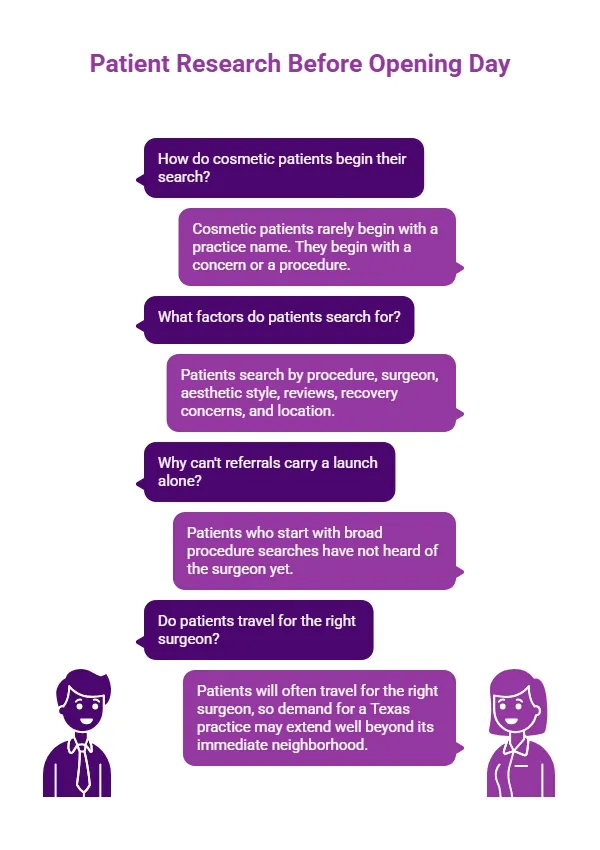
Cosmetic patients rarely begin with a practice name. They begin with a concern or a procedure.
BVM’s documented view of the plastic surgery patient journey is that patients search by procedure, surgeon, aesthetic style, reviews, recovery concerns, and location. Their research moves in stages. A patient may start with a query like “breast augmentation before and after,” then narrow to surgeons in her area, then vet each candidate on credentials, reviews, and gallery work. The consultation request usually comes last, after much of the evaluation is already complete.
Referrals and reputation, while valuable, cannot carry a launch on their own, because patients who start with broad procedure searches have not heard of the surgeon yet. Even a referred patient will usually look the practice up before booking, so a thin online presence can weaken a warm introduction.
Geography adds a second consideration. Patients will often travel for the right surgeon, so demand for a Texas practice may extend well beyond its immediate neighborhood. Its reach depends on the procedure and the surgeon’s reputation, but it argues for regional visibility over a narrow local radius.
The Pre-Opening Job Is Different
Before opening, the job is infrastructure, not competitive rankings. Established practices have built authority over years that a new site cannot match on day one; as a general principle of search, authority accumulates over time through content, links, reviews, and consistent signals. Google’s SEO Starter Guide frames optimization in the same practical terms: it helps search engines understand a site’s content and helps people discover and evaluate it.
Think of the work as building the runway before the first plane needs to land. Ideally, this foundation should be laid 90 to 120 days before your doors open. This provides adequate time for content drafting, clinical review, and initial search engine crawling. Patient demand needs somewhere to arrive: complete procedure pages, credible surgeon profiles, labeled galleries, accurate listings, and a working consultation path. Rankings can grow on that foundation after launch. They cannot grow without it.
The common shortcut is to publish a polished website, claim a Google Business Profile, and consider search handled. Both are necessary. Neither is sufficient, because a site can look finished while giving search engines and patients very little to evaluate. Picture a biography that never links to the procedures, procedure pages that never name the surgeon, an unlabeled gallery, and a form that works on desktop but stalls on a phone. The website has launched, but the patient-discovery system has not.
The Four Parts of a Launch-Ready Search Foundation
BVM’s Plastic Surgery SEO services are organized around four connected components. They work as one patient journey, so a gap in one tends to weaken the others.
Procedure-to-Consult Search Strategy
Start by choosing the procedures the practice will lead with at launch. These should reflect the surgeon’s actual focus and the patients the practice most wants to attract, and they must be services the practice genuinely provides.
For each lead procedure, BVM’s method maps two kinds of patient intent. Procedure intent covers what the procedure involves and who tends to be a suitable candidate. Recovery intent covers downtime, aftercare, and what patients should expect in the weeks after surgery. Recovery questions deserve particular attention, because patients often plan around work and family obligations before they commit. Both kinds of content should inform without judging any individual’s candidacy, which requires medical evaluation.
The output is a pathway, not just a page—one that answers the patient's core questions, connects to the performing surgeon, links to relevant gallery work, and ends with a consultation request specific to that procedure. A patient reading about rhinoplasty should reach the surgeon’s profile without returning to the homepage to search again.
Suppose a patient lands on a facelift page that describes the procedure but offers no route to the surgeon’s biography or gallery, with the only contact link in the footer. Another educational article would not repair that pathway; connecting the information already on the site would.
The number of lead procedures depends on the surgeon’s focus, the time before opening, and the team’s capacity for clinical review. Fewer complete pathways generally serve a new practice better than many thin pages.
Surgeon Credibility and Gallery Conversion
The surgeon profile is where many patients decide whether a consultation is worth their time. BVM’s method positions the profile around verified credentials and the surgeon’s aesthetic philosophy, so patients can judge both qualifications and fit. Phrases such as “world-class expertise” give patients nothing to verify; documented qualifications, clinical interests, and the surgeon’s approach to patient evaluation do.
Accuracy starts with a central, approved record of practice facts: practice name, surgeon identities, qualifications, services, location, contact details, and facility information. Drawing every page and profile from it prevents conflicting details.
Credentials must be accurate and verifiable, and no certification, membership, affiliation, or facility accreditation should be implied unless it can be substantiated. Patients can check board certification directly through tools such as the American Board of Plastic Surgery’s certification lookup, which also notes that certification is a voluntary credential. A profile whose credentials match what third-party sources show builds trust. For a closer look at how physician profiles should answer patient questions, see BVM’s guidance on when specialist bios fail to answer treatment-intent questions.
Galleries carry real persuasive weight in this specialty. BVM’s method treats before-and-after work as search content that needs context: each gallery set should be labeled by procedure and surgeon, linked back to the relevant procedure pathway, and easy to navigate on a phone. Images should never imply that another patient can expect identical results or replace a balanced discussion of risks. If a lead procedure has no authorized gallery by opening day, that gap does not justify unrelated photographs or illustrative imagery presented as clinical results. Verified evidence carries more weight than decorative proof.
Galleries also carry privacy obligations. Under the HIPAA Privacy Rule, full-face photographs and comparable images are listed among the identifiers that must be removed for health information to qualify as de-identified. This makes documented patient authorization for gallery use a standard part of launch preparation. Texas physicians are also subject to state rules on physician advertising, so confirm current requirements with qualified counsel before any patient image goes live.
Structured data can support this layer. The BVM framework integrates PlasticSurgery and Physician schema where appropriate. For example, using MedicalWebPage schema can highlight specific treatments, while MedicalSpecialty schema clarifies the exact nature of the facility. Google’s structured data guidelines require that markup accurately represent the content visible on the page. Markup that describes credentials or services not shown to patients creates risk rather than value, and even correct markup does not guarantee a special search appearance.
Aesthetic Authority and Regional Demand Signals
Authority for a plastic surgery practice extends beyond its own website. Patients consult third-party sources, and those sources should tell a consistent story.
The Google Business Profile is the most visible of these at launch, and Google’s guidelines require that a profile reflect the business accurately and correspond to a real-world location. Google’s business opening date guidance lets eligible businesses set an opening date up to one year in advance, and a verified profile can appear during the 90 days before that date. That is a profile feature, not a ranking timetable, and the profile should never suggest an unopened location is already providing care. A relocating practice must also retire outdated address details. Complete the categories, description, hours, and photos before opening; a placeholder description signals a practice that is not ready.
BVM’s method also includes cleanup of professional platform profiles such as RealSelf, Healthgrades, and ASPS where they are relevant. These are credibility and discovery assets, not ranking switches. Assess which ones apply and make sure any existing profile is accurate and consistent with the website. Regional content follows the same discipline: near-identical city pages without meaningful differences in services or access add little value.
Reviews build slowly, which is why planning for them belongs before launch. BVM’s method focuses on review themes that matter in cosmetic decisions: trust, outcomes, communication, and safety. The Federal Trade Commission’s guidance on endorsements and reviews emphasizes truthful representation, and an ethical review request process set up before opening lets the practice collect feedback from its first patients.
AI Readiness for Cosmetic Procedure Research
Patients increasingly ask AI tools which procedure fits a concern, what recovery involves, and what to look for in a surgeon. BVM’s method prepares for this with question-led content on procedure choice, recovery, and candidate fit, along with consistent entity signals for surgeons, credentials, procedures, and the facility. Short expertise blocks summarize surgeon qualifications without overclaiming.
Certainty matters here. No practice can control whether a given AI system includes it in an answer, and how these systems select sources continues to evolve. A website also cannot determine a visitor’s surgical suitability, so this content should mark where general information ends and individual evaluation begins. What a practice can control is whether its pages offer accurate, well-organized information; structured data can reinforce those relationships but cannot compensate for missing page content. BVM’s article on what makes specialty-practice content legible to AI search systems covers this in more depth.
What Belongs Before Opening and What Can Wait
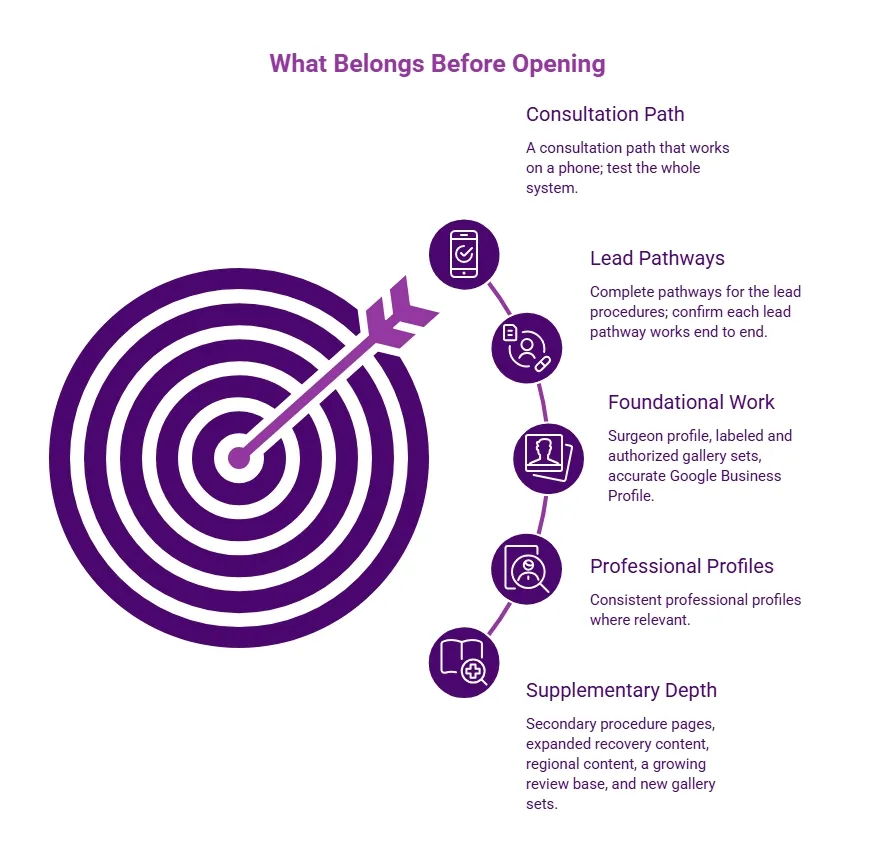
Not every page needs to exist on opening day. The distinction is between foundational completeness and supplementary depth.
Foundational work is anything a patient needs to move from a first search to a consultation request: the surgeon profile, complete pathways for the lead procedures, labeled and authorized gallery sets for those procedures, an accurate Google Business Profile, consistent professional profiles where relevant, and a consultation path that works on a phone. Depth is everything that strengthens the journey over time, including secondary procedure pages, expanded recovery content, regional content, a growing review base, and new gallery sets.
The most common mistake is counting pages instead of pathways. A procedure page that does not connect to the surgeon, credible proof, recovery context, and a consultation request is not ready. Confirm that each lead pathway works end to end before adding volume.
The consultation path deserves its own check. Every procedure page and surgeon profile should offer a relevant next action that is easy to complete on a phone. A form that submits is still not a working pathway, so test the whole system: what the visitor sees, what the form requests, where the submission goes, and how staff handle it. If the practice is not yet accepting consultations, the site should say so. Use nonpatient information for test submissions, and keep sensitive medical details out of general marketing forms. A patient should never have to guess whether a request arrived.
The Plastic Surgery SEO Launch-Readiness Scorecard
Use this scorecard to audit the practice site before opening. Mark each item Ready, Partial, or Missing. Missing items in the first two rows usually deserve attention first, because the surgeon and lead procedures carry the rest of the system.
| Readiness area | What “ready” looks like |
|---|---|
| Surgeon identity and credibility | Verified credentials and aesthetic philosophy stated clearly; details match external profiles |
| Priority procedure pathways | Each lead procedure covers candidate fit and recovery, links to its surgeon and gallery, and ends with a procedure-specific consultation request |
| Clinical content accuracy | Procedure explanations approved, with appropriate limitations and documented review |
| Proof and gallery context | Gallery sets are labeled by procedure and surgeon, linked to pathways, and backed by documented patient authorization |
| Local and regional signals | Google Business Profile complete and accurate; relevant professional profiles consistent; review process in place |
| Consultation pathway | Consultation requests are visible, contextual, and functional on mobile; someone owns responses from day one |
The technical controls below support every area above. They reflect widely accepted practice, and BVM’s method includes each of them:
| Technical control | Check |
|---|---|
| Titles and descriptions | Each priority page has a distinct, descriptive title and meta description |
| Internal links | Procedure, surgeon, gallery, and consultation pages link to one another |
| Structured data | Markup matches visible content and passes validation |
| Images and media | Surgeon, facility, and gallery images are compressed, clearly named, and carry descriptive alt text |
| Heading structure | Each priority page has one H1 and a logical subheading hierarchy |
| Mobile experience | Key information and consultation actions work on small screens |
| Crawlability | Priority pages are crawlable, indexable, reachable through navigation, and free of broken links |
| Indexing settings | Development-site settings that block indexing are removed before launch |
| Canonicals and sitemap | Canonical URLs are appropriate, the sitemap is accurate, and indexing is confirmed in Google Search Console |
| User experience | A patient can evaluate expertise and find the next action without effort |
| Calls to action | Each consultation prompt matches the page it appears on |
The scorecard is a starting picture, not a full audit. Give every Partial or Missing item an owner and a documented next action. A core failure outweighs strengths elsewhere: incorrect surgeon credentials or a broken consultation process cannot be offset by excellent metadata. These priorities reflect practical planning, not validated ranking factors; their value lies in showing where the runway is solid and where it still needs work.
How to Judge Whether the Launch Is Working
A launch is working when it produces qualified consultation demand, not just traffic. Traffic and time on page show that content is being found and read, but they are not the outcome a practice needs.
Qualified demand means patients who arrive understanding the procedure, the surgeon’s approach, and why this practice fits them. Visits from outside the service area or from unrelated searches can raise traffic while producing no useful consultations.
A practical approach is to track both layers separately. Engagement measures show whether the foundation is being discovered; consultation measures, such as requests for lead procedures and how well-prepared those patients are, show whether it is working. Google Search Console and analytics reveal which pages attract attention and where visitors struggle; report outcomes in aggregate without exposing patient information. How quickly either layer moves will vary by market, procedure mix, and implementation, so treat early numbers as direction rather than verdict.
Frequently Asked Questions
Opening Day, Search-Ready
Return to that opening morning. The website goes live, and this time the patient researching your surgeon’s lead procedure finds a pathway that answers her recovery questions. She reviews the surgeon’s verified credentials, studies a labeled gallery set, and requests a consultation from her phone.
The surgeon’s skill is identical in both versions of that morning. The difference is preparation. One practice treated search as something to fix after opening. The other planned it with the same discipline it applied to licensing and facility setup.
That is the practical value of a plastic surgery SEO launch plan. It does not promise rankings on day one. It gives qualified patients a way to find, evaluate, and trust the practice during the weeks they are deciding whom to call.
Start with the scorecard and mark each item honestly. For an outside view, a consultation visibility review shows where prospective patients evaluate surgeons in your market and whether the practice earns a place in that first round of consideration, and a strategy session with BVM can identify what still needs attention before opening.
Prepared. Credible. Findable.
Disclaimer: This article is provided for educational and informational purposes and does not constitute legal or medical advice. Search performance varies by market, competition, and implementation. Clinical statements, credentials, patient photography, privacy practices, and physician advertising should be reviewed with qualified counsel before publication. Platform requirements may change. Scenarios are illustrative, not measured outcomes.*
Our Editorial Process: Our expert team uses AI tools to help organize and structure our initial drafts. Every piece is then extensively rewritten, fact-checked, and enriched with first-hand insights and experiences by expert humans on our Insights Team to ensure accuracy and clarity.
By: About the BVM Insights Team
The BVM Insights Team is our dedicated engine for synthesizing complex topics into clear, helpful guides. While our content is thoroughly reviewed for clarity and accuracy, it is for informational purposes and should not replace professional advice.