
 BVM Insights Team
Nineteen days until the doors open.
The opening date is circled in red on the office calendar. The surgeon bio still sits in an unapproved draft, and a click from the priority procedure page ends at a blank contact form. We'll clean up search after launch.
That plan feels reasonable when everything else is urgent. The catch is timing. A plastic surgery practice can have informative procedure pages, qualified surgeons, and extensive before-and-after galleries yet still lose prospective patients during online research — not because content is missing, but because it fails to connect. Prospective patients start building shortlists before your pathway is ready.
A useful procedure-search audit checks four things before you expand content:
Procedure entry: the page where procedure research begins Surgeon connection: the link to the right surgeon Proof coverage: trust and proof information along the route Consultation action: the next move once trust is established
Fix broken connections before creating additional pages for the route. Within 48 hours, you can see where one priority route breaks and which repairs come first.
Most launch teams rely on a keyword-focused procedure page plus a contact link. That captures the query, then weakens once patients compare recovery, surgeon fit, credentials, galleries, and regional options. A page can win the search and still lose the shortlist.
Procedure-to-Consult Search Strategy is a search architecture that connects procedure research, recovery questions, surgeon discovery, visual proof, and consultation intent. It is the route from a patient's first procedure question to a credible reason to evaluate the surgeon, rather than a collection of disconnected pages. The strategy works when the patient can progress from concern or procedure intent to fit, credentials, galleries, and a clear next step without restarting research elsewhere. The mechanism matters because generic procedure-keyword targeting can attract traffic while still losing the patient during comparison; the practical requirement is to prioritize connected procedure and surgeon pathways around the practice's most important launch services.
Procedure Search Pathway Audit: Start by Freezing Expansion and Choosing One Priority Route
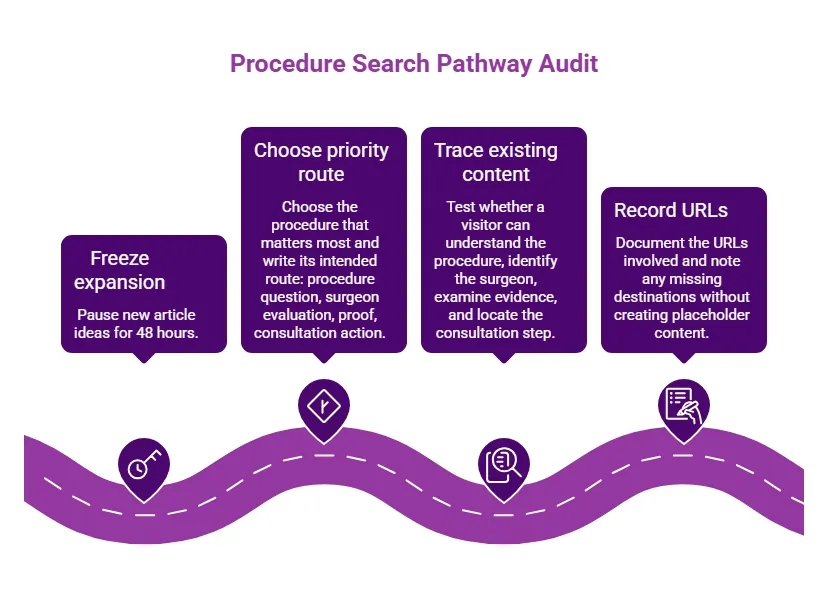
Pause new article ideas for 48 hours. Choose the procedure that matters most to your opening, and write its intended route on one line: procedure question, surgeon evaluation, proof, consultation action. Then trace what already exists. A Texas practice preparing to promote breast augmentation, for example, could begin with its primary procedure page and test whether a visitor can understand the procedure, identify the relevant surgeon, examine supporting evidence, and locate the consultation step — all without leaving the route.
Record the URLs involved. If an expected destination does not exist, document that absence rather than creating placeholder content.
Narrow scope keeps the work controlled. One route, one owner, and one clinical reviewer won't turn into a sitewide redesign. You also don't need mature SEO data, because you're inspecting connections that exist today. A structural audit can identify missing links even before meaningful conversion data becomes available. Building a clear search-to-evaluation content path across several services is a larger, later project.
One route. Four checks.
Procedure Search Pathway Pass 1: Audit the Entry Page and the Patient's Next Question
The procedure search pathway rarely starts with a surgeon's name. BVM's plastic surgery SEO guidance notes that patients may begin with procedure, concern, recovery, or before-and-after questions.
Identify the page that owns the priority procedure, then name the patient's next likely question and look for a visible path to its answer. A patient researching breast augmentation may initially want general procedure information, while another visitor may be comparing recovery considerations or seeking a surgeon in a specific Texas market. These questions reflect different stages of evaluation, and they do not automatically require separate pages.
Check regional context while you're here. Google's Business Profile documentation says local results are based primarily on relevance, distance, and prominence. For a practice entering a new Texas market, that makes a clear location and service area part of the entry page, not a footer detail.
Google Search Central's guidance on helpful, people-first content supports prioritizing genuinely useful information rather than producing additional pages primarily to attract search traffic. Improve the existing page's explanation or navigation before commissioning another article. Expand only when a distinct patient question remains unanswered.
Procedure-to-Surgeon Pathway Pass 2: Check Whether the Right Surgeon Becomes Easy to Evaluate
A procedure-to-surgeon connection is incomplete when the procedure page links to a bio that could belong to any practice. The same BVM guidance states that cosmetic patients compare credentials, galleries, reviews, procedure focus, and surgeon reputation before booking.
From the procedure page, click to the surgeon. Procedure focus, aesthetic philosophy, and board certification should be easy to find. Patients can confirm that last item through the American Board of Plastic Surgery's public lookup, so keep the wording consistent. For multisurgeon practices, avoid implying that every surgeon performs every procedure — the connection should explain the relevant surgeon's procedure focus rather than directing visitors to an unrelated physician directory.
A common pitfall: strong branded searches hide this gap. Procedure researchers haven't heard the surgeon's name yet. An isolated biography may contain accurate credentials without explaining their relevance to the patient's original procedure question. That is an architectural weakness, even when the biography itself is complete.
The practical test is whether someone can understand who provides the procedure and why that clinician belongs in the evaluation. Connect the procedure to an accurate surgeon profile and make the verified relationship explicit. Clinical credentials and scope-of-practice statements require appropriate review.
Procedure Proof Pathway Pass 3: Trace Recovery, Gallery, Credential, and Review Context
Proof coverage supports evaluation when recovery information, galleries, credentials, and reviews sit inside the procedure route. Scattered proof forces research restarts. A gallery buried behind a general menu item sends patients away just as trust forms.
You don't need a finished gallery to run this check. You need to know whether existing proof is reachable. Unavailable or unapproved assets can be classified as Missing and assigned for review separately rather than published prematurely.
Gallery organization should support procedure relevance without suggesting that individual results are representative or predictable. Patient imagery requires appropriate consent and accurate presentation. HHS guidance explains that the HIPAA Privacy Rule requires patient authorization for most marketing uses of protected health information. Confirm how that applies to your gallery images with compliance counsel.
Google's image SEO guidance also recommends meaningful surrounding text, descriptive image information, and accessible image implementation. Those technical principles support discoverability but do not replace patient consent or clinical review. Connect approved supporting evidence to the relevant procedure and surgeon before creating more volume.
Consultation Pathway Pass 4: Audit the Action After the Patient Has Enough Trust
The consultation pathway is a handoff, not a button. The action should appear after fit and proof information. It should also carry context, such as the procedure and surgeon, instead of opening a generic dead end.
For an opening or relocating practice, verify that the location and appointment arrangements match approved operational information. Test the submission process using nonpatient test information and verify that the request reaches its intended destination.
This handoff shapes consult quality. The signal that matters is the fit of the patients who reach out, not visit volume. Correct broken controls, ambiguous instructions, or inaccurate routing before increasing traffic to the page.
Diagnosing the Procedure Search Pathway: When More Content Is Not the Fix
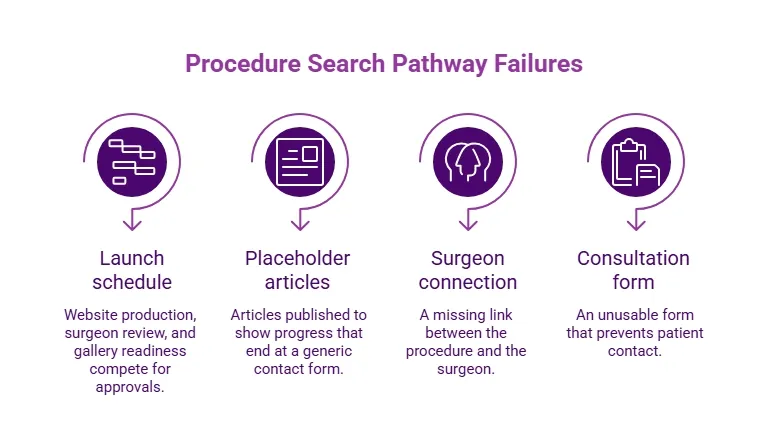
Sometimes the problem isn't missing content; it's the launch schedule, where website production, surgeon review, and gallery readiness compete for approvals.
Consider an illustrative example. A practice administrator is 11 days from opening, and galleries are stuck in consent review. The team publishes two placeholder procedure articles to show progress, but both end at the same generic contact form. Activity rises. The route stays broken.
A new article cannot repair a missing surgeon connection. Additional gallery images will not solve an unusable consultation form. Traffic alone cannot establish where the patient journey fails, but tracing the route manually uncovers architectural flaws that analytics might otherwise miss. For more on where search journeys break before evaluation, compare those patterns against your audit marks.
First 48-Hour Pathway Blueprint: Prioritize Missing Connections Before Expansion
The First 48-Hour Pathway Blueprint turns the four passes into one repair order. Use the first 24 hours to trace the selected procedure route and document observable conditions. Conduct this trace manually on both a desktop and a mobile device, using a simple spreadsheet to log the URLs and note exactly where the patient's context or navigation breaks down. Use the following 24 hours to classify gaps, assign responsibility, and establish a repair order. The 48-hour window is a planning framework, not a promise that every repair or clinical approval can be completed within that period.
The marks below are qualitative judgments, not scores. Write a short reason beside each one so a surgeon-owner can see why every fix is on the list.
| Audit zone | Inspect | Connected | Partial | Missing | Immediate decision |
|---|---|---|---|---|---|
| Procedure entry | The priority procedure page or search-entry page | Patient question is answered and a logical next evaluation path is visible | The page answers the procedure question but leaves the next evaluation step vague | No clear entry owner, or the page fails to route deeper evaluation | Repair the entry route before adding related articles |
| Surgeon connection | Link between procedure intent and relevant surgeon expertise | Relevant surgeon and fit signals are easy to evaluate | Surgeon is linked but relevance is generic or unclear | Procedure content does not reach the surgeon | Add or strengthen the surgeon connection |
| Proof coverage | Recovery information, credentials, galleries, reviews, relevant context | Proof appears where the patient needs it | Proof exists but is scattered or weakly contextualized | Key trust information is absent from the route | Connect existing proof before creating more volume |
| Consultation action | Action after fit and trust have been established | The next action is obvious and contextually appropriate | Action exists but feels generic or disconnected | Patient reaches a dead end | Repair the handoff before widening acquisition |
For each finding, record the affected URL, observed problem, classification, repair owner, required approval, and verification action.
Then work in this order:
Repair route-breaking Missing items: Fix any Missing mark that stops the procedure-to-surgeon-to-consult route.
Strengthen Partial connections: Clarify vague next steps, generic surgeon links, and scattered proof. A Missing item that does not block the current journey may reasonably follow a more disruptive Partial issue.
Expand content last: Add pages once the route is intact and the audit reveals a genuine unanswered patient question.
Start with direct links. Google's SEO Starter Guide states that Google primarily finds pages through links from pages it has already crawled.
Surgeon-owners should approve clinical relationships and sensitive claims. Marketing leads should maintain search intent and page ownership. Practice administrators should track approvals, dependencies, and completion.
Repeat the patient journey after each repair. Record whether the intended connection now functions.
Your Procedure Search Pathway on Opening Day
Visualize the repaired route in action. A patient searches a recovery question and lands on your procedure page. One click reaches the surgeon, with verifiable board certification. Matched gallery cases sit nearby, and the consultation request already names the procedure.
That's plastic surgery SEO launch sequencing for new Texas practices working as intended. The opening date hasn't moved, but the practice now enters its market discoverable and credible. How quickly inquiry quality responds varies by market and existing authority.
See how BVM connects procedure, surgeon, gallery, regional, and consultation signals in its approach to Plastic Surgery SEO Services Texas.
Trace the route. Mark the gaps. Repair before you expand.
If you want to see how procedure, surgeon, gallery, regional, and consultation signals fit into a broader search system, explore BVM's Plastic Surgery SEO services: https\://www.brazosvalleymarketing.com/services/plastic-surgery-seo
Disclaimer: This article provides general information about auditing a plastic surgery procedure search pathway for educational purposes. Individual circumstances vary significantly based on factors like existing website architecture, available surgeon and proof assets, current search authority, and clinical review requirements. For personalized guidance tailored to your practice's search readiness and patient-evaluation pathway, it is recommended to consult with a qualified professional.
Our Editorial Process: Our expert team uses AI tools to help organize and structure our initial drafts. Every piece is then extensively rewritten, fact-checked, and enriched with first-hand insights and experiences by expert humans on our Insights Team to ensure accuracy and clarity.
About the BVM Insights Team
The BVM Insights Team is our dedicated engine for synthesizing complex topics into clear, helpful guides. While our content is thoroughly reviewed for clarity and accuracy, it is for informational purposes and should not replace professional advice.