
 BVM Insights Team
A traffic chart can hide the real problem.
The numbers are open on one screen. A BD manager is looking at visits, rankings, and a few encouraging green arrows, but the question in the room is still unanswered: Which of these searches helped create a serious due diligence conversation?
That gap is where many environmental and geotechnical firms lose confidence in SEO. Marketing sees visibility. PMs see technical gaps. BD sees weak-fit inquiries that never become qualified RFQs. Everyone is looking at the same report, but each role is using a different definition of “good.”
A due diligence keyword map fixes that criteria problem. It organizes Phase I ESA, Phase II ESA, site assessment, lender due diligence, and environmental site investigation searches by buyer context, page role, technical proof, and qualification signal. The goal is not more keywords. Instead, it creates a shared operating tool for prioritizing search clusters which search clusters deserve pages, proof, review time, and tracking.
Why Marketing and PMs Disagree About Keyword Quality
Internal disagreement usually starts before content is written.
Marketing may look at a keyword cluster and see a visibility gap. An environmental PM may look at the same cluster and worry that the topic is too broad, too thin, or technically imprecise. BD may ask whether the search pattern points to a real project, a lender requirement, a property transaction, or a proposal-quality inquiry.
None of those reactions are wrong. They are incomplete on their own.
The common mistake is treating keyword quality as a marketing-only decision. That works for early discovery, where broad keyword grouping can help the team understand the search landscape. It breaks down once leadership needs search-to-pipeline accountability.
A generic “environmental consulting services” keyword may attract broad traffic. A more useful cluster asks a sharper question: is this search tied to Phase I ESA due diligence, a Phase II subsurface investigation, a lender-driven timeline, a commercial property transaction, or a remediation planning need?
That is the difference between visibility and shortlist relevance.
The Due Diligence Keyword Map as a Shared Decision Tool
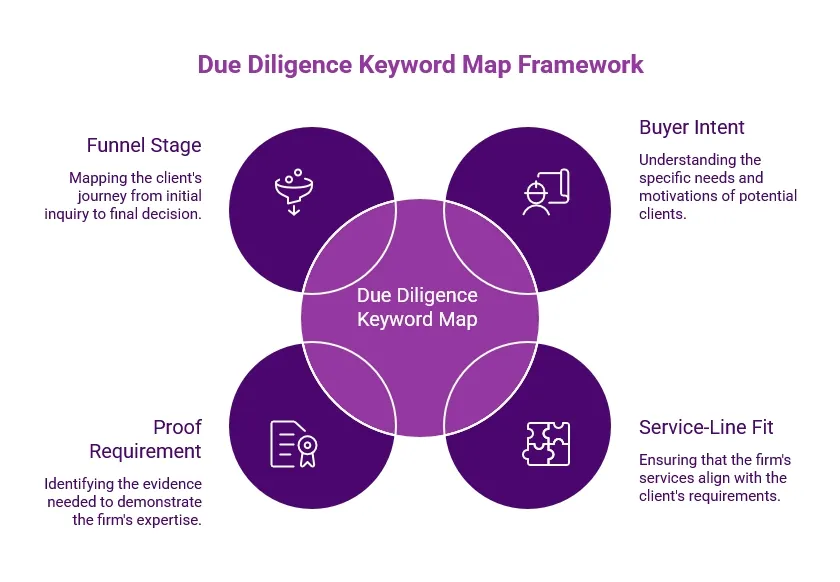
A due diligence keyword map is a process for organizing engineering-service searches by buyer intent, service-line fit, proof requirement, and funnel stage instead of search volume alone.
Think of it as a technical shortlist map. A buyer or AI system should be able to connect the search query to the firm’s relevant capability before the first call. Internally, marketing should understand the page opportunity. PMs should understand the technical proof required. BD should understand whether the query could plausibly connect to qualified RFQs.
This matters because technical buyers do not evaluate environmental and geotechnical firms through generic service language. They look for evidence of fit. That evidence may include project type, geography, regulatory context, methodology, professional qualifications, PE licensure where relevant, certifications, software expertise, discipline expertise, or prior experience with comparable site conditions.
For Phase I ESA language, the map may reference recognized due diligence context such as EPA Brownfields All Appropriate Inquiries or the ASTM E1527-21 Standard Practice. These references should ground terminology, not turn the page into legal advice.
BVM’s broader approach to Engineering Services SEO follows the same principle: technical search strategy has to connect buyer-language searches to credible proof, not just pageviews.
Internal Alignment Checklist for a Better Due Diligence Keyword Map
Use this before a service-page rewrite, content sprint, or reporting review. It gives each stakeholder one clear job.
| Checklist Field | What to Decide | Owner or Validator |
|---|---|---|
| Search Cluster | The grouped due diligence query or buyer-language theme | Marketing |
| Likely Buyer Context | The project, lender, transaction, property, or regulatory context behind the search | PM or practice lead |
| Page Role | Service page, proof section, FAQ, case-study module, or supporting article | Marketing + PM |
| Required Proof | Credentials, project examples, process explanation, standards references, or SME-validated details | PM or practice lead |
| Qualification Signal | The clue that the search could connect to a qualified RFQ or proposal-quality inquiry | BD |
| Owner | The person responsible for keeping the cluster updated | Marketing or practice lead |
| Reviewer | The person responsible for technical accuracy before publication | PM or SME reviewer |
The short version for internal sharing is simple: list the search cluster, identify the buyer context, assign the page role, define the proof needed, record the qualification signal, and assign a marketing owner, PM reviewer, and BD validation point.
Query → Page role → Proof → Qualification signal
Mini-flowchart:
That sequence prevents a broad keyword list from becoming a content calendar by default. A cluster only moves forward when the team can explain what the page should do and how it connects to a commercially useful inquiry.
For firms building a broader content system, related work on Building Deep Content Architecture for Engineering Topical Authority can support the architecture behind this checklist.
Stakeholder Priorities: What Each Role Needs to See
| Stakeholder | What They Care About | What the Due Diligence Keyword Map Must Show |
|---|---|---|
| Marketing Director | Visibility gaps, intent clusters, search-to-proposal attribution | Whether the cluster deserves a page and how it should be tracked |
| Environmental PM | Technical accuracy, proof quality, service-line fit | Whether the topic matches real Phase I/II or site-assessment work |
| Due Diligence Practice Lead | Practice-area architecture, risk context, publishable proof | Whether the page can credibly represent the service line |
| BD Manager | Qualified RFQs, shortlist visibility, buyer-readiness | Whether the search pattern could lead to proposal-quality inquiries |
This is where internal friction becomes useful. Marketing should push for findability. PMs should push for accuracy. BD should push for commercial relevance.
The mistake is letting one role dominate the map. When marketing owns the whole decision, pages can become too broad. When PMs own the whole decision, content can become accurate but difficult for buyers to find. When BD owns the whole decision, the map can overfit to recent conversations and miss earlier research behavior.
The stronger map uses all three perspectives.
Simple Comparison Chart: Broad Keyword List vs Due Diligence Keyword Map
| Decision Area | Broad Keyword List | Due Diligence Keyword Map |
|---|---|---|
| Primary Organizing Logic | Volume, broad topic, or generic service category | Buyer intent, service-line fit, proof need, and funnel stage |
| Stakeholder Usefulness | Mostly useful to marketing | Useful to marketing, PMs, practice leads, and BD |
| Technical Proof Requirement | Often added after the page is drafted | Identified before the page is written |
| Qualified RFQ Signal | Hard to connect to proposal-quality demand | Easier to connect to qualified RFQs and shortlist visibility |
| Best Use Case | Early discovery | Stakeholder alignment and content prioritization |
| Failure Mode | More visibility without clearer fit | Slower setup, but stronger internal agreement |
A broad list is not wrong. It is just not enough when the firm needs to defend organic search as a pipeline-quality channel.
The pivot happens when BD cannot tell which searches created serious due diligence conversations. At that point, the next step is not another generic blog. The next step is to map technical intent to proof-backed pages and tracking fields.
That same logic applies to AI search. If service expertise is buried inside generic pages or PDFs, AI systems may struggle to identify the firm’s fit. The structure discussed in How to Structure Technical Content for ChatGPT and Perplexity Citations can help make proof easier to parse.
How to Score Search Clusters Without Starting a Stakeholder Fight
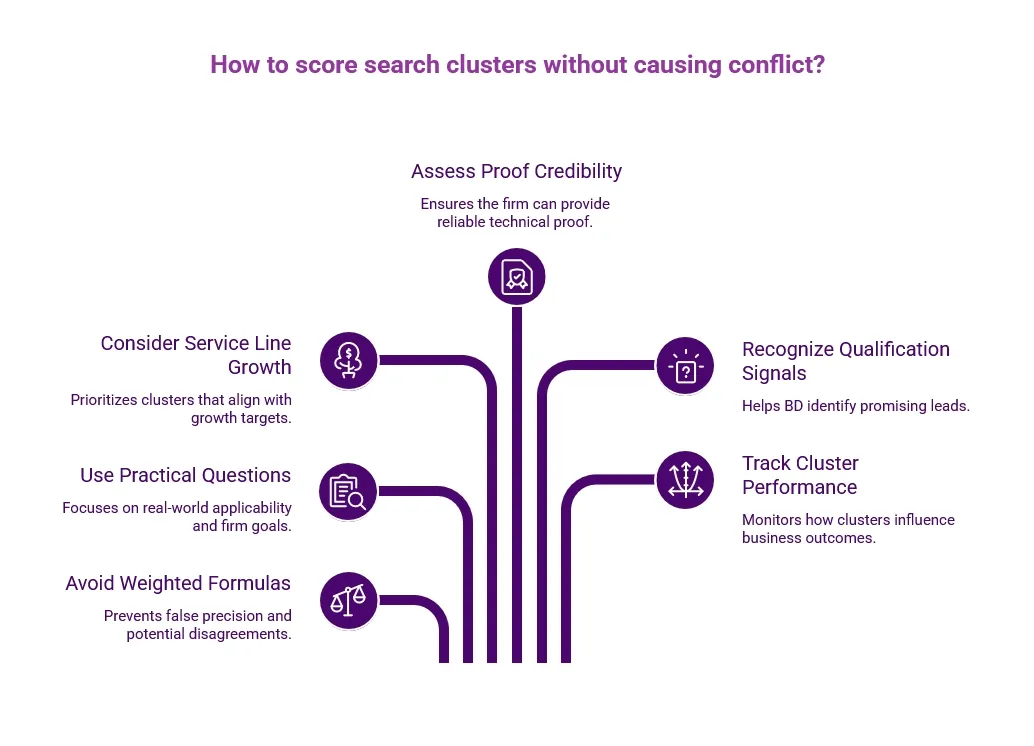
Avoid starting with a weighted formula. It creates false precision.
Start with practical questions:
Does the cluster point to a real due diligence phase or scope?
Does it connect to a service line the firm wants to grow?
Can the firm publish credible technical proof without overburdening SMEs?
Can BD recognize a qualification signal in the query?
Can the cluster be tracked through form fields, CRM notes, call summaries, or proposal records?
The answer may vary by firm. A Phase I ESA cluster may deserve a dedicated service page if the firm has clear proof, repeatable process language, and relevant project context. A narrow remediation-planning query may work better as a supporting article if the proof exists but the service line is not a primary growth target.
This is decision support, not mathematical scoring.
For measurement, the useful question is not “Did traffic increase?” The useful question is “Did the right search clusters influence qualified inquiries, shortlist visibility, or proposal-quality conversations?” Related guidance on connecting organic search data to engineering proposals can help close that reporting gap.
When It Is Not a Keyword Problem: Diagnosing the System
Sometimes the keyword map is only where the symptoms show up.
The deeper issue may be practice-area architecture. One generic environmental services page may be trying to cover Phase I ESA, Phase II ESA, remediation planning, site assessment, lender due diligence, and environmental site investigation. That structure asks one page to satisfy too many buyer contexts.
Another issue may be proof mapping. The firm may have the right expertise, but the website does not show the process, project type, standards context, professional qualifications, or SME-validated details that make the claim credible.
A third issue may be review workflow. PMs are busy. BD is chasing deadlines. Marketing is trying to publish with limited technical input. Under that pressure, broad pages get shipped because they are faster.
Faster is not always clearer.
Before adding more content, check whether the site architecture separates major due diligence intents. Then check whether each page has the technical proof needed to support that intent. Work on mapping search intent to engineering specs can help keep weak-fit searches from overwhelming the content plan.
How to Turn the Checklist Into Next Steps
Pick one due diligence service line first. Do not try to rebuild the entire website in one pass.
Choose a cluster where marketing sees opportunity, PMs can validate the technical scope, and BD recognizes the buyer context. Assign the page role. Identify the proof asset. Define the qualification signal. Then decide how the inquiry will be tracked.
For example, a Phase II ESA cluster may need a service page if it reflects core commercial demand. The proof may include process explanation, project-type context, relevant investigation methods, and SME-reviewed language. The qualification signal may be a buyer asking about a specific site condition, transaction timeline, lender requirement, or next-step scope.
That is the map doing its job.
It helps the firm stop arguing about whether a keyword has enough volume and start deciding whether the search deserves a place in the technical shortlist.
For a broader operating model, BVM’s Engineering Services SEO approach is the most relevant next resource.
FAQ: Using a Due Diligence Keyword Map With Marketing, PMs, and BD
Disclaimer:
This article is for informational purposes only and does not constitute legal, engineering, environmental, or regulatory advice. Environmental due diligence requirements may vary by project, jurisdiction, transaction type, lender requirements, and applicable standards. Consult qualified professionals before making decisions based on regulatory, legal, or technical requirements.
Editorial Process:
This article was developed using BVM’s internal content strategy process, source-corpus review, and editorial quality checks for clarity, factual grounding, and practical usefulness.
By: BVM Insights Team
The BVM Insights Team creates practical SEO and AI-search resources for technical service firms, B2B companies, and high-value service businesses that need stronger organic visibility, clearer content architecture, and more commercially useful search demand.