
 BVM Insights Team
The pipeline looks full.
Dashboards show steady traffic. Form submissions trickle in. But when the principal reviews the quarterly pipeline report, the numbers tell a different story—eight months into a sales cycle with a prospect who found you through a search for "environmental consulting firm," and the project scope doesn't match a single service line you sell. The proposal dies quietly. Another quarter of effort, gone.
If your firm is spending 6–12 month sales cycles chasing leads that never had real commercial potential, the problem started at the search bar. The queries bringing visitors to your site shape your pipeline long before anyone picks up the phone.
Search intent in engineering services functions as an early-stage lead qualification mechanism. Technical decision-makers search with the language of specifications, tolerances, compliance requirements, and methodology—not broad category terms. A search query does not prove budget, scope, or fit on its own. It does, however, often reveal whether a prospect is browsing broadly or searching with the language of a real project. Firms that structure content around those real-world spec patterns attract commercially serious buyers and naturally filter out non-commercial traffic.
Why Search Intent Qualifies Engineering Leads Before Sales Ever Speaks to Them
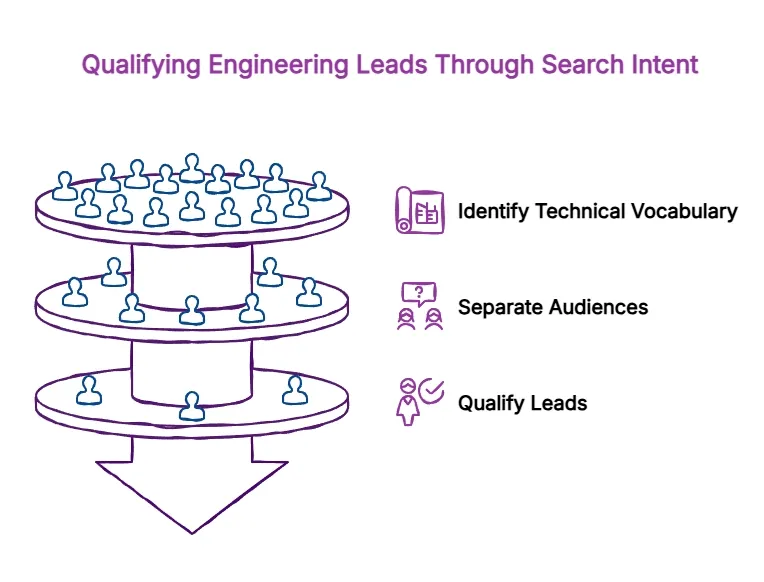
Pipeline quality is shaped upstream. A prospect searching "geotechnical services" could be a graduate student, a homeowner with a cracked foundation, or a facilities director sourcing a retaining wall stability analysis for a $4M expansion. The query itself separates these audiences before your sales team speaks to them.
That separation is qualification. For engineering firms operating in long-cycle, multi-stakeholder sales environments, search is the first filter in the qualified RFQ pipeline—not just a traffic channel.
Broad visibility can create activity without creating value. A site can attract more visits and still produce weak pipeline quality if those visits come from people who are curious, early-stage, or commercially misaligned. The goal is not raw inquiry count. The goal is better-fit opportunity flow.
In practice, technical buyers rarely search like general consumers. They search with the vocabulary of the problem they need solved—a method, a contaminant, a regulatory standard, a project condition, or a defined engineering outcome. When that language appears in the query, the buyer is already doing part of the qualification work before reaching the website. That is why firms that mirror real engineering language tend to attract more commercially serious opportunities and naturally repel low-fit traffic.
The Difference Between Category Keywords and Spec-Driven Buyer Queries
Not all queries carry the same commercial weight. The difference is not subtle. A broad category term may signal general research. A spec-driven query usually signals a clearer problem, stronger internal alignment, or a more mature buying process. Consider the gap:
| Generic Category Query | Spec-Driven Buyer Query |
|---|---|
| environmental consulting firm | PFAS remediation consulting |
| geotechnical services | slope stability analysis for retaining wall failure |
| engineering compliance help | Phase II ESA vapor intrusion assessment |
| remediation consultant | in situ chemical oxidation remediation consultant |
Queries on the right signal someone who already knows the methodology, regulatory framework, or site condition they're addressing. That specificity correlates with project readiness and budget allocation. Building your strategy around generic terms means pipeline quality depends on luck, not design.
The point is not to dismiss every broad query. Some broad searches are still research-relevant. But they are less self-qualifying at the query stage. A person searching "PFAS remediation consulting" reveals far more about project shape and technical seriousness than a person searching "environmental consulting firm." That distinction matters when leadership is trying to connect organic visibility to pipeline quality, not just pageviews. For a related angle on how generic terms undermine this connection, see The Failure of Category Keywords.
The Four Spec Buckets That Reveal Real Engineering Buying Intent
Technical buyers' queries cluster around four categories of specificity, each revealing a different dimension of buying intent.
Methodology and service-method queries. Searches like "in situ chemical oxidation" or "cone penetration testing" name a specific technical approach. The prospect already knows what they need—they're looking for who delivers it.
Regulatory and compliance queries. "Phase II ESA vapor intrusion assessment" or "RCRA corrective action consulting" signal a prospect working within a defined regulatory framework—often on a deadline. Standards ecosystems maintained by bodies like ASCE and NIST shape this kind of search behavior.
Material, contaminant, or condition-specific queries. "PFAS remediation consulting" or "karst terrain foundation analysis" indicate the problem is diagnosed, the scope is defined, and the buyer likely has approval to engage a firm.
Project-type and use-case queries. "Slope stability analysis for retaining wall failure" describes a specific project context. These buyers are matching their project to a provider, not browsing a capability list. For more on how engineering buyers search by specs and applications, the part/spec/application intent mapping framework breaks this down further.
As a general principle, the more a query reflects method, condition, compliance, or application, the more useful it becomes as a qualification signal. That does not make it a guaranteed sales opportunity. It makes it a better early clue.
How to Map Specs to Pages Without Creating a Messy, Generic Site
One page should not try to serve every service line, every spec type, and every buyer at once. When firms compress geotechnical, remediation, compliance, and due-diligence intent into one generic page, they blur the message for both search engines and buyers.
A more effective approach maps your practice-area architecture to the way engineering buyers search by specs and applications. Each service line gets its own page. Each page mirrors the spec language real buyers use—channeling visitors into a qualified inquiry pathway.
To visualize how this works, think of query qualification along two axes: specificity and commercial readiness.
| Query Specificity | Commercial Qualification | Recommended Response |
|---|---|---|
| Broad | Low | Keep high-level service or overview content limited and clear |
| Broad | Research-relevant | Use educational support content to clarify buyer needs |
| Specific | Solution-shaped | Build focused service pages around method, condition, or regulation |
| Specific | Commercially qualified | Route to dedicated pages with strong technical relevance and clear next steps |
This matrix is a decision aid, not a rigid scoring system. Exact page boundaries will vary by service mix, geography, and permitting context. Still, the underlying rule is stable: spec patterns should map to dedicated content paths, not disappear inside generic umbrella pages. For more on structuring these pages, Engineering Firm Service Page SEO walks through the practice-area page architecture that generates commercial RFQs.
For general search-structure guidance, Google Search Essentials and Google's guidance on helpful, reliable, people-first content are useful references. In technical environments, standards ecosystems like ASCE and NIST also help explain why formal terminology and precise language matter to search behavior and to buyers.
What Broad-Traffic Patterns Usually Signal Low-Quality Pipeline
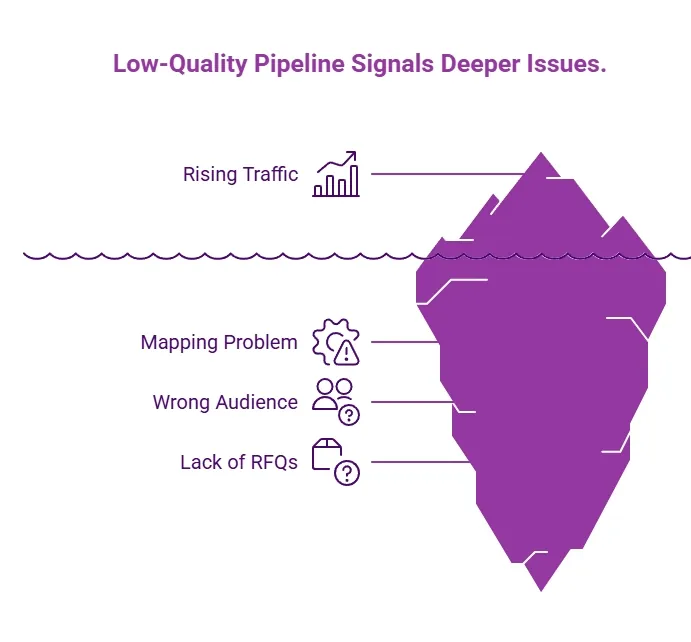
Rising traffic feels like progress. But for engineering firms, a traffic increase that doesn't correlate with better-fit inquiries is a warning sign.
A common failure pattern looks like this: leadership sees improving impressions and traffic, while sales sees vague inquiries and slow follow-up value. That gap is usually not a form problem. It is a mapping problem. The site is ranking for language that does not match how technical buyers evaluate engineering firms.
Your site ranks for broad terms, traffic climbs, and the marketing report looks strong. Meanwhile, sales fields inquiries from DIY homeowners, thesis students, bargain shoppers, and small-business owners well outside your service scope. The dashboard says growth. The pipeline says otherwise.
Compare your top landing pages against actual inquiries. If a page drives traffic but produces few qualified RFQs, the content is attracting the wrong audience. The fix isn't more traffic—it's a spec-driven SEO strategy that filters at the search level.
How Sales and Marketing Can Use the Map to Improve Lead Quality Over Time
The intent-to-spec map becomes a shared operating tool when sales and marketing use it together. Start with the CRM: which recent RFQs came from organic search, and what pages did those prospects visit before submitting?
Cross-reference inquiry quality with landing pages, and patterns emerge fast. Sales flags the queries and page paths that lead to strong opportunities. Marketing prioritizes future content around that signal—building pages around the exact spec language real buyers use. The map becomes a living document connecting content decisions to pipeline outcomes.
Over time, that feedback loop sharpens future page priorities, reduces vague content production, and creates a more defensible connection between search visibility and commercial outcomes. The operating model this builds toward is closed-loop reporting: RFQ tracking and pipeline attribution tied directly to organic content across long engineering sales cycles. For a framework on the metrics that matter most in this process, see Engineering Firm SEO Metrics: What BD Directors Should Track to Measure Commercial Pipeline Impact.
From Search Bar to Shortlist
Remember the principal reviewing that disappointing pipeline? Eight months invested in a prospect who never should have reached the proposal stage.
Mapping search intent to engineering specs changes where the filtering happens. Instead of relying on sales conversations to qualify prospects after months of engagement, the content does the work upstream. Technical buyers searching with method-specific, regulation-specific, and condition-specific language find pages built for that level of detail. Everyone else self-selects out.
The firms that build this way don't just rank. They attract the right conversations, shorten the path from search to shortlist, and give their sales teams a pipeline worth closing.
Qualified pipeline. Qualified content. That's the connection.
For a deeper look at how intent capture builds qualified pipeline, read Beyond the Form Fill: Engineering a Lead Generation System That Delivers Qualified RFQs. For more on how broad keywords undermine lead quality, explore Why Broad Keywords Destroy Pipeline Quality.
Frequently Asked Questions
Our expert team uses AI tools to help organize and structure our initial drafts. Every piece is then extensively rewritten, fact-checked, and enriched with first-hand insights and experiences by expert humans on our Insights Team to ensure accuracy and clarity.
The BVM Insights Team is our dedicated engine for synthesizing complex topics into clear, helpful guides. While our content is thoroughly reviewed for clarity and accuracy, it is for informational purposes and should not replace professional advice.
Our Editorial Process: Our expert team uses AI tools to help organize and structure our initial drafts. Every piece is then extensively rewritten, fact-checked, and enriched with first-hand insights and experiences by expert humans on our Insights Team to ensure accuracy and clarity.
About the BVM Insights Team: The BVM Insights Team is our dedicated engine for synthesizing complex topics into clear, helpful guides. While our content is thoroughly reviewed for clarity and accuracy, it is for informational purposes and should not replace professional advice.