
 Dustin Ogle
- Match Pages to Search Terms: When someone searches “PFAS in-situ remediation,” they need a page with that exact focus - not a catch-all services page that buries it.
- Map Four Intent Types: Buyers search by contaminant (PFAS, solvents), method (soil vapor extraction), regulation (CERCLA, Phase II), or project stage (due diligence, brownfield) - each deserves its own page.
- Build Before You Expand: Create your specialty taxonomy first, then add location variants - doing it backward means rebuilding everything later.
- Use Spec Language in Headlines: “PFAS Remediation for Industrial Sites” beats “Our Environmental Services” for both search engines and technical evaluators scanning results.
- Link Pages Like a Clinic Routes Patients: Parent pages (Remediation Services) connect to specialty pages (PFAS Treatment) that link to related content - this structure signals expertise.
Clear site architecture turns technical depth into search visibility and qualified project inquiries.
Environmental and geotechnical engineering firms looking to attract better-fit RFQs will find a practical framework here, preparing them for the detailed mapping matrix that follows.
A project manager types “PFAS in-situ remediation consulting” into Google. Your firm has done dozens of these projects. But your website shows them a page called “Environmental Services.”
They leave.
This scene plays out hundreds of times a month across environmental and geotechnical engineering firms. The technical capability exists. The search visibility does not. And the gap has nothing to do with content volume - it's a structural mismatch between how engineers search and how most websites are organized.
Practice-area architecture solves this by mapping complex environmental specifications directly to search intent, creating dedicated pathways for buyers who know exactly what they need. When a technical evaluator searches for soil vapor intrusion investigation or remedial investigation support, they should land on a page that mirrors that precise need - not a catch-all services page that forces them to guess whether you can help.
Why Generic Environmental Service Pages Attract the Wrong Search Intent
Broad environmental service pages create a visibility paradox: they rank for general terms while missing the specific queries that signal genuine project readiness.
Consider what happens when a single page tries to cover geotechnical drilling, PFAS remediation, environmental compliance consulting, and subsurface investigation. Search engines struggle to determine what the page is actually about. More critically, technical buyers scanning results see a generic title and assume the firm lacks specialized depth.
This architecture problem compounds in three ways. First, it flattens distinct technical disciplines into one undifferentiated offering. A buyer searching for groundwater contamination assessment has a fundamentally different need than someone researching environmental due diligence for an industrial acquisition - yet both might land on the same page. Second, it weakens the topical authority signals that search engines use to evaluate expertise. Third, it shifts the burden of qualification downstream to your sales and technical teams, who must now sort through inquiries that never should have reached them.
The result is traffic that looks promising in analytics dashboards but produces leads that drain your sales team's bandwidth without converting to qualified RFQs.
The Four Types of Environmental Spec Signals You Need to Map
Environmental specifications cluster into four distinct intent categories, each requiring different architectural treatment.
Contaminant-driven queries center on specific substances: PFAS, petroleum hydrocarbons, chlorinated solvents, heavy metals. Buyers searching these terms typically have a known contamination issue and need remediation expertise for that specific contaminant class. The EPA's PFAS resources illustrate just how specialized this terminology becomes - and how differently buyers search when they know what they're dealing with.
Method and process queries focus on remediation techniques: in-situ treatment, soil vapor extraction, pump-and-treat systems, monitored natural attenuation. These searches signal a buyer who has moved past problem identification and is now evaluating solution approaches.
Regulatory and compliance queries reference specific statutory frameworks and recognized industry standards: CERCLA requirements, state voluntary cleanup programs, RCRA corrective action, and ASTM standards for Phase I and Phase II Environmental Site Assessments. The EPA defines the remedial investigation as the phase used to characterize site conditions and assess risk, while the feasibility study evaluates remedial alternatives - a distinction that shapes how buyers frame their searches and what page intent should satisfy them. The EPA's RI/FS process documentation provides the regulatory foundation these buyers are working from. Buyers using this language often face deadline pressure and need firms that understand the procedural landscape.
Project-context queries describe situational needs: pre-acquisition environmental due diligence, brownfield redevelopment support, industrial facility closure. These searches reveal where the buyer sits in their project lifecycle and what kind of engagement they're seeking.
Each category represents a different entry point into your firm's capabilities - and each deserves dedicated architectural attention rather than being collapsed into a single services page.
How to Translate Each Spec Class into Practice-Area Architecture
Think of your site like a specialized medical clinic. You would not send a buyer looking for PFAS remediation to a general geotechnical drilling page. You would route them to the right specialty, then to the right sub-specialty.
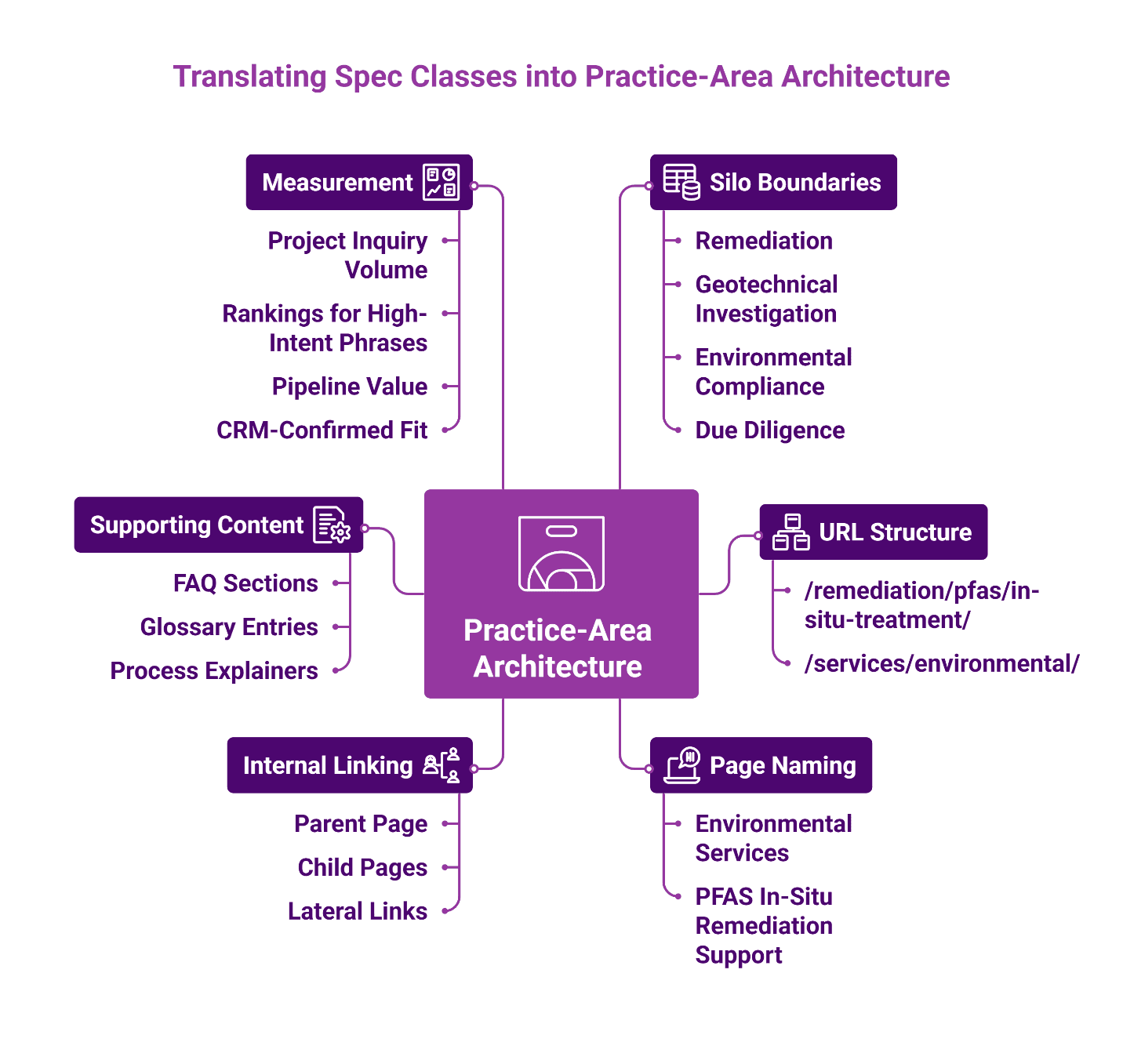
Translating spec classes into architecture requires decisions across six dimensions. The goal is creating a navigation path that matches how technical buyers actually research solutions.
Silo boundaries. Each major practice area - remediation, geotechnical investigation, environmental compliance, due diligence - should occupy its own content cluster. Within each cluster, individual pages address specific capabilities at the spec level. This mirrors how your firm is actually organized and how buyers mentally categorize their needs. Some firms collapse these because internal teams overlap, but internal adjacency is not buyer intent. Different query classes need different destinations.
URL structure. URL paths should reflect the hierarchy clearly. A path like /remediation/pfas/in-situ-treatment/ immediately signals to both search engines and human visitors what level of specificity they're entering. Compare this to /services/environmental/ followed by a wall of text covering everything from soil testing to regulatory consulting. Google's documentation on structured data and site hierarchy describes how clear topical signals and logical link structures help search systems understand content - your architecture itself communicates expertise.
Page naming. Your H1 should carry the spec language that defines the problem set. “Environmental Services” is too broad. “PFAS In-Situ Remediation Support” is specific enough to qualify intent from the first glance.
Internal linking. Use parent-child logic. A parent page on remediation services links down to specific contaminant and method pages. Those pages link laterally to related compliance requirements and back up to the practice area hub. This creates the topical relationships that reinforce authority. That is where Deep Content Architecture and governance against intent drift become practical rather than theoretical.
Supporting content. Not every query deserves a capability page. FAQ sections address common technical questions. Glossary entries define specialized terms. Process explainers and methodology pages help qualify buyers and reinforce trust signals such as PE licensure, software expertise, and certifications. Each element strengthens the topical authority of its parent silo.
Measurement. Track what matters: project inquiry volume, rankings for high-intent technical phrases, pipeline value, and CRM-confirmed fit. Not vanity traffic. This is the same strategic framing behind treating your website as infrastructure rather than a marketing expense - architecture decisions compound over time.
A Worked Example of Spec-to-Intent Mapping
Consider how a firm might restructure its PFAS-related content using practice-area architecture.
The wrong approach: A single “Environmental Remediation” page mentions PFAS alongside twenty other contaminants and treatment methods. The page ranks poorly for specific PFAS queries because it lacks focused depth. Technical buyers scanning search results see a generic title and click on competitors with dedicated PFAS content.
The better architecture: A parent hub page - “PFAS Remediation Services” - establishes the practice area and links to specific capability pages beneath it. Child pages address distinct aspects: “PFAS Site Investigation and Characterization,” “In-Situ PFAS Treatment Technologies,” “PFAS Regulatory Compliance Support.” Each page targets a different search intent while reinforcing the parent hub's authority.
Internal links connect related content across silos. The PFAS investigation page links to relevant groundwater assessment capabilities in the geotechnical cluster. Compliance pages link to authoritative external references like EPA documentation. Each connection strengthens the overall topical network.
This structure captures searches at multiple intent levels - from buyers just learning about PFAS regulations to those actively seeking treatment implementation partners. It also gives technical directors confidence that the website accurately represents actual firm capabilities, which matters for maintaining content credibility over time.
The Most Common Mapping Mistakes That Kill Technical Credibility
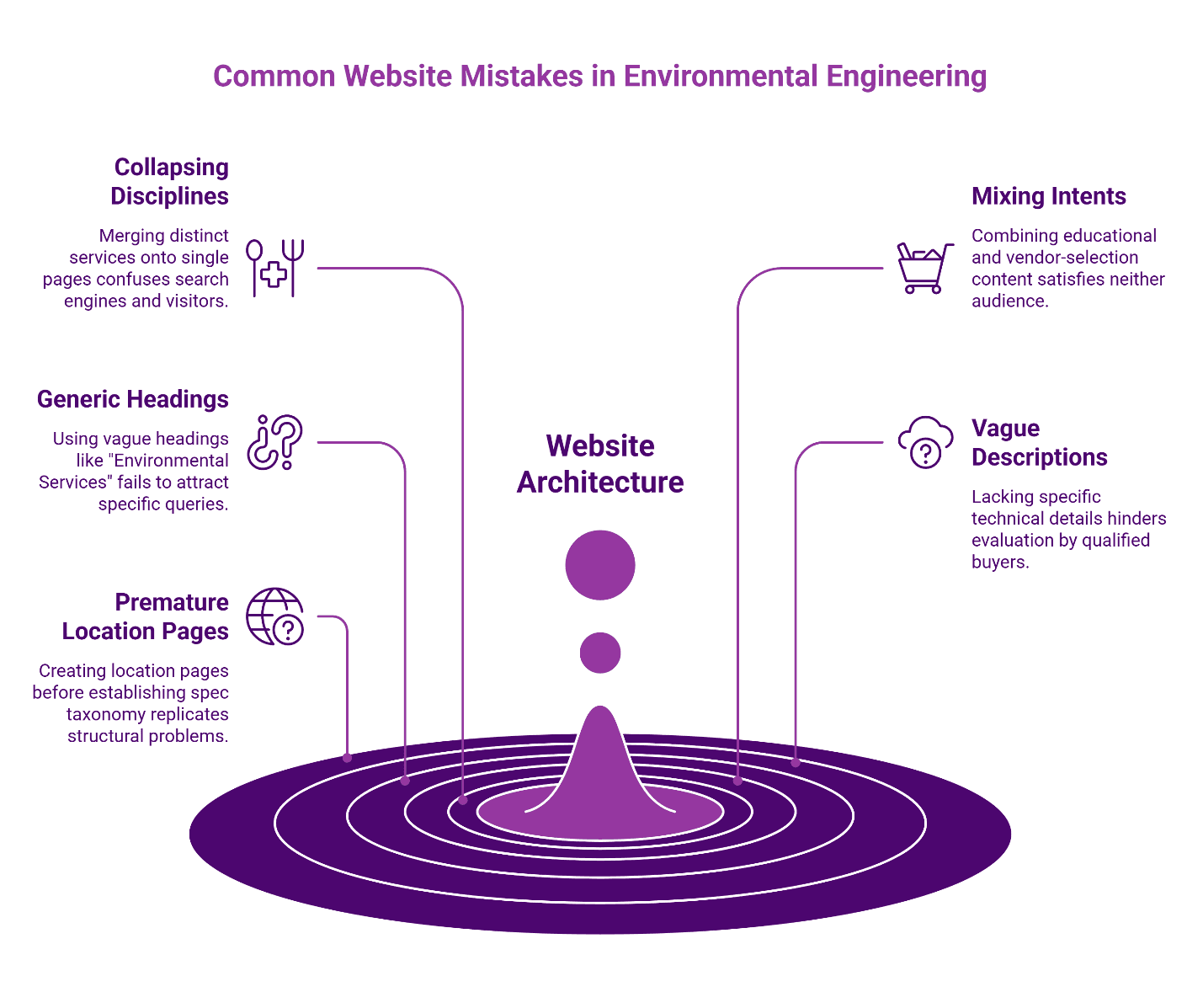
Several architectural patterns consistently undermine environmental engineering visibility, even when technical capabilities are strong.
Collapsing distinct disciplines onto shared pages. Geotechnical drilling and remediation consulting serve different buyers with different timelines. Forcing them together confuses search engines and frustrates visitors who must hunt for relevant information.
Mixing educational intent with vendor-selection intent. A page explaining what Phase II assessments involve serves a different purpose than a page positioning your firm as a Phase II provider. Combining both creates content that satisfies neither audience fully. A glossary-style explainer and a capability page can support each other - they should not pretend to be the same asset.
Using generic H1 headings that ignore spec language. “Our Environmental Services” tells search engines nothing about your specific capabilities. “PFAS Remediation for Industrial Sites” immediately signals relevance to the right queries.
Publishing capability pages without naming technical conditions, methods, or regulatory context. Vague descriptions like “we help clients with contamination issues” lack the specificity that technical buyers use to evaluate fit. They also miss the long-tail queries where qualified intent concentrates.
Creating location pages before the core spec taxonomy exists. Geographic variants work only when they're built on a solid foundation of spec-mapped content. Otherwise, you're replicating structural problems across multiple markets. This reinforces why establishing a sound, intent-mapped framework is critical before scaling across new regions.
How to Prepare These Pages for Future Geographic Variants
A well-designed spec taxonomy makes geographic expansion straightforward rather than chaotic.
Once your core architecture maps contaminants, methods, regulations, and project contexts into distinct practice-area silos, adding regional variants follows a predictable pattern. A national page on remedial investigation services becomes the template for state-specific or regional versions. The spec-level structure remains consistent; only the geographic and regulatory modifiers change.
This approach prevents the cannibalization problems that plague firms with poorly organized content. When your Texas PFAS page and your national PFAS page compete for the same queries, both suffer. But when each serves a distinct geographic intent within a clear hierarchical relationship, they reinforce rather than undermine each other.
Environmental engineering buyers often research across multiple visits, multiple stakeholders, and multiple months before an RFQ. Clean architecture gives marketing a clearer taxonomy, gives technical leads a cleaner review process, and gives leadership a stronger case for why structural choices protect pipeline quality over time. That is upstream leverage.
The practical sequence: build the spec taxonomy first, validate that it captures the right intent signals, then extend geographically. Firms that reverse this order - launching location pages before the core architecture is sound - often find themselves rebuilding from scratch.
Environmental Spec-to-Intent Mapping Matrix
Use this framework to audit existing content or plan new pages:
| Spec Phrase | Buyer Intent | Practice Area | Page Type | Common Mismatch | Future Local Variant |
|---|---|---|---|---|---|
| PFAS in-situ remediation | Solution evaluation | Remediation | Dedicated capability page | Buried in generic “remediation” page | PFAS in-situ remediation in Texas industrial corridors |
| Environmental due diligence industrial site | Pre-acquisition assessment | Due Diligence | Project-type landing page | Mixed with compliance content | Environmental due diligence for Gulf Coast industrial assets |
| Groundwater contamination assessment | Site characterization need | Investigation | Technical service page | Combined with unrelated geotechnical services | Groundwater contamination assessment for manufacturing sites |
| Soil vapor intrusion investigation | Specific diagnostic need | Investigation | Specialized capability page | Listed as bullet point only | Soil vapor intrusion investigation for redevelopment sites |
| Remedial investigation feasibility study | Regulatory process support | Compliance | Process-focused page | No dedicated content exists | RI/FS support for federal cleanup projects |
For each row in your own matrix, ask: Does a dedicated page exist? Does it use the spec language buyers actually search? Does it link appropriately within the practice-area silo? What geographic variant would serve your priority markets?
From Scattered Visibility to Mapped Intent
The difference between environmental firms that capture qualified RFQs and those that lose opportunities to less capable competitors often comes down to architecture, not capability.
Practice-area architecture translates your technical depth into search visibility by mapping how buyers actually look for environmental engineering services. Contaminant queries lead to contaminant pages. Method searches find method content. Regulatory questions land on compliance resources. Each pathway confirms to both search engines and technical evaluators that your firm understands the specific problem at hand.
The investment is structural, not promotional. Once the spec taxonomy is clean and the silo boundaries are clear, every piece of content you add reinforces rather than dilutes your topical authority. Future geographic variants, new service offerings, and emerging regulatory requirements all have logical homes within the architecture.
For environmental engineering firms ready to move beyond generic service pages, the path forward starts with mapping: specs to intent, intent to architecture, architecture to qualified RFQs.
Explore our Resources library for more on translating technical expertise into search visibility, or see how BVM approaches engineering services SEO.