
 Dustin Ogle
Treatment intent is not the same as service-line fit. A searcher typing "treatment for [condition]" or "[procedure] specialist near me" looks like exactly the patient a practice wants — the intent is real. Yet a page built around a broad condition can still send that person toward physicians who do not handle their case, a subspecialty the practice does not offer, or a location it does not staff. The difference between intent and fit is where specialty practices quietly lose qualified demand.
The mismatch is easy to overlook because it rarely surfaces first in an SEO report. It surfaces at the front desk, in the inquiries a team keeps rerouting, and in the appointment requests that take three calls to untangle. The point of noticing it is not to screen patients or decide who deserves care. It is to make the practice's scope, physician fit, and appointment path clear enough that the right searcher recognizes the right next step. The warning signs below tend to appear in inquiry quality and intake friction long before they show up in top-line traffic.
Your Team Keeps Redirecting The Same Questions

Repetition at intake is the clearest signal that a page is reaching the wrong searcher. When the same kinds of inquiries arrive again and again and staff have to reroute them by hand, the content sitting above those inquiries is usually too broad. Callers ask for services the practice does not provide. Patients request a different subspecialty than the page covers. A searcher lands on a detailed condition page, then needs an entirely different page to understand what to do next.
The fix is not to give medical advice on the page. It should not tell a patient what treatment they need or whether a specific physician is clinically appropriate for them. Instead, it should clarify the operational pathway: which service line the page belongs to, which physicians are relevant, which locations apply, and what the appointment next step looks like.
Consider a spine condition page that explains symptoms thoroughly but never clarifies which physicians evaluate which types of cases. The information is all there. The routing is not — so a motivated reader still calls to ask a question the page should have answered. When a condition page fails to answer those basic fit questions, intake becomes the routing system. That creates avoidable friction for both the searcher and the practice.
High-Traffic Condition Pages That Never Connect To A Named Physician
A condition page can rank well and still be structurally weak. Specialty patients often want to confirm one specific thing before they act: does a physician here actually treat my problem? A page that ranks but stays anonymous leaves that question hanging, and even an eager searcher stalls.
This is where specialty SEO for physician-led practices differs from generic healthcare content. The goal is not simply to rank a condition page. The page needs to connect condition interest to physician-fit signals, service-line clarity, location access, and the next appropriate operational step. In content architecture terms, it is a structural problem. In practice operations terms, it is a routing problem.
A practical review of any high-traffic condition page should ask:
- Does the page identify which physicians or care teams evaluate the condition?
- Does it link to physician bios that explain clinical focus?
- Do those physician bios link back to relevant conditions, procedures, or service lines?
- Does the page clarify appointment pathways without making medical recommendations?
Measured against that standard, a top-traffic page is worth auditing whenever it fails to name the relevant physicians, omits links to their bios, or describes a pathway to an appointment without ever connecting it to a named clinician. When a page cannot hand the searcher off to the person who can help, the ranking is not the problem — the absence of a bridge is.
Broad Treatment Pages Attract Expectations The Practice May Not Meet
Broad treatment terms attract broad expectations. A page targeting a wide procedure category will draw searchers whose needs sit just outside what the practice does — a related subtype it refers out, or a level of care it does not provide. The instinct to delete the page is usually wrong. More often the fix is segmentation: giving the topic enough structure that a searcher can self-identify before picking up the phone.
Segmentation can run along several lines depending on how the practice is organized:
- By specialty or subspecialty, and by condition subtype or procedure category
- By physician or care team, and by location
- By referral path and by insurance or access requirements
Those last two deserve particular attention because they are most often left out. A page that never signals which referrals it accepts, or what access and coverage realities apply, will keep attracting people who are a poor operational match no matter how precise the clinical language is. A good specialty page gives the searcher enough context to understand the path forward. It does not make clinical decisions for them.
Physician Bios That Read Like Directory Entries
Physician pages carry unusual weight in specialty care. A patient comparing options is trying to judge whether a doctor treats their problem often, practices somewhere reachable, and has enough relevant credibility to book. A bio that lists only titles and training answers none of that.
The warning sign is sameness: credentials without clinical focus, no links back to the conditions or procedures a physician handles, no way to tell one provider's scope from another's, and the same paragraph structure copied across several profiles. A bio may be underperforming if it lists credentials without explaining clinical focus, does not connect to relevant condition pages, procedure pages, or appointment options, or fails to help a searcher understand what the physician focuses on and where the appointment path continues.
If every provider page says nearly the same thing, the practice is hiding its strongest physician-fit signals. One physician's page should not be interchangeable with another's if their clinical focus, service-line involvement, or location coverage differs.
Strengthening provider pages so they support a decision rather than fill a roster often does more for inquiry quality than another condition article. For teams reviewing technical implementation, applying specific Schema.org markup (such as MedicalBusiness, Physician, or MedicalProcedure types) can reinforce clarity for search engines — though the visible copy still has to do the persuading.
Traffic Climbs While Appointments Stay Flat
More organic traffic is not automatically better patient demand. Traffic that grows while appointment actions hold steady is worth examining because it can mean content is attracting interest without attracting fit.
This one calls for care. Weak conversion can also reflect tracking gaps, scheduling friction, page usability, or payer and access barriers — and treating a measurement problem as a content problem wastes effort. Content misalignment is one plausible cause among several.
The signal points toward content specifically when several things cluster: heavy traffic to condition pages with few appointment actions, calls from outside the service area or specialty scope, repeated "do you treat X?" questions, and intake staff reporting that inquiries do not line up with available services. When that pattern holds, the path from page to appointment is the place to look.
This is where appointment-first healthcare SEO becomes relevant. The question is not only whether a page attracts visits. The better question is whether the page helps the right searcher understand the right next step. For multi-location or multi-specialty practices, location fit can create additional confusion — if a physician, service, or procedure is available only at certain offices, location pages for multi-specialty clinics can clarify how office pages, physician pages, and appointment pathways work together.
Search Reports Show Keywords, Not Service-Line Fit
Keyword rankings describe what a site is visible for. They do not reveal whether the searcher behind each query matches the practice's business goal — so a page can rank, earn traffic, and still misdirect people. Closing that blind spot means setting search data beside intake categories and appointment outcomes.
| Wrong-Fit Search Signal | What It May Mean | What to Review |
|---|---|---|
| Calls ask for services not offered | Condition page is too broad | Page scope, FAQ, CTA |
| Patients request the wrong specialist | Physician mapping is unclear | Bio links, specialty sections |
| Traffic grows but appointments do not | Intent may not match access path | CTA, form, scheduling flow |
| One page serves many service lines | Page is overgeneralized | Service-line segmentation |
| Referrals stall after patients search online | Online validation is weak | Physician bio, reviews, location page |
This table is a general diagnostic framework, not a fixed rule. The same signal can have different causes depending on the specialty, location structure, scheduling process, referral requirements, and website setup. The key is to compare what the page appears to promise with what the practice can actually route.
How To Audit Treatment-Intent Alignment Without Making Medical Claims
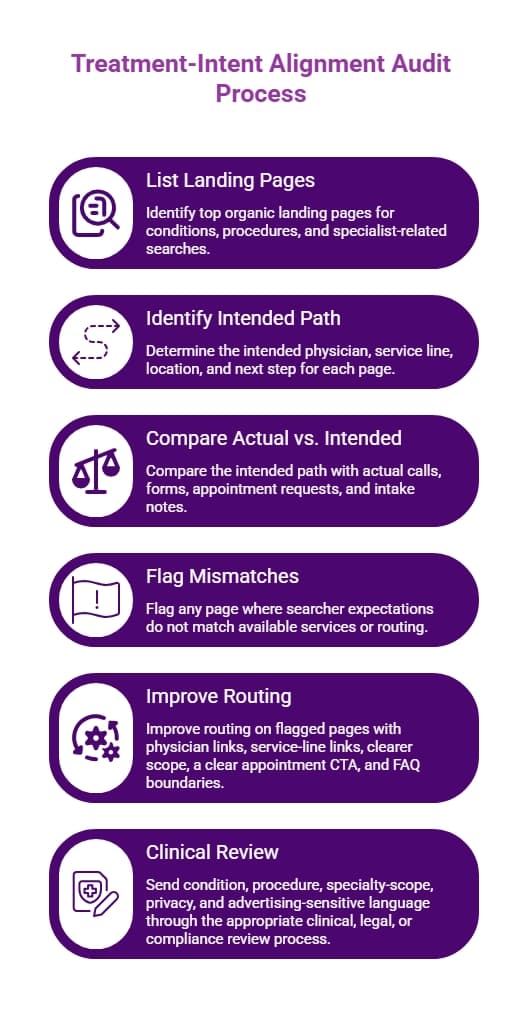
A treatment-intent alignment audit should stay on the marketing and operations side of the line without making a single clinical claim. A practical audit follows this process:
1. List the top organic landing pages for conditions, procedures, and specialist-related searches.
2. Identify the intended physician, service line, location, and next step for each page.
3. Compare that intended path with actual calls, forms, appointment requests, and intake notes.
4. Flag any page where searcher expectations do not match available services or routing.
5. Improve routing on flagged pages first: physician links, service-line links, clearer scope, a clear appointment CTA, and FAQ boundaries that set expectations.
6. Send condition, procedure, specialty-scope, privacy, and advertising-sensitive language through the appropriate clinical, legal, or compliance review process.
Prioritizing matters. The pages generating the most rerouted or off-scope inquiries are where attention pays off fastest, so it is worth fixing the highest-friction handful before touching anything else.
External standards can help teams frame review questions. Google's guidance on helpful, reliable, people-first content is useful for evaluating whether content serves readers clearly rather than existing only to rank. For practices using Google Business Profile appointment or business links, Google's guidance on local business links provides useful platform context.
Two boundaries protect the practice throughout this work. Any language describing what a condition is, who it affects, or how it is treated should be validated by a qualified clinical reviewer before it goes live. And if content touches patient examples, testimonials, reviews, advertising language, or protected health information, the practice should not rely on SEO judgment alone. The U.S. Department of Health and Human Services (HHS) provides specific guidance on HIPAA compliance in the context of online tracking technologies; qualified legal or compliance reviewers should be involved in assessing these implementations. Neither step is an SEO judgment, and neither should be skipped to ship a page faster.
What Better-Aligned Specialty Seo Content Does
The pages that produce well-matched inquiries behave the same way. Better-aligned specialty content does not need to be more aggressive — it needs to be more precise.
A strong page clarifies what it is about, connects condition or procedure interest to the appropriate specialist or service line, and states the next step without offering personalized medical advice. It links cleanly to physician, location, and appointment pages — including the referral and access details a patient needs to tell whether the practice is reachable for their situation. It avoids overbroad claims and helps intake receive better-informed inquiries.
That clarity benefits practice leadership because it ties SEO visibility to service-line reality. It also benefits the searcher because they can better understand whether the practice is a relevant option before starting the appointment process. None of this is exotic — it aligns with Google's long-standing guidance to publish helpful, reliable, people-first content rather than pages built mainly to capture traffic.
For multi-office groups, the same logic extends to geography. A condition page that never clarifies where care is available can route a patient toward an office they cannot reach, which is why clear location pages earn their place in this audit.
This quick reference turns the warning signs into a short review list.
| Warning Sign | What It May Mean | What to Review |
|---|---|---|
| Calls ask for services not offered | The condition page is too broad | Page scope, FAQ, CTA |
| Patients request the wrong specialist | Physician mapping is unclear | Bio links, specialty sections |
| Traffic grows but appointments do not | Intent may not match the access path | CTA, form, scheduling flow |
| One page serves many service lines | The page is overgeneralized | Service-line segmentation |
| Referrals stall after patients search online | Online validation is weak | Physician bio, reviews, location page |
The Goal Is Better-Matched Demand, Not More Treatment Traffic
Treatment-intent traffic can rise while inquiry quality stays flat. When that happens, the problem is usually not a shortage of intent — it is that the content never tells the right searcher whether this practice, this physician, this service line, and this appointment path are the right next step.
The strongest starting point is a practical content map: condition to physician, physician to service line, service line to location, location to appointment path, and appointment path to intake reality. Spotting misalignment does not require SEO expertise. Look at the inquiries the team reroutes most often, the condition pages that never name a physician, and the bios that all read alike. Those are the places where the right patients are most likely getting lost.
Not sure whether your condition pages are attracting the right patients? Start with a specialty search audit that maps condition, treatment, physician, location, and appointment pathways.
Frequently Asked Questions
This article is for general educational and marketing strategy purposes only. It is not medical advice, legal advice, or compliance guidance. Specialty practices should have qualified clinical, legal, or compliance reviewers evaluate medical, privacy, and advertising claims before publishing patient-facing content.
Our Editorial Process: Our expert team uses AI tools to help organize and structure our initial drafts. Every piece is then extensively rewritten, fact-checked, and enriched with first-hand insights and experiences by expert humans on our Insights Team to ensure accuracy and clarity.
By: About the BVM Insights Team
The BVM Insights Team is our dedicated engine for synthesizing complex topics into clear, helpful guides. While our content is thoroughly reviewed for clarity and accuracy, it is for informational purposes and should not replace professional advice.