
 BVM Insights Team
A page goes live fast.
The cursor blinks beside a Phase I ESA claim, and the report folder is still open on a second screen. Someone knows the firm has the experience. Someone else knows the page cannot say too much. The problem is not the expertise. The problem is deciding what proof can safely support the claim before buyers, reviewers, and AI systems are asked to trust it.
Proof rules’—a recommended framework for internal content governance—are specific review protocols that define what each Phase I or Phase II ESA page claim asserts, what evidence supports it, what details remain confidential, and who must authorize the content before publication. For environmental and geotechnical firms, proof rules make service-page content safer, clearer, and easier to evaluate without turning the page into legal, regulatory, environmental, or engineering advice.
When the rules are clear, a marketing director, environmental PM, due diligence practice lead, or BD manager can review a service page with less guesswork. The page stops sounding like broad brochure copy. It starts working like a technical shortlist map.
Why Phase I and Phase II Proof Rules Belong Before Publication
Phase I and Phase II pages carry more risk than generic service pages because they often sit close to lender due diligence, site history, environmental findings, sampling work, property transactions, and project-sensitive details.
That does not mean the page should become vague.
A useful page still needs to show service-line fit. It should help a buyer understand whether the firm handles the right kind of due diligence work, in the right context, with the right technical judgment. In general practice, technical buyers do not search only for a broad “engineering company.” They search by capability, project type, compliance concern, geography, due diligence phase, or the problem blocking a transaction.
That is where proof rules help. They connect the claim on the page to the support behind it.
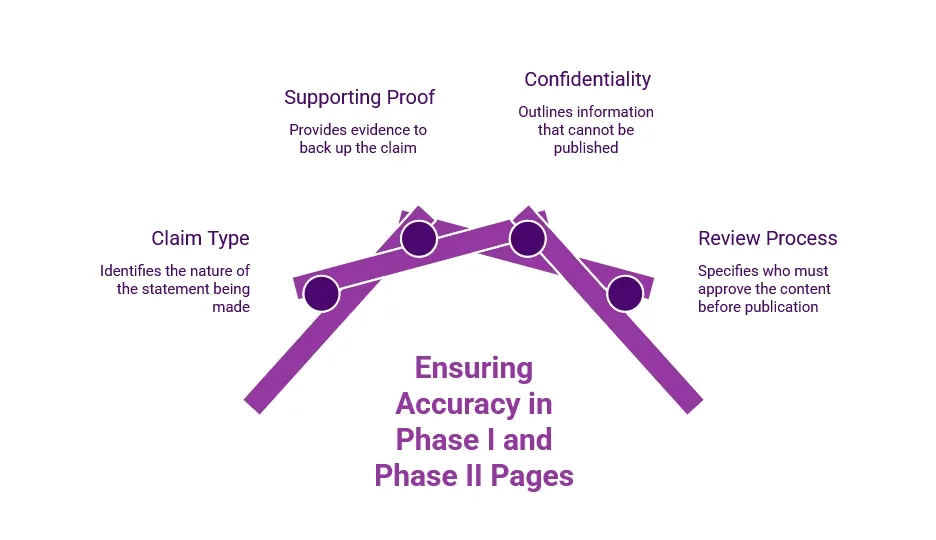
A proof rule should answer four questions:
- What type of claim is being made?
- What proof supports that exact claim?
- What details cannot be published?
- Who must review the claim before it goes live?
This keeps the page useful without asking the writer to invent technical detail. It also protects SME time by making the review task specific.
Step 1: Separate Claim Types Before Reviewing Evidence
Do not start by asking, “Do we have proof?”
Start by asking, “What kind of claim is this?”
A Phase I or Phase II page may contain several claim types at once. Each one needs a different review standard. A service capability claim is not the same as a credential claim. A process claim is not the same as an outcome claim.
Common claim types include:
1. Capability claims: what the firm can do.
2. Process claims: how the firm approaches a service.
3. Credential claims: qualifications, licenses, or professional experience.
4. Project-experience claims: the kinds of work the firm has handled.
5. Outcome claims: what the work helped clarify, support, or enable.
6. Geography claims: where the firm serves clients.
7. Timeline claims: how the firm handles urgency or coordination.
This sorting step prevents a common mistake. Teams often use one strong proof point to support every statement nearby. That can make the page sound confident, but it does not make every claim properly supported.
The proof has to match the claim.
Step 2: Match Each Claim to a Proof Type
Once the claim type is clear, attach the right proof type.
Think of AI-readable proof assets like the right stamped exhibit in an appendix. The reviewer should not have to search the whole file to understand why a claim belongs on the page. The proof should sit close to the issue it supports.
For Phase I and Phase II service pages, useful proof types may include approved process explanations, professional qualifications, SME-reviewed service definitions, anonymized project patterns, internal source notes, or publishable examples of service-line experience.
The key word is exact.
A general statement that the firm has environmental consulting experience does not automatically support a specific claim about Phase II investigation planning. A credential may support the reviewer’s expertise, but it may not support a statement about a particular site condition. A project summary may show experience, but it may need anonymization before it can appear in public content.
A practical proof rule might look like this:
A claim about Phase I ESA report coordination should be supported by an SME-reviewed process note, not by a broad company history paragraph. A claim about Phase II ESA sampling support should be reviewed by a qualified technical stakeholder before publication, especially if the page refers to site conditions, findings, or lender context.
That level of matching reduces drift. No guesswork. No borrowed credibility.
Step 3: Set Confidentiality Limits Before Proof Goes Live
Specific proof is useful only when it respects boundaries.
Phase I and Phase II pages may touch client names, site addresses, property conditions, transaction details, lender-related context, environmental findings, sampling scope, or project outcomes. Those details should not be published unless the firm has the right approval and review process in place.
This article does not provide legal, regulatory, environmental, or engineering advice. As a general content-governance principle, sensitive project details should be flagged before publication and routed to the appropriate reviewer.
A confidentiality rule can still allow useful content. The page can say the firm supports environmental due diligence for commercial property transactions without naming the client. It can describe a general project pattern without revealing a site. It can explain a service process without exposing restricted report language.
The goal is not to drain the page of detail. The goal is to publish detail that the firm is comfortable defending.
Step 4: Assign Reviewer Responsibility for Technical Claims
A proof rule is incomplete until someone owns the review.
Different claims need different reviewers. A marketing lead may be able to confirm page structure, internal links, and brand language. A BD manager may understand which claim supports proposal-quality inquiries. An environmental PM may need to review technical accuracy. A due diligence practice lead or principal may need to approve higher-risk claims.
That division matters because vague review requests waste SME time.
“Can you review this page?” is too broad.
A better request is: “Please review the Phase II ESA process claims in sections two and three. The proof source notes are attached. The page avoids client names, site findings, and project-specific outcomes.”
This turns review into a focused task. It also creates a record for future updates. When the page is revised later, the next editor can see why a claim was approved, who reviewed it, and where the support came from.
Step 5: Use the Proof Rules Review Checklist
A checklist makes the review process visible.
Use this before SME review, not instead of SME review.
| Review Field | What to Check | Ready Signal |
|---|---|---|
| Claim text | What does the page actually say? | The claim is specific and easy to isolate. |
| Claim type | Is it a capability, process, credential, project, outcome, geography, timeline, or AI-readability claim? | The claim has one primary category. |
| Proof type | What support is attached? | The proof type fits the claim type. |
| Proof source note | Where did the support come from? | The source can be found by the reviewer. |
| Confidentiality boundary | What must stay private? | Client, site, finding, lender, and project-sensitive details are flagged. |
| Required reviewer | Who must approve it? | The reviewer role is named. |
| Reviewer notes | What did the reviewer clarify? | Notes are saved for future updates. |
| Publish decision | Is the claim ready, revised, or removed? | The decision is documented. |
| Buyer intent or service-line context | Why would this claim matter to a buyer? | The claim supports a real service-line need. |
| AI-readability note | Is the entity relationship clear? | The page connects firm, service, proof, and context. |
| Internal ownership note | Who owns future updates? | A page owner or team is identified. |
The checklist does not need to become a heavy governance program. It should be simple enough for a writer, marketer, PM, or BD stakeholder to use before the page reaches a senior reviewer.
If the checklist feels too long, start with the first eight rows. Add the remaining fields when the page has complex buyer intent, AI-readability goals, or unclear ownership.
When It Is Not a Proof Problem: Diagnosing the System
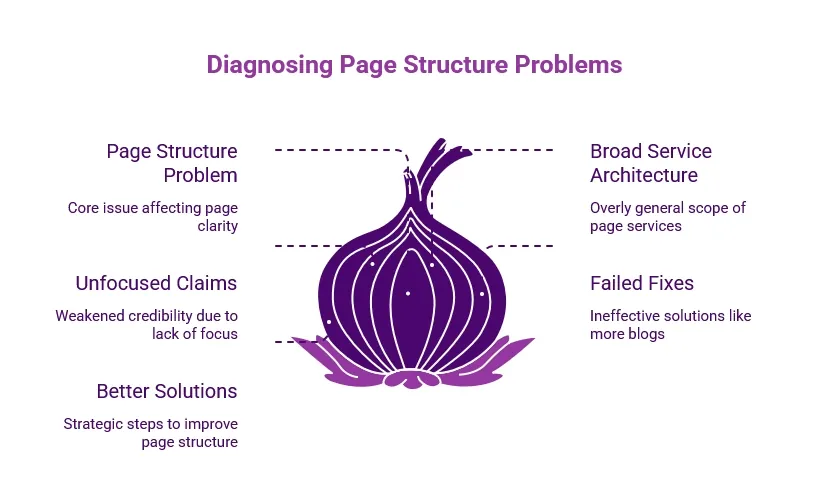
Sometimes the page does not have a proof problem. It has a structure problem.
If proof keeps drifting, the service architecture may be too broad. A single page may be trying to cover Phase I ESA, Phase II ESA, remediation support, permitting, geotechnical work, and lender due diligence at the same time. When that happens, every claim becomes softer because the page has no clear service-line focus.
The failed fix is familiar: publish more blogs, add more exact-match keywords, or paste in another credential paragraph.
That usually does not solve the issue.
The better move is to check page ownership, service-line structure, and review workflow. A page that supports due diligence decisions should have a clear role in the larger content system. It should connect to the right practice area, use the right proof assets, and give reviewers enough context to approve or reject claims quickly.
For broader context on this type of architecture, BVM’s resource on building deep content architecture for engineering topical authority explains how technical content can be structured around expertise rather than generic service labels.
How Proof Rules Make Pages Easier for Buyers and AI Systems to Trust
Buyers need fast clarity. AI systems need clear relationships.
Proof rules help both by making the connection between organization, service, expertise, credential, project context, and support more explicit. While no structure can guarantee how a specific AI platform will interpret, cite, or prioritize content, organizing technical data into clear, distinct entities and proof assets increases the likelihood that AI retrieval systems will accurately identify and reference the firm's expertise.
That distinction matters.
AI-readable proof assets are not magic language. They are structured credentials, service definitions, process explanations, project evidence, and outcome proof formatted so a buyer or system can recognize firm fit. When proof is buried in PDFs, scattered across old proposals, or disconnected from the service page, the page asks for trust without showing the trail.
A stronger Phase I or Phase II page does not just say, “We have experience.” It shows which claim is being made, what kind of proof supports it, and where the reviewer boundary sits.
BVM’s resource on structuring technical content for ChatGPT and Perplexity citations gives additional context on how clear structure can support AI-readable technical content. For environmental consulting contexts, the article on knowledge graph optimization for environmental consulting adds useful background on entity relationships and technical proof.
Resources for Building AI-Readable Engineering Content
Proof rules work best when they sit inside a larger content system. A checklist can improve a single page, but the bigger gain comes from connecting service pages, proof assets, reviewer workflows, and technical expertise across the site.
Start with the resource that matches the immediate problem:
- For service-page structure, read Building Deep Content Architecture for Engineering Topical Authority.
- For AI-readable technical writing, read How to Structure Technical Content for ChatGPT and Perplexity Citations.
- For environmental consulting entity structure, read Securing Citations for Environmental Consulting Using Knowledge Graph Optimization.
The next page does not need more confidence. It needs cleaner proof.
When a BD manager can connect the service claim to the proof source, when an environmental PM can see the technical boundary, and when a reviewer knows exactly what to approve, the page becomes easier to defend.
That is the standard worth setting before publication.
Disclaimer: This article provides general information about content governance for Phase I and Phase II due diligence service pages. It is not environmental consulting, legal, regulatory, or engineering advice. Technical claims should be reviewed by a qualified subject matter expert before publication, especially where confidentiality, client details, site conditions, environmental findings, lender requirements, or regulatory context are involved.
Editorial Process: Our expert team uses AI tools to help organize and structure our initial drafts. Every piece is then extensively rewritten, fact-checked, and enriched with first-hand insights and experiences by expert humans on our Insights Team to ensure accuracy and clarity.
About the BVM Insights Team: The BVM Insights Team is our dedicated engine for synthesizing complex topics into clear, helpful guides. While our content is thoroughly reviewed for clarity and accuracy, it is for informational purposes and should not replace professional advice.