 BVM Insights Team
The keyword list is not enough.
The traffic chart is open on the screen. The line is moving up, the spreadsheet has 47 rows, and the BD manager still cannot point to a serious due diligence inquiry.
That is the problem many environmental and geotechnical firms face. You have the technical expertise. You may even have service pages, project language, and rankings. Yet the website still does not make it easy for a buyer, PM, or BD lead to connect a search term to the proof behind the service.
Due-diligence search terms should be mapped to proof needs because serious buyers are not just looking for a service label. They are looking for evidence that the firm understands the relevant scope, project context, lender expectations, technical process, and service-line fit. A proof map connects each query type to the credibility assets that should appear near the claim.
High-intent keyword mapping for engineering services SEO in Phase I/II due diligence work is not a search-volume exercise. It is a way to organize engineering-service searches by buyer intent, service-line fit, proof requirement, and funnel stage. Think of it as a technical shortlist map. It helps buyers and internal teams see which service fits a project before the first call.
The search term functions strictly as a surface signal. The proof requirement underneath it is where the value sits.
What Buyer Proof Needs Mean in Due Diligence Search
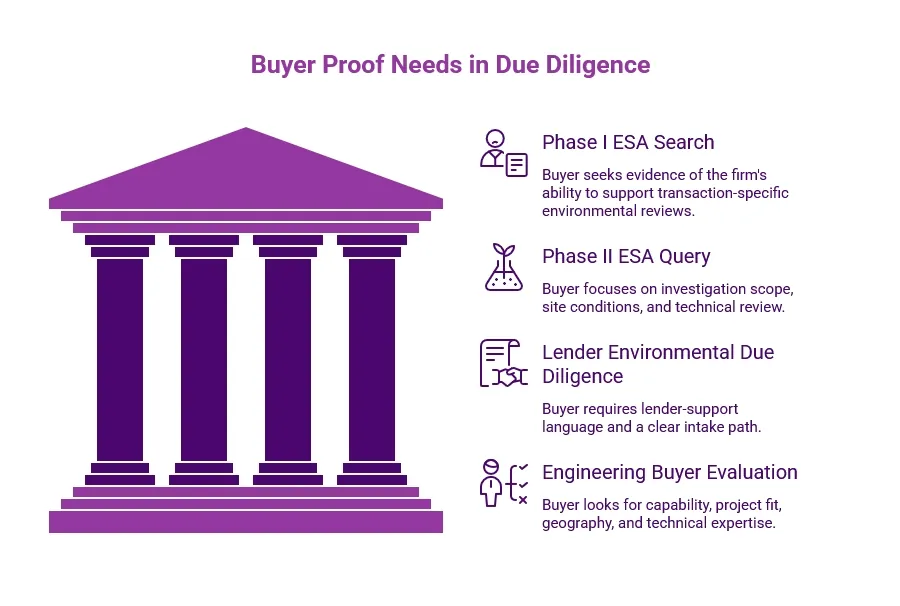
A proof need is the credibility evidence a buyer expects to see before trusting a technical service claim.
For a Phase I ESA search, the buyer may be asking whether the firm can support a transaction-specific environmental review. For a Phase II ESA query, the concern may shift toward investigation scope, site conditions, and technical review. For lender environmental due diligence, the search may signal a need for lender-support language and a clear intake path.
Those examples are general planning patterns, not universal technical rules. Actual service language should be reviewed against the firm’s workflow, proof availability, confidentiality limits, and regulatory context.
Proof Need: The credibility evidence a buyer expects to see before trusting a technical service claim. In due-diligence SEO, the proof need changes by query type, service scope, buyer context, and page intent.
Engineering buyers rarely evaluate a firm through a single generic label. They look for signs of capability, project fit, geography, discipline expertise, technical process, and review readiness. Some proof may include service definitions, process explanations, professional qualifications, project-context descriptions, licensure or certification signals, and publishable proof assets. Use only what is accurate and verified for the firm.
Search does not replace relationships. It helps referred and non-referred buyers verify capability earlier.
Why Broad Keyword Buckets Hide Buyer Readiness
Broad keyword buckets are useful for initial discovery. They become weak when leadership needs to know which searches influenced qualified RFQs, shortlist visibility, or proposal-quality inquiries.
A single “environmental consulting” bucket can hide several different buyer questions. One buyer may need lender support. Another may need a site assessment. Another may be trying to understand whether a property condition requires deeper investigation. The same broad bucket can contain different phases, contexts, and proof expectations.
That is where broad mapping breaks down. Traffic can rise while BD still cannot explain which searches created serious conversations. Marketing sees movement in the dashboard. PMs still see generic copy. Principals still wonder whether organic search is producing the right kind of demand.
Myth: Broad category keywords are the safest path for engineering firms.
Fact: Broad keywords can start discovery, but due-diligence buyers need proof tied to scope, service-line fit, and project context before they trust a page enough to shortlist a firm.
The Search Term to Proof Need Table
The better question is not, “Which keyword should this page target?” The better question is, “What does this search need to prove?”
Use this table as a planning tool. It is not a technical compliance document. It helps marketing, BD, and technical reviewers agree on what each query needs to demonstrate before the page is published or improved.
| Search Term Pattern | Likely Buyer Question | Proof Needed | Where Proof Should Appear | Internal Reviewer |
|---|---|---|---|---|
| Phase I ESA due diligence consultant | Can this firm support a transaction-specific environmental review? | Service definition, process overview, verification of Environmental Professional (EP) qualifications (per 40 CFR § 312.10), ASTM E1527-21 compliance, lender-support context, review notes | Near the Phase I ESA service claim and supporting process explanation | Environmental PM or due diligence practice lead |
| Phase II ESA investigation support | Can this firm handle site conditions that require deeper investigation? | Scope boundaries, process steps, technical review notes, publishable project context | Near investigation scope and method explanations | Environmental PM or senior technical reviewer |
| Lender environmental due diligence | Does this firm understand lender-driven review expectations? | Lender workflow language, report review process, service-line fit notes | Near lender-support service language and intake guidance | BD manager and practice lead |
| Commercial site assessment environmental consultant | Does this firm understand the property type and transaction context? | Property-type context, project constraints, relevant service definitions, proof-safe examples | Near service-line pages and supporting FAQs | Marketing director and environmental PM |
A due-diligence search term should answer three proof questions:
1. Does the firm handle this type of due-diligence work?
2. Can the firm explain the relevant scope, context, and review process clearly?
3. Is there enough proof near the claim for a buyer, PM, or AI system to recognize fit?
That third question matters more than many firms realize. Proof buried in a PDF, tucked inside a project archive, or separated from the service claim may not help the buyer at the moment of evaluation. It may exist, but it does not work as searchable authority.
How to Place Proof Near the Service Claim It Supports
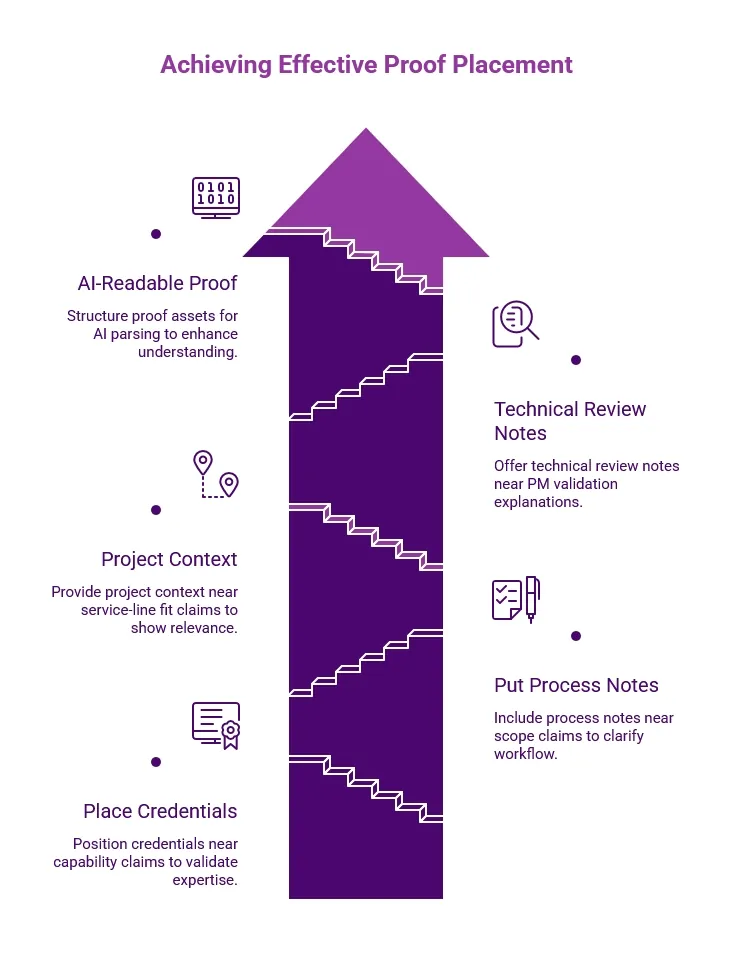
Proof should appear close to the claim it validates.
If a page says the firm supports Phase I ESA work, the nearby copy should explain the service in plain language and show the proof a buyer needs to keep reading. If a page discusses investigation support, scope boundaries and review notes should sit close to that claim. If the page references lender due diligence, the buyer should not have to search across 6 unrelated pages to understand how the firm supports that workflow.
A practical placement model looks like this:
- Put credentials near capability claims.
- Put process notes near scope claims.
- Put project context near service-line fit claims.
- Put technical review notes near explanations that require PM validation.
This is also where AI-readable proof assets become useful. Structured capability proof connects service claims, credentials, project context, and review notes in a format that buyers and AI systems can parse. The goal is not to overstate AI outcomes. The goal is to make the firm’s real expertise easier to understand.
BVM’s engineering SEO approach is built around a central premise: search visibility is only commercially valuable when technical fit, proof assets, and buyer intent are made explicit. Our Engineering Services SEO page provides a complete framework for shifting from generic traffic to a high-margin lead pipeline.
How Marketing, BD, and Technical Reviewers Should Use the Map
A proof map works because it gives each role a clear job.
Marketing directors own the page structure, intent clusters, and visibility gaps. They decide which page should target which search pattern and where the proof belongs.
BD managers own inquiry-quality feedback and RFQ language. They know which phrases sound like serious commercial intent and which ones usually create weak-fit conversations.
Environmental PMs and due diligence practice leads own technical accuracy and proof validation. They should not need to rewrite every page. Their highest-value role is confirming whether the page reflects the firm’s actual service scope, risk context, and proof assets.
That division protects limited SME bandwidth. It also prevents the common failure pattern: marketing drafts broad copy, technical reviewers get overloaded, and the final page says too little about the firm’s actual judgment.
Diagnosing the System When It Is Not a Keyword Problem
Many engineering firms respond to weak organic pipeline by publishing more blogs or optimizing exact-match terms. That can help in limited cases, but it does not fix a broken practice-area architecture.
The deeper issue is usually structural. The firm has credible expertise, but the site does not connect buyer-language searches to service-line fit, technical proof, and tracking fields. The result is a visibility system that looks active but remains hard to defend in BD conversations.
Look for these signs:
- Traffic is improving, but RFQ quality is unclear.
- Service pages bundle several buyer needs into one generic page.
- Senior engineers keep explaining basic fit on intro calls.
- Project proof exists, but buyers cannot find it near the relevant claim.
- Organic reporting shows rankings, but not search-to-proposal attribution.
When those problems appear, the fix is not another generic content batch. The fix is a better map.
Do not publish past the proof. If a technical, regulatory, or project-specific claim is not supported by verified source material, keep it qualitative or collect SME input before publishing.
How This Proof Map Supports the Next Stage of Engineering SEO
A good proof map gives your firm a cleaner foundation for deeper content architecture. It shows which due diligence search terms matter, what those terms need to prove, which pages should carry the proof, and who should validate it.
That is how organic search becomes easier to discuss with BD and technical leaders. The conversation shifts from “Are rankings up?” to “Are the right buyers finding the right proof before they shortlist a provider?”
Start with one service line. Choose 4 or 5 search patterns tied to real buyer questions. Map each one to a proof need, a page location, and an internal reviewer. Small teams do not need a massive SEO rebuild to begin. They need a focused map that turns technical authority into visible buyer confidence.
Resources
The traffic chart can still matter. It just needs a second layer: the proof map that explains which searches are tied to service fit, buyer confidence, and proposal-quality demand.
Better visibility starts when the page proves the claim.
Disclaimer:
This article provides general information about due-diligence search term mapping for educational purposes. Actual content strategy should be reviewed against the firm’s services, proof availability, confidentiality requirements, and regulatory context. For project-specific legal, environmental, or compliance guidance, consult qualified professionals.
Our Editorial Process:
Our expert team uses AI tools to help organize and structure our initial drafts. Every piece is then extensively rewritten, fact-checked, and enriched with first-hand insights and experiences by expert humans on our Insights Team to ensure accuracy and clarity.
About the Brazos Valley Marketing Insights Team
The BVM Insights Team is our dedicated engine for synthesizing complex topics into clear, helpful guides. While our content is thoroughly reviewed for clarity and accuracy, it is for informational purposes and should not replace professional advice.