
 Dustin Ogle
Most specialty practices have no shortage of condition topics. A cardiology group can list dozens of heart-related conditions before lunch, and a dermatology practice can name everything from acne to skin cancer screening. The list is never the hard part.
Fit is. Not every physician treats every condition, locations rarely offer identical services, and service lines carry different growth priorities. A roadmap built on topic volume alone tends to produce pages that attract the wrong patient, name no clear physician, or imply care a given office cannot actually deliver.
That gap creates real operational friction. A page that announces "we treat this" without showing who treats it, where, and what happens next can confuse patients, slow down front-desk staff, and quietly weaken trust with referring providers. Prioritization is not about publishing more pages. It is about publishing the right ones, in the right order, with the right physician behind each one.
Why Keyword Volume Alone Cannot Set the Order

Keyword data earns its place in planning. It shows that people are searching for a condition and roughly how often. What it cannot tell a practice is whether that page should come next.
Volume is silent on the questions that actually govern priority. It does not say whether a physician on staff clearly evaluates the condition, whether the condition ties to a priority service line or procedure, whether the nearest location can support the appointment path, or whether a qualified clinical stakeholder can review the page before it goes live. Two conditions can show nearly identical search interest while differing completely in how well the practice can serve them.
A cardiology group is a useful illustration. A broad heart-health topic may look attractive in a keyword tool. But priority changes if only one physician handles a particular advanced condition, or if only one office supports a related diagnostic pathway. The practice may still need the page. It may just need a more careful rollout.
Healthcare content also differs from general business content because a page should reflect genuine clinical coverage, not aspiration. Google's guidance on helpful, reliable, people-first content reinforces a broader principle: content should be useful to people, not created only to target search engines. A condition page written to chase volume, rather than to route a real patient to a real provider, tends to underperform on both counts.
The better question is not, "Which topic has the highest search volume?" The better question is, "Which condition page can be published accurately, reviewed responsibly, connected to the right physician, and supported by a clear access path?"
The Five-Part Condition Page Prioritization Framework
A condition page is worth prioritizing when it clearly connects the patient need to the practice's real clinical coverage. The following framework gives administrators, marketing directors, and service-line leaders a practical way to sort candidates before writing begins.
| Prioritization Factor | What to Ask | Why It Matters |
|---|---|---|
| Physician fit | Which physicians actually evaluate or treat this condition? | Prevents generic pages that fail to route patients to the right provider. |
| Service-line importance | Is this condition tied to a priority program, procedure, or growth goal? | Keeps content aligned with practice strategy. |
| Patient intent | Is the searcher trying to understand symptoms, choose a specialist, compare treatment paths, or book? | Shapes page depth and the next step. |
| Location and access fit | Where is this care available, and what is the next step? | Avoids appointment friction. |
| Review readiness | Can the right physician or clinical stakeholder review the page? | Reduces the risk of inaccurate or outdated healthcare content. |
A candidate that scores well across all five is usually worth building soon. One that scores well on patient intent but poorly on physician fit or review readiness can wait, or needs work before publication is safe.
Start Where Physician Expertise and Patient Intent Overlap
The strongest early candidates share a pattern. They have clear physician ownership, recurring patient or referral demand, a known service-line priority, enough clinical nuance to justify a dedicated page, and an obvious appointment or referral path. Where those conditions meet, a page tends to be both accurate and useful from day one.
That overlap matters because specialty patients are often not just gathering information. Many are trying to work out which kind of specialist they need, and whether this practice has the right one. A condition page earns priority when it points toward an appropriate physician rather than a broad service line. This is the core of medical specialty SEO: mapping symptoms, diagnoses, procedures, and physician-fit signals so that treatment intent connects to the right provider instead of stalling on a generic overview.
What This Looks Like Across Specialties
The same prioritization logic plays out differently by specialty, which is exactly why generic condition templates feel risky.
In orthopedics, a practice may treat knee pain broadly, yet sports injuries, joint replacement, and complex revision cases often belong to different physicians. A roadmap that lumps them together obscures who handles what, so separating general condition education from physician-fit and treatment-path clarity usually serves patients better.
A gastroenterology group might want pages for reflux, IBS, IBD, colonoscopy, liver disease, and swallowing disorders. Each carries its own mix of physician focus, procedure availability, location access, and review ownership, so the order should reflect those realities rather than search demand. A procedure offered at only one of three offices, for instance, changes the access picture entirely.
A dermatology practice may need distinct paths for acne, psoriasis, skin cancer screening, Mohs surgery, cosmetic services, and pediatric dermatology. Patient intent, physician fit, and compliance sensitivity differ sharply across that list. Cosmetic interest and a skin cancer screening search are not the same journey, and the content should not pretend they are.
Build a Condition-to-Physician Map First
Before ranking anything, it helps to assemble an internal planning map. This is a working document for the team, not a patient-facing table unless clinical reviewers approve it as one.
| Condition | Treating Physician(s) | Specialty / Subspecialty | Related Procedure or Service |
|---|---|---|---|
| Location(s) | Referral Relevance | Review Owner | Publish Priority |
| Candidate topic | Assigned physician or team | Specialty area | Related service or page |
| Office availability | Patient/referral context | Clinical reviewer | Tier 1, 2, or 3 |
Filling this in tends to surface gaps a keyword list never would: a high-demand condition with no clearly associated physician, or a procedure tied to a single office. The map guards against the most common specialty-content mistake, which is publishing a page that says "we treat X" without ever showing who "we" means.
Two Tricky Cases Worth Handling Deliberately
Two situations come up often enough to deserve their own logic.
The first is a condition treated by only one physician. The page can still be valid because it points to a clear owner, but it should not imply that every provider in the practice offers that care. It should connect the topic to the right physician bio, relevant location information, and an appropriate appointment or referral path. If that physician's availability is limited, or coverage depends on a single location, the page should set honest expectations about access rather than imply broad, always-available care. In many practices, a single-physician condition belongs in an earlier tier only when the appointment path and review owner are genuinely in place.
The second is a condition that is clinically important but low in search volume. While volume-first planning deprioritizes these conditions, they remain critical for referring providers and priority programs. Search demand is the wrong yardstick here. If physician fit, service-line value, and referral relevance are strong, the page can warrant priority even when few people search the exact term, because much of its value comes through referral validation and specialist selection rather than raw traffic.
Use Tiers Rather Than Publishing Everything at Once
No team can build every page at once, and attempting it usually produces thin work. Sorting candidates into three tiers keeps the roadmap honest about readiness.
Tier 1 pages publish first: strong physician fit, clear service-line importance, a defined access path, and available clinical review. Tier 2 pages matter but depend on foundations that are not yet in place, such as updated physician bios, treatment pages, or location clarity; building them early means linking to pieces that do not exist. Tier 3 pages should be held or consolidated, because ownership is unclear, access is weak, review capacity is limited, or the page would risk misleading patients. Tiering also gives marketing and clinical teams a shared vocabulary, since "this is Tier 2 until the bios are updated" is far clearer than a vague backlog.
Decide the Right Page Type Before Building
Not every topic deserves a standalone condition page. Some are better served as a treatment or procedure page, a section within a physician bio, part of a specialty overview, a service module on a location page, or a short FAQ beneath a broader page. A practical test helps: if a topic cannot be tied to physician ownership, patient intent, and a clear next step, it is probably not ready to stand alone.
Connect Pages to Bios, Locations, and Treatment Paths
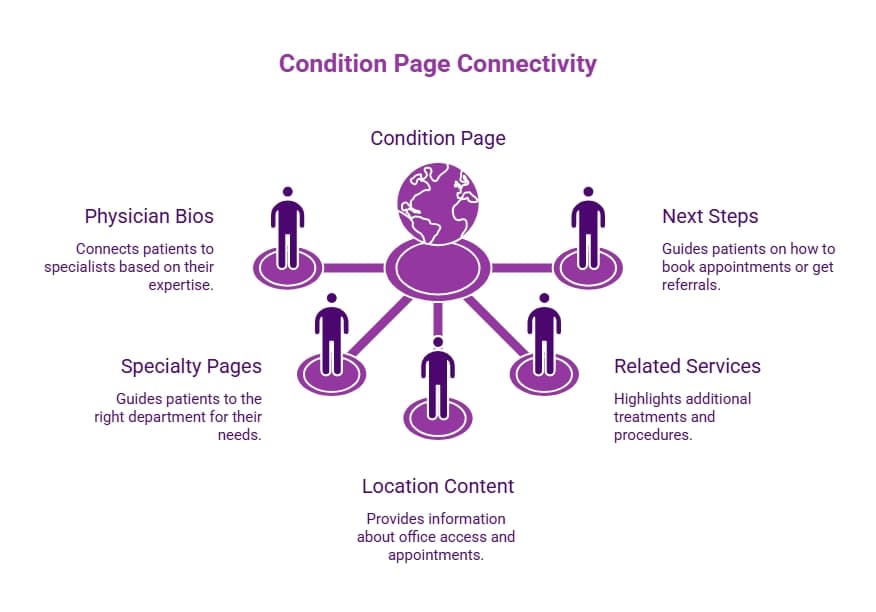
A condition page rarely works in isolation. A useful one helps the reader understand which kind of specialist evaluates the condition, which physicians at the practice focus on the area, which locations support the care pathway, what related services or procedures may be relevant, and what the appropriate next step is to request an appointment or referral.
That points the architecture outward. Condition pages should connect to physician bios written around the conditions each doctor treats, to specialty pages that route patients to the right provider, and to location content tied to office access and appointment intent. Thinking about the next step early tends to make the structure follow naturally, which is the idea behind an appointment-first healthcare SEO framework. When availability varies across offices, location pages for multi-specialty clinics and a well-maintained Google Business Profile for clinics help patients reach the office that actually offers the relevant service.
These same relationships are what help search engines and AI systems understand which physicians treat which needs. Machine-readable connections across these clinical data points, supported by appropriate entity markup such as the Schema.org Physician type, improve clarity and discoverability potential. They do not guarantee rankings or visibility, and they never replace accurate, reviewed content.
Build Review Capacity Into the Plan
Clinical review is a prioritization factor, not a final checkbox. A clinically sensitive page should not jump to the top of the list if no qualified reviewer is available.
For each priority page, it helps to name a clinical reviewer, a marketing owner, a compliance reviewer where required, an update cadence, and the source material needed before work begins. A marketing team should not approve clinical content on its own.
Healthcare advertising also carries professional expectations. The AMA Code of Medical Ethics on advertising and publicity cautions against publicity that is false, misleading, or deceptive. HHS guidance on HIPAA and marketing is relevant when communications involve protected health information, and the FTC's Health Products Compliance Guidance applies when health-related benefit or safety claims are being made. All three are reason enough to route claims about expertise, outcomes, and patient care through qualified review before publication.
What Not to Prioritize Yet
Some pages are better left for later. A condition page should usually be held when:
- no physician is clearly associated with the condition;
- the service is not available at the locations the page would imply;
- the practice cannot verify the clinical claims involved;
- the page would duplicate another without adding physician or service-line specificity;
- the next step for the patient is unclear;
- the page would overpromise treatment access, outcomes, or expertise;
- the topic is mainly informational and does not support the practice's actual care pathways.
Holding a topic is not a failure. It may simply mean the supporting architecture needs to come first.
A Practical Scoring Model
When a team needs to compare candidates quickly, a simple one-to-three score across the same factors works well.
| Factor | Score 1 | Score 2 | Score 3 |
|---|---|---|---|
| Physician fit | Unclear owner | One provider loosely connected | Clear physician or team ownership |
| Service-line value | Low priority | Moderate relevance | Priority service line or program |
| Patient intent | Mostly general education | Mixed intent | Strong specialist-selection or appointment intent |
| Location / access clarity | Unclear | Somewhat clear | Clear office, referral, or appointment path |
| Review readiness | No reviewer | Reviewer uncertain | Reviewer assigned |
Begin with the pages scoring high across fit, value, access, and review readiness. The aim is not the highest-volume topic; it is the page where accuracy, ownership, and patient routing already line up.
The scorecard also gives marketing, operations, intake, and physicians a shared language. Marketing may see search opportunity. Physicians may see clinical nuance. Operations may see access constraints. Service-line leaders may see growth priorities. A scoring model helps those perspectives meet in one practical workflow.
For serious-care and high-consideration service lines, where patients compare specialists carefully before booking, this discipline matters most, and it tends to align with broader high-value healthcare SEO planning built around diagnosis, treatment-path, and program pages.
Prioritization Should Reduce Confusion, Not Just Add Pages
The best condition-page roadmap is not the longest one. It is the one that helps the right patient reach the right physician with fewer assumptions, while improving clarity for referring providers, internal teams, search engines, and AI systems at the same time. A roadmap no longer has to be sequenced by whatever topic looks biggest; it can be sequenced by where physician fit, patient intent, access clarity, and review readiness actually overlap.
If a specialty practice has the right physicians but unclear condition-to-provider content paths, BVM can help map which condition, physician, and location pages deserve priority first. Start with a Get My Visibility Analysis.
Disclaimer: This article is for healthcare marketing and content strategy education only. It is not medical, legal, or compliance advice. Practices should have condition, treatment, credential, access, and privacy-related content reviewed by qualified clinical, legal, and compliance stakeholders before publication.
Our Editorial Process: Our expert team uses AI tools to help organize and structure our initial drafts. Every piece is then extensively rewritten, fact-checked, and enriched with first-hand insights and experiences by expert humans on our Insights Team to ensure accuracy and clarity.
By: About the BVM Insights Team
The BVM Insights Team is our dedicated engine for synthesizing complex topics into clear, helpful guides. While our content is thoroughly reviewed for clarity and accuracy, it is for informational purposes and should not replace professional advice.