
 BVM Insights Team
Traffic can hide the problem.
A BD manager opens the monthly dashboard, sees the line moving up, and still cannot connect those visits to a serious Phase I ESA, Phase II ESA, lender due diligence, or remediation planning conversation. The chart looks encouraging. The proposal pipeline does not feel clearer.
You are not looking for more SEO activity to manage. You are looking for a way to show whether search visibility is helping the firm become easier to find, easier to trust, and easier to shortlist for the right environmental or geotechnical work. That requires a different working model: the keyword map to proof assets connection.
A keyword map identifies the buyer situation behind a search. A proof asset validates whether the firm is credible for that situation. When marketing, PMs, and BD plan those two layers together, service pages stop acting like brochure copy and start acting like shortlist evidence.
The goal is not to turn every technical detail into public content. Some proof is confidential. Some claims need SME review. Some regulatory or lender-related language needs careful qualification. The practical goal is simpler: create a shared map that shows what each search cluster means, what the page must prove, who should review it, and what inquiry-quality signal would show that the content is attracting the right demand.
Why Keyword Maps and Proof Assets Belong in the Same Search Trust System
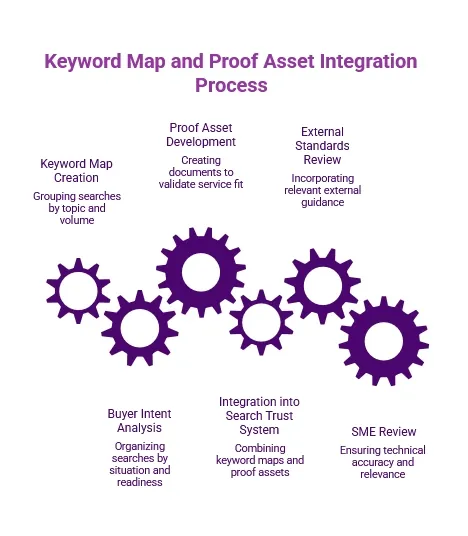
A keyword map is incomplete when it only groups phrases by topic, volume, and broad service category. That approach may help with early discovery, but it breaks down when leadership wants to know which searches influenced proposal-quality conversations.
For environmental and geotechnical firms, buyer intent is rarely generic. A search around “Phase I ESA lender due diligence” carries a different need than a search around “Phase II ESA investigation support.” A query about remediation planning suggests a different level of buyer readiness than a broad search for environmental consulting.
That difference matters.
A useful buyer-intent keyword strategy should organize searches by the situation behind them. The map should clarify whether the buyer is dealing with a property transaction, a lender requirement, a suspected site condition, a follow-up investigation, or a next-step planning problem. That context helps marketing build the right page. It helps PMs protect technical accuracy. It helps BD decide whether the inquiry resembles a qualified RFQ.
Proof assets are the other half of the system. They may include methodology explanations, reviewer-approved project patterns, credentials, service-line definitions, process notes, non-confidential experience summaries, or decision criteria. Proof assets help a buyer understand why the firm fits the situation being described.
The connection is the point. Keyword maps identify demand language. Proof assets validate service-line fit. Together, they help turn search intent into proof-backed pages.
External standards and guidance can support that context, but they should not replace firm-specific SME review. For example, the EPA’s All Appropriate Inquiries guidance provides useful context for Phase I environmental site assessment discussions, and ASTM E1527-21 serves as the current EPA-recognized industry standard for conducting Phase I Environmental Site Assessments (ESAs) to satisfy All Appropriate Inquiries (AAI) requirements under CERCLA. Those links are context, not legal advice, project guidance, or a substitute for qualified review.
The Search-to-Proof Alignment Model: What Each Team Owns
Search-to-proof alignment works because it gives each stakeholder a clear role. No single team owns the full picture.
Marketing owns the demand language. That includes buyer-language search clusters, keyword grouping, SERP intent, page role, internal linking opportunities, and the content brief structure. Marketing can see how the market phrases the problem, where the page should sit in the site, and how related resources should connect.
PMs and practice leads own technical proof. They validate service-line fit, technical accuracy, publishable evidence, SME review needs, technical nuance, and claims that should not be made publicly. This is where many engineering SEO projects stall. The marketing team can draft the page, but the technical team must help determine what can be safely and accurately said.
BD owns inquiry quality. That includes RFQ language, proposal relevance, shortlist fit, sales feedback, and evidence that search demand matches commercial opportunity. BD can tell the team whether a search cluster is likely to produce a serious conversation or another weak-fit inquiry that drains technical time.
A practical workflow starts with one shared question:
What must this page prove before a serious buyer would trust it?
That question changes the conversation. It moves the team away from “What keyword are we targeting?” and toward “What buyer situation are we answering, and what proof does that situation require?”
For teams working with limited SME bandwidth, this distinction matters. PM review time should not be spent rewriting generic copy. It should be used to confirm accuracy, approve proof categories, and flag claims that need qualification.
How to Turn the One-Pager Into Page Briefs and Review Workflows
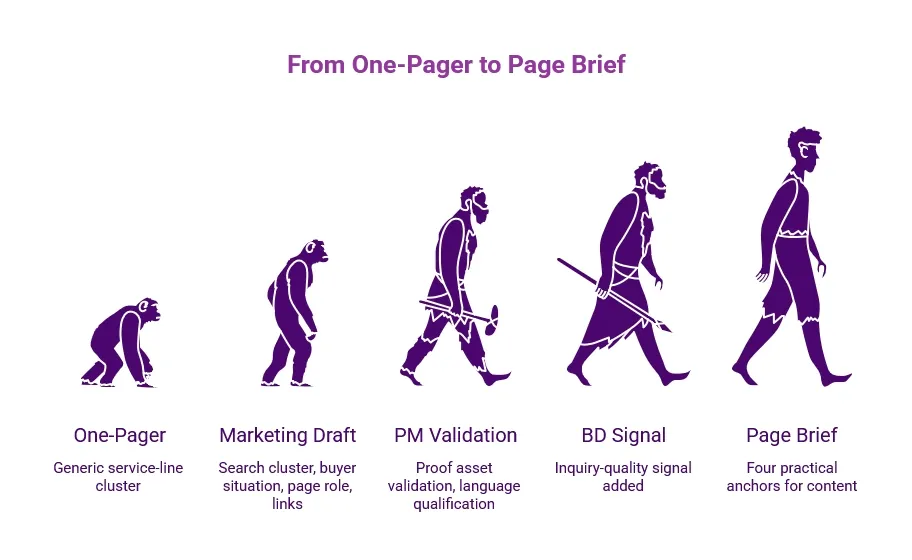
The one-pager becomes useful when it feeds the page brief.
Start with one service-line cluster, not the whole site. A Phase I ESA lender due diligence cluster is enough for a first pass. Marketing can draft the search cluster, buyer situation, likely page role, and internal links. Then the PM or due diligence lead can validate the proof asset and identify language that needs qualification. BD can add the inquiry-quality signal.
That creates a page brief with four practical anchors:
1. The buyer situation: What is the buyer trying to resolve?
2. The technical proof: What evidence can be safely published?
3. The reviewer owner: Who confirms accuracy before the page goes live?
4. The commercial signal: What would show that the page is attracting better-fit demand?
This workflow also protects SME time. Instead of asking a PM to review an entire generic page, the process asks for targeted judgment. Is this claim accurate? Can this proof be published? Does this page describe the right service-line fit? Is the language too broad for the work being discussed?
A common pitfall is treating this as a one-time content exercise. It should work more like a living operating document. As BD hears better RFQ language, the table should improve. As PMs identify stronger proof assets, the brief should sharpen. As marketing sees which pages earn visibility for high-intent searches, internal links and supporting content can be refined.
That is how the bridge asset supports the broader content system. It gives the team a first alignment layer before deeper service pages, supporting spokes, and proof-led resources are built.
For related planning, BVM’s guide to deep content architecture for engineering topical authority can help teams think beyond individual pages. The resource on structuring technical content for ChatGPT and Perplexity citations is also useful when the team needs clearer entity relationships between services, standards, and proof. For BD alignment, mapping search intent to engineering specs offers a related path into qualified RFQ filtering.
Questions to Resolve Before Writing the Page
The one-pager should surface questions early, when they are easier to answer.
For Phase I/II due diligence content, the internal review should clarify which search phrases tend to signal qualified opportunities and which phrases attract students, homeowners, or low-fit inquiries. It should also identify whether terms tied to lender context, property type, timeline, site condition, or assessment phase change the buyer’s level of readiness.
The proof review should be just as specific. The team should identify what can be safely extracted from proposals, reports, project summaries, credentials, process documentation, or methodology notes without exposing confidential client information.
BD should define what a qualified SEO-sourced RFQ looks like in practical language. The signal might involve project scope, property transaction context, lender timing, due diligence phase, or a clear next-step planning request. The exact signal will vary by firm and service line, so the table should reflect real sales feedback rather than generic lead definitions.
This is where technical proof becomes operational. It stops being a vague request for credibility and becomes a specific review task.
Frequently Asked Questions
Closing Thought
The traffic chart still matters. It just cannot be the whole story.
A stronger system gives marketing, PMs, and BD a shared way to explain what the searcher needs, what the page must prove, who should review the proof, and what signal shows that the inquiry was worth pursuing.
That is the practical value of moving from keyword map to proof assets. The firm gets a clearer path from search visibility to technical credibility. BD gets better language for pipeline conversations. PMs get a defined place to protect accuracy. Marketing gets a structure that supports search, AI interpretation, and internal trust.
Not more content for its own sake. Better evidence, mapped to better intent.
Explore the Engineering Services SEO framework to see how BVM connects buyer-language searches, technical proof, and qualified RFQ visibility.
Ready to connect search visibility to better-fit engineering inquiries?
Book a Call with BVM to discuss how your keyword map, proof assets, and service-page structure can work together.
Resources
Use these resources to continue the alignment process:
- Explore the Engineering Services SEO framework
- Build deep content architecture for engineering topical authority
- Structure technical content for ChatGPT and Perplexity citations
- Connect engineering search intent to qualified RFQ language
- Review EPA All Appropriate Inquiries context
- Review ASTM E1527-21 Phase I ESA standard reference
- Review Google’s people-first content guidance
Disclaimer: This article provides general information about connecting keyword maps, proof assets, and engineering SEO workflows for educational purposes. Individual circumstances vary based on service lines, project types, confidentiality limits, reviewer availability, lender requirements, and regulatory context. For technical, legal, or regulatory guidance specific to a project, consult the appropriate qualified professional.
Our Editorial Process: Our expert team uses AI tools to help organize and structure our initial drafts. Every piece is then extensively rewritten, fact-checked, and enriched with first-hand insights and experiences by expert humans on our Insights Team to ensure accuracy and clarity.
By: About the BVM Insights Team
The BVM Insights Team is our dedicated engine for synthesizing complex topics into clear, helpful guides. While our content is thoroughly reviewed for clarity and accuracy, it is for informational purposes and should not replace professional advice.