
 BVM Insights Team
Proof cannot stay buried.
The traffic chart is open at 7:43 a.m., and the BD manager still cannot tie the spike to a serious due diligence inquiry. The numbers moved. The proposal pipeline did not.
You have real environmental or geotechnical expertise, but the website does not make that expertise easy to verify. A Phase I ESA page may describe the service. A separate credentials page may mention qualifications. A project PDF may show relevant experience. The problem is that buyers, internal stakeholders, and AI systems have to connect those pieces on their own. Is any of this creating qualified demand?
Service pages and proof help AI tools understand firm fit when each capability claim is connected to the credentials, project evidence, process details, and internal links that validate it. For engineering firms, AI-readable proof assets may include licensure, certifications, discipline expertise, project type, methodology explanation, site context, and publishable project experience.
That does not mean AI tools will cite a firm because one page was updated. AI behavior varies by system, query, source access, and context. The practical goal is simpler: make service-line fit easier to understand for human buyers first, then structure the evidence clearly enough that search and AI systems can interpret the same relationships.
Why disconnected proof weakens firm fit
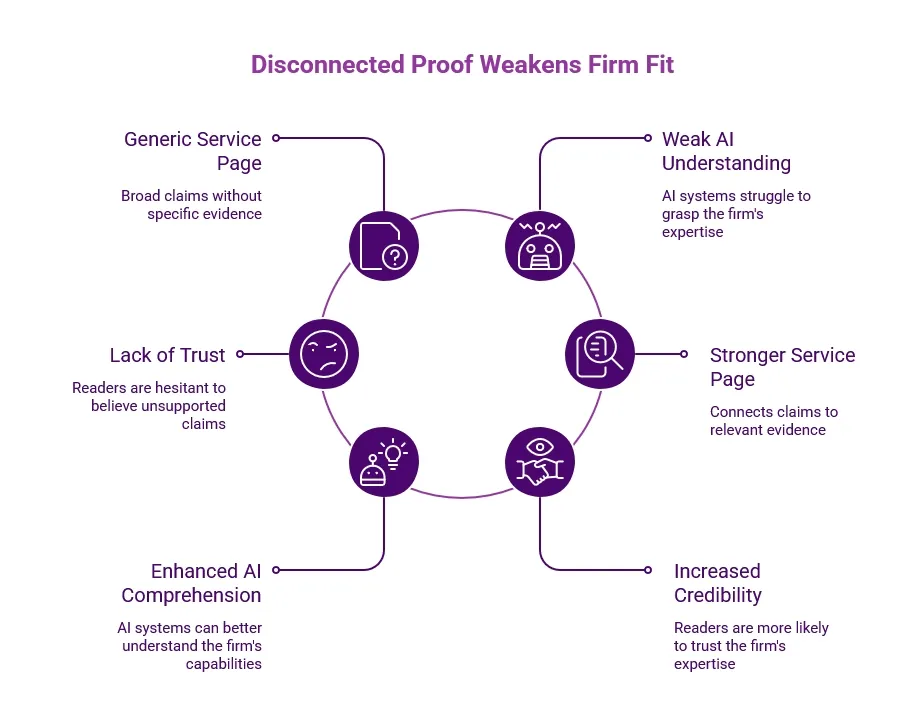
A generic service page asks the reader to trust a claim without showing enough support nearby.
For example, “We provide environmental due diligence” is broad. It does not tell a lender, developer, owner, or procurement reviewer whether the firm understands Phase I ESA workflows, Phase II ESA follow-up, site-condition complexity, reporting expectations, or regional constraints. It also gives an AI system little structure to work with beyond a general service label.
A stronger service page connects the claim to evidence. If the page discusses Phase I ESA support, it should also help the reader see the firm’s relevant process, credentials, stakeholder experience, and safe project context. Not every detail belongs on the public website. Confidential project facts should stay protected. Still, the relationship between service and proof should be visible.
Think of it like a technical appendix. The claim is easier to trust when the right exhibit sits close enough for a reviewer to verify it.
Use a Service-to-Proof Link Map
A Service-to-Proof Link Map is a simple content planning tool. It connects each service page to the buyer question, proof asset, clarifying support, and internal link needed to make technical fit easier to evaluate.
| Service page | Buyer question | Proof asset | Clarifying support | Internal link needed |
|---|---|---|---|---|
| Phase I ESA | Can this firm support lender due diligence? | Relevant credentials, process explanation, safe project context | Explain scope, review process, and decision points without giving legal advice | Link to a supporting due-diligence or technical authority resource |
| Phase II ESA | Can this firm investigate site conditions after initial findings? | Methodology summary, testing-related explanation, publishable project context | Clarify how the service fits after a Phase I finding or site concern | Link to related environmental investigation content |
| Remediation Planning | Can this firm help plan the next step after investigation? | Technical process, discipline expertise, outcome context | Explain the planning logic and stakeholder coordination needs | Link to supporting proof or process content |
The map is useful because it forces a practical question: does the service page give a qualified buyer enough evidence to keep evaluating the firm?
For marketing directors, the map clarifies page architecture. For environmental PMs, it protects claim accuracy. For due diligence practice leads, it shows whether technical fit is visible. For BD managers, it connects the page to proposal-quality conversations instead of anonymous traffic.
What proof belongs near a service claim
Proof should match the type of claim being made.
If a page claims technical capability, the proof may include discipline expertise, methodology explanation, equipment or testing context where appropriate, or a project-type example that can be safely published. If a page claims suitability for lender due diligence, the proof may include process clarity, credential visibility, and language that aligns with how lenders and transaction teams evaluate risk.
Some proof categories are especially relevant for environmental and geotechnical firms:
- Professional qualifications, including PE licensure where applicable
- Certifications or discipline-specific expertise
- Project type, application, and site context
- Region or state coverage when geography affects fit
- Methodology explanations reviewed by SMEs
- Publishable project experience that avoids confidential details
These are general content-architecture principles. The exact proof depends on the firm’s services, jurisdictions, credentials, confidentiality limits, and review process.
For regulatory-adjacent topics, keep the content informational. Phase I ESA and All Appropriate Inquiries (AAI) are governed by federal regulation (40 CFR Part 312), with ASTM E1527-21 serving as the industry-standard practice for compliance. A service page can link to authoritative context when useful, but it should not turn into legal or environmental consulting advice without proper review.
Buried PDFs do not carry the whole burden
Many firms already have useful proof. It sits in proposal boilerplate, old project sheets, qualification packages, staff bios, slide decks, and PDFs.
That proof may help during a proposal process, but it is weaker during early online evaluation if it is disconnected from the service page. A buyer scanning a Phase II ESA page should not have to open 4 files, guess which credential matters, and infer whether the firm handles the relevant site condition.
The same principle applies to AI-readable structure. Clear content relationships matter. Google’s own guidance on structured data makes a useful distinction: additional markup can help systems understand page information, but it does not replace clear, useful content. For technical teams, Schema.org’s Article type can help search engines parse metadata such as author, publication date, and organization, but the visible page still needs plain-language proof.
A common pitfall is treating proof as a separate archive. Proof should function like support placed beside the claim it validates.
Internal links should help readers follow the evidence
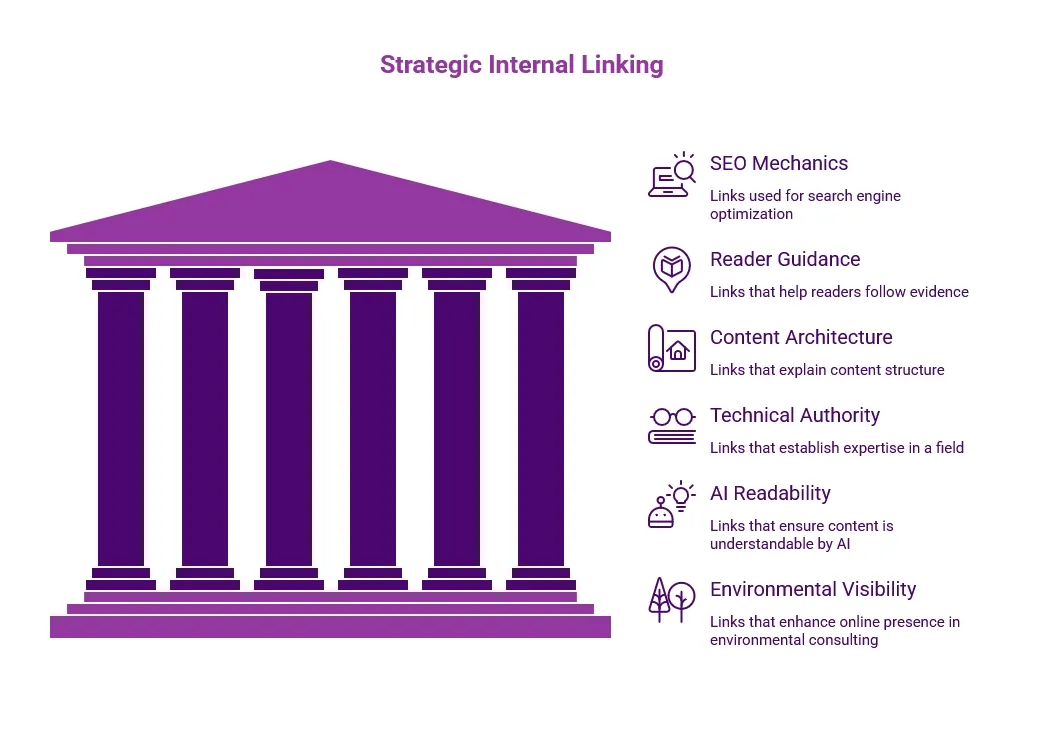
Internal links should not exist only for SEO mechanics. They should help a serious evaluator move from a service claim to the evidence behind it.
A service page about engineering due diligence can link to supporting resources that explain content architecture, technical authority, AI-readable content, or environmental consulting visibility. For example, BVM’s page on Engineering Services SEO gives broader context for engineering search strategy. The related resource on building deep content architecture for engineering topical authority is a more focused fit when the discussion turns to hub-and-spoke structure.
When the topic shifts toward AI-readable formatting, the resource on structuring technical content for ChatGPT and Perplexity citations is the more relevant next step. If the page specifically involves environmental consulting visibility, the piece on knowledge graph optimization for environmental consulting can support the entity-relationship discussion.
The link should answer a reader’s next question. Otherwise, it is decoration.
The problem is usually not more content
Publishing more pages can make the problem larger if the structure is wrong.
A firm may add blog posts, rewrite service copy, or target broader keywords and still miss the buyer’s real question. A developer does not simply need “environmental consulting.” A lender may need Phase I ESA support. An owner may need clarity after a recognized environmental condition. A technical stakeholder may need confidence that the firm understands site conditions, investigation steps, and the handoff from due diligence into remediation planning.
That is why service pages and proof should be mapped before content volume increases. The first pass does not need to cover the whole website. It should make one important service line easier to evaluate.
Start where the commercial signal is strongest.
A first pass for connecting service pages and proof
Choose one service page that matters commercially. Phase I ESA, Phase II ESA, lender due diligence, environmental site investigation, or remediation planning are practical starting points when they match the firm’s actual work.
Then run a focused review:
1. Pick one commercially important service page.
2. List the buyer questions that page should answer.
3. Inventory safely publishable proof.
4. Add clarifying support near each major claim.
5. Link the service page to proof and related explanations.
6. Review the page with one marketing stakeholder and one technical stakeholder.
7. Repeat only after the first service-to-proof loop is clear.
During review, look for missing relationships. Does the page show which credentials support the claim? Does it explain the process without oversimplifying the technical work? Does it connect project type, application, region, or methodology when those factors affect fit?
This is where SME review matters. A marketer can make the page readable. A technical reviewer protects accuracy. The strongest version uses both.
Resources
For broader context on engineering search strategy, start with Engineering Services SEO. For the content-architecture layer, read Building Deep Content Architecture for Engineering Topical Authority. For AI-readable formatting, continue with How to Structure Technical Content for ChatGPT and Perplexity Citations.
Turn the service page into evidence
The traffic chart is not the real test. The better test is whether a qualified buyer can look at a service page and understand why the firm fits the need.
Disconnected proof leaves too much work for the reader. Connected proof makes the evaluation path visible. It gives marketing a clearer structure, gives BD stronger support, and gives technical stakeholders a better way to protect accuracy.
A service page should not read like a brochure. It should work like shortlist evidence: clear claim, visible proof, practical next step.
Specific. Verifiable. Easy to follow.
Our Editorial Process
Our expert team uses AI tools to help organize and structure our initial drafts. Every piece is then extensively rewritten, fact-checked, and enriched with first-hand insights and experiences by expert humans on our Insights Team to ensure accuracy and clarity.
About the BVM Insights Team
The BVM Insights Team is our dedicated engine for synthesizing complex topics into clear, helpful guides. While our content is thoroughly reviewed for clarity and accuracy, it is for informational purposes and should not replace professional advice.