
 BVM Insights Team
Proof needs a home.
The cursor blinks beside a service-page claim that says your firm has “deep Phase I and Phase II due diligence experience.” The sentence sounds professional. The problem is that a buyer still has to decide whether it is true, relevant, and safe to trust.
A proof asset is a structured, reviewable piece of evidence that supports a specific technical claim on a service page. For environmental and geotechnical engineering firms, proof assets can include credentials, process explanations, service definitions, project-context examples, methodology notes, and SME review records.
The point is simple: a technical claim should not ask buyers to believe it on tone alone.
When proof is placed close to the claim it supports, marketing directors, environmental PMs, due diligence leads, and BD managers can all work from the same map. Buyers see what the firm does, where the expertise fits, and why the claim deserves attention. Less guesswork. Better trust.
Why technical claims need proof, not polish
Technical service pages often fail because the language is too broad. A page says “trusted environmental due diligence support,” but the buyer is silently asking more specific questions.
Does this firm understand lender due diligence?
Can this team support the scope tied to a Phase I ESA?
Is the claim reviewed by someone who knows the technical risk?
That concern is valid. Environmental due diligence is not ordinary brochure copy. The U.S. EPA describes All Appropriate Inquiries as the process of evaluating a property’s environmental conditions and assessing potential liability for contamination, and it notes that Phase I environmental site assessments funded through EPA Brownfields Assessment Grants must comply with the AAI Final Rule. That context raises the bar for how firms describe services online.
A polished sentence can make a firm sound capable. A proof-backed sentence helps a buyer evaluate fit.
For example, “Phase I ESA support” is clearer when it sits beside the kinds of proof a buyer expects: relevant qualifications, scope boundaries, process steps, report-review responsibility, and approved language around standards. The same is true for Phase II investigation support, remediation planning, permitting assistance, or lender-driven environmental review.
What belongs in a proof asset
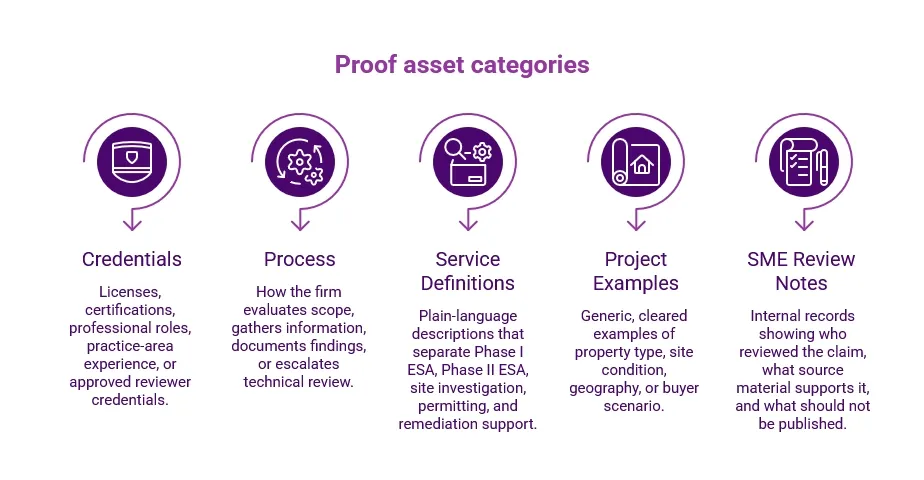
A proof asset does not have to be a massive case study. It only has to answer the buyer’s silent question: Why should this claim be believed?
For engineering service pages, useful proof assets often fall into five categories:
- Credentials and qualifications: licenses, certifications, professional roles, practice-area experience, or approved reviewer credentials.
- Process explanations: how the firm evaluates scope, gathers information, documents findings, or escalates technical review.
- Service definitions: plain-language descriptions that separate Phase I ESA, Phase II ESA, site investigation, permitting, and remediation support.
- Project-context examples: generic, cleared examples of property type, site condition, geography, or buyer scenario.
- SME review notes: internal records showing who reviewed the claim, what source material supports it, and what should not be published.
The strongest proof is not always the most dramatic. In technical markets, restrained proof often works better because it feels reviewable. A buyer does not need hype. The buyer needs confidence that the claim is specific, accurate, and tied to the service being evaluated.
Unsupported claims slow buyer trust
Unsupported claims create friction because they force buyers to fill in missing details. That is especially risky for small environmental and geotechnical firms, where technical staff may already be stretched thin.
A BD manager may want the page to generate proposal-quality inquiries. An environmental PM may worry that the wording overpromises. A marketing director may be trying to improve visibility without creating technical risk.
That is the real gap. The issue is not whether the page ranks, but whether it demonstrates the requisite service-line fit for a serious buyer.
A generic service page might say the firm provides “comprehensive environmental consulting.” Buyer-language proof is more precise. It connects the claim to scope, methodology, review, and context. That is the difference between broad marketing language and structured capability proof.
For related structure, BVM’s guide to technical content for ChatGPT and Perplexity citations explains how technical service pages can connect services, standards, and proof in clearer content blocks.
Use a Technical Claim Proof Table before publishing
A Technical Claim Proof Table gives marketing, PMs, SMEs, and BD a shared review tool before a claim goes live. It keeps the review focused on one practical question: what proof belongs beside this claim?
| Technical claim | Buyer doubt | Proof asset needed | Where the proof comes from | Reviewer | Publishing note |
|---|---|---|---|---|---|
| “We support Phase I ESA due diligence.” | Does the firm understand the expected scope? | Service definition, process summary, reviewed standards reference | Approved service documentation and SME notes | Environmental PM or practice lead | Avoid legal or regulatory advice. |
| “We help identify next-step investigation needs.” | Is this a technical judgment or a vague sales claim? | Generic workflow showing how findings are reviewed | Internal methodology summary | Senior technical reviewer | Keep examples generic unless cleared. |
| “We support lender-driven environmental review.” | Does the page speak to lender due diligence needs? | Buyer-context explanation and scope boundaries | BD input and approved technical language | BD manager plus SME | Do not imply guaranteed lender acceptance. |
The table should stay simple enough to use in a short review session. If a claim needs too much explanation to fit, that is a signal. The page may need a clearer service definition before it needs more copy.
This table also protects SMEs from becoming full-time writers. Marketing can draft the page. BD can check buyer usefulness. The SME can review accuracy, nuance, and risk. Each role does its part.
Place proof where buyers can use it
Proof loses strength when it is buried.
A credential hidden on an About page may not support a Phase II service claim. A project PDF may contain strong context, but it may not help if the buyer never opens it. A case study may show experience, but it should still connect to the exact service claim on the page.
Better structure puts proof near the decision point.
For example, a Phase I ESA section can include a short scope explanation, a reviewed note about process, and a link to a related resource. A page about environmental consulting proof assets can connect to broader environmental consulting proof and entity structure when the buyer needs more context.
Structured data can also support clarity for search systems. Google Search Central explains that structured data gives Google explicit clues about the meaning of a page and helps classify page content. That does not replace human-readable proof. It supports it.
Human readers still come first.
Build a lightweight SME review workflow
Small firms do not need a complicated publishing committee. They need a repeatable review path that respects technical judgment.
A practical workflow looks like this:
1. Marketing drafts the claim in plain language.
2. The PM or practice lead identifies what proof should support it.
3. The SME reviews accuracy, scope, and nuance.
4. BD checks whether the proof answers buyer doubts.
5. The publishing owner records the reviewer and source location.
This workflow is a general content-governance practice, not legal or engineering advice. The details will vary by firm, service line, and review requirements.
The key is ownership. Every proof asset should have someone responsible for accuracy before publication. That may be a PM, practice lead, senior consultant, or other qualified reviewer.
For firms building broader topic authority, Deep Content Architecture for engineering topical authority offers a related way to organize pages around services, entities, and buyer intent.
What not to publish without review
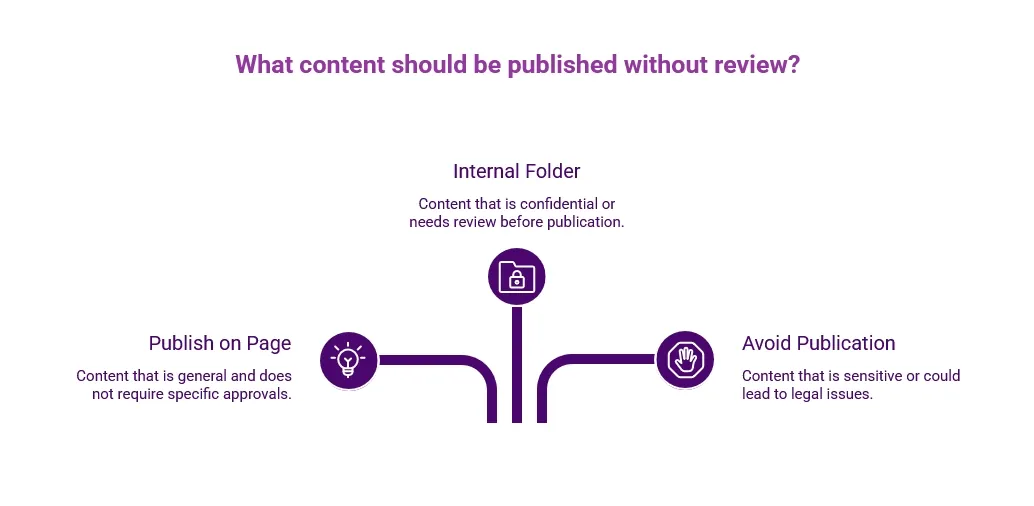
Some proof belongs on the page. Some proof belongs in an internal folder until it is cleared.
Do not publish confidential client names, private site conditions, report excerpts, financial details, proposal language, or client-provided content unless rights and approvals are confirmed. Do not invent credentials, project outcomes, regulatory status, or reviewer names. Do not imply that a marketing page can provide legal, engineering, environmental, ASTM, or lender advice.
Be especially careful with claims tied to standards or liability. ASTM E1527-21 describes the Phase I Environmental Site Assessment Process as an approach for assessing the environmental condition of commercial real estate, and ASTM also notes that professional judgment remains vital to the performance of All Appropriate Inquiries. That kind of context should be handled carefully and reviewed by qualified professionals before publication.
AI-search claims deserve the same restraint. A page can be structured to be easier for search and AI systems to understand. It should not promise AI citations, AI recommendations, rankings, RFQs, or shortlist inclusion.
Turn one claim into one proof-backed section
Start with one service page.
Choose a claim that matters commercially and carries some technical weight. “We support Phase I and Phase II due diligence” is a useful example because it attracts real buyer questions. Then map the claim to the buyer doubt, the proof needed, the source of that proof, and the reviewer.
One proof-backed section is better than a page full of unsupported confidence.
This is how invisible expertise becomes easier to evaluate. The page stops asking buyers to trust vague language. It gives them a technical shortlist map: claim, proof, context, review, and next step.
For a broader service-line view, BVM’s engineering services SEO page explains how technical capability, service-line fit, and buyer intent connect inside search strategy.
Frequently Asked Questions
Disclaimer:
This article is for general marketing and content strategy education only. It is not legal, engineering, environmental, or regulatory advice. Technical, environmental, ASTM, lender, and compliance-related claims should be reviewed by qualified professionals before publication.
About the BVM Insights Team
The BVM Insights Team is our dedicated engine for synthesizing complex topics into clear, helpful guides. While our content is thoroughly reviewed for clarity and accuracy, it is for informational purposes and should not replace professional advice.
Our expert team uses AI tools to help organize and structure initial drafts. Every piece is then extensively rewritten, fact-checked, and enriched with first-hand insights and experiences by expert humans on our Insights Team to ensure accuracy and clarity.