
 BVM Insights Team
The report looks healthy.
A BD manager stares at the traffic chart, then at the inquiry list, and the two do not line up. Visits are up. Rankings look cleaner. Yet the RFQs still feel vague, student-like, homeowner-focused, or outside the firm’s actual due-diligence work.
Broad engineering keywords are search terms that describe a service category without enough context to reveal buyer role, project scope, due-diligence need, or proof requirement. They can help a firm become more visible. They can also hide whether the searcher needs a Phase I ESA, Phase II ESA, lender due diligence, site assessment, remediation support, permitting guidance, or something far less commercial.
That distinction matters. Being found is not the same as being recognized as a fit.
Why Broad Engineering Keywords Can Look Successful and Still Miss the Buyer
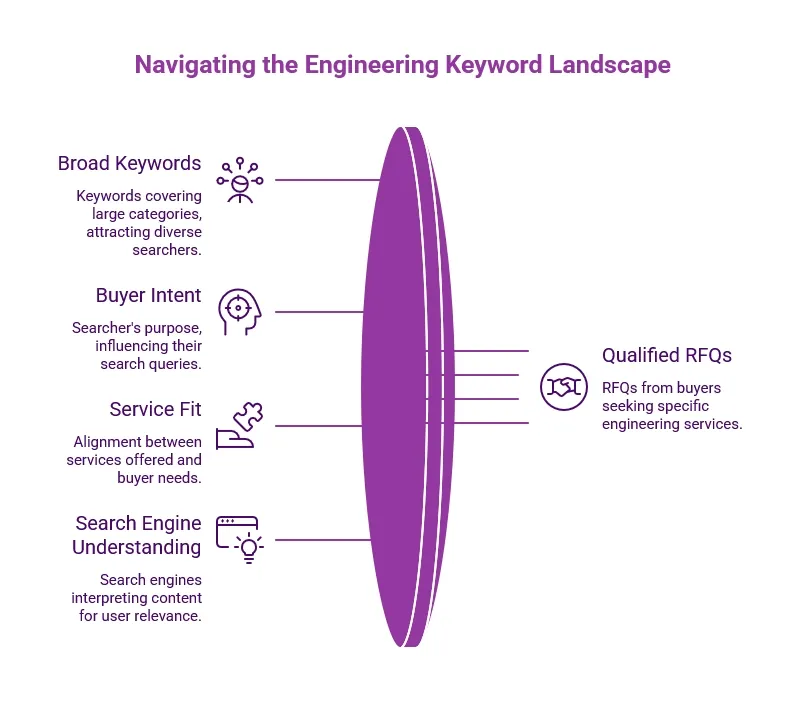
Broad engineering keywords feel safe because they cover a large category. “Environmental engineering,” “geotechnical services,” or “engineering consultant” may look valuable in a ranking report. They sound close to what the firm does.
The problem is that broad language does not explain the buyer’s situation. A searcher may be a student looking for a definition. A homeowner may be looking for residential advice. A vendor may be doing research. A commercial buyer may need a due-diligence partner for a specific property, lender requirement, site condition, or transaction timeline.
Search engines also need clear structure. Google’s own SEO guidance frames SEO as helping search engines understand content and helping users decide whether a result is useful. That general principle applies here: if the page does not make service-line fit clear, the search result may attract attention without attracting the right next step.
For environmental and geotechnical firms, the stronger question is not “Can this keyword bring traffic?” It is “Can this keyword help the right buyer understand technical fit before the shortlist forms?”
Myth: More Engineering Traffic Means Better RFQs
The myth is appealing. Traffic feels measurable. Rankings feel objective. Broad service terms look like they open more doors.
A broad engineering keyword strategy can obscure proposal-quality due diligence demand. It may increase visibility while weakening the connection between query, page, proof, and RFQ quality. The firm gets more activity, but BD still cannot explain which searches led to useful conversations.
Broad traffic is not automatically bad. It can support early discovery when the page is clear about who the service is for. The issue starts when broad terms become the main map. A generic service page may try to serve geotechnical investigation, environmental due diligence, remediation planning, permitting support, and general consulting at once. No single buyer sees the exact proof they need.
Reality: Qualified RFQs Depend on Buyer Intent, Service Fit, and Proof Need
A stronger keyword map starts with buyer intent. High-intent keyword mapping separates commercial due-diligence intent from weak-fit traffic by asking practical questions before a page is written.
Who is likely searching? What service line does the search connect to? What project context might be implied? What proof would a serious buyer need next? Can the search be routed to a page that makes technical fit clear?
Think of it as a technical shortlist map. A useful map does not simply say “engineering services.” It helps a buyer connect the firm to a specific need: Phase I ESA support for a commercial acquisition, Phase II investigation after a recognized concern, geotechnical review for a development site, or remediation planning tied to a known condition.
External standards and agency materials show why this specificity matters in the due-diligence world. The EPA describes All Appropriate Inquiries (AAI) as the process for evaluating a property's environmental conditions and assessing potential liability to qualify for certain landowner liability protections under CERCLA, and officially recognizes that the ASTM E1527-21 standard may be used to satisfy these statutory AAI requirements. ASTM describes E1527-21 as the standard practice for Phase I Environmental Site Assessments and emphasizes site-specific professional judgment.
Those references are not SEO instructions. They are reminders that due-diligence buyers often operate inside specific scopes, standards, and risk questions. Keyword mapping should reflect that specificity.
How Broad Engineering Keywords Hide Weak-Fit Inquiries
Broad keywords often fail in predictable ways. The term is too general to reveal whether the searcher has a commercial project. The receiving page covers too many service lines. The visitor needs education, not an engineering provider. The page lacks credentials, project context, or technical proof.
A keyword can rank well and still send the wrong people to your firm.
The same problem shows up in brochure language. “Full-service engineering support” may sound credible, but it does not match how a buyer describes a real need. A better search pattern might include due-diligence phase, site type, geography, lender context, permitting concern, or service-line fit.
This is where query-to-page mismatch weakens RFQ quality and reporting confidence. The report may show ranking movement, but the page does not help BD understand whether the inquiry belongs in a serious proposal conversation.
Broad Keyword Signals Versus Qualified RFQ Signals
| Broad Keyword Signal | Qualified RFQ Signal |
|---|---|
| General service-category phrase | Search includes project type, due-diligence phase, lender context, or service-line need |
| High visibility but vague intent | Clear connection to a buyer problem or technical scope |
| One page tries to cover many services | Search can be mapped to a specific service page or proof asset |
| Traffic increases but BD is unconvinced | Inquiry language matches proposal-quality conversations |
| Search term attracts non-commercial audiences | Search term suggests buyer role, project urgency, or proof requirement |
This table is a diagnostic tool, not a scoring formula. The specific answer may vary by firm, market, service mix, and available proof assets.
Wrong-RFQ Warning Signs Checklist
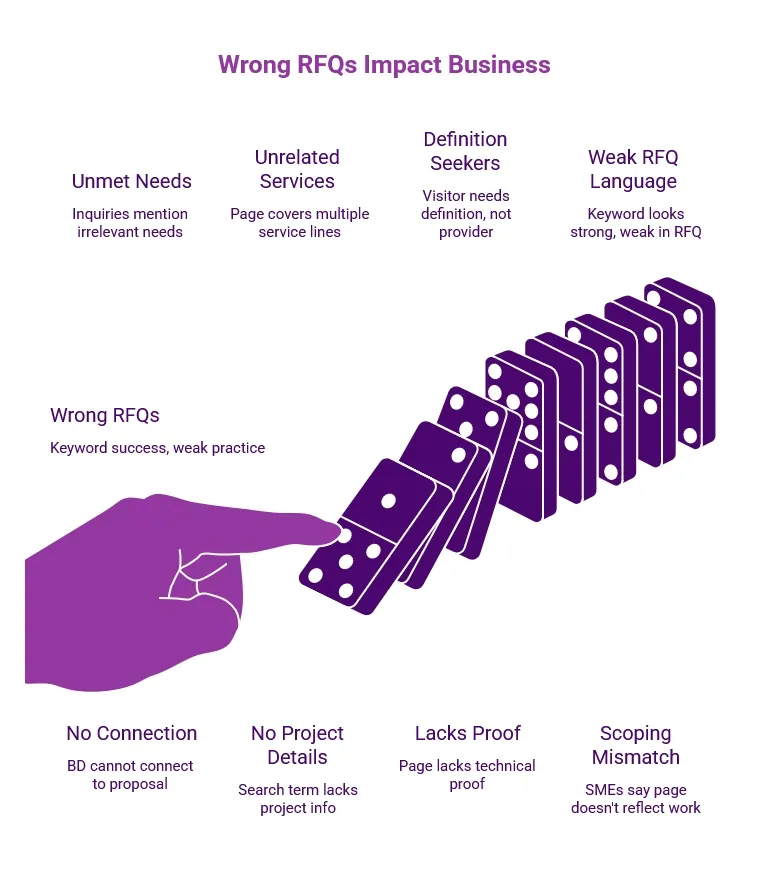
Use this checklist when a keyword looks successful in a report but weak in practice.
- The keyword ranks, but inquiries mention needs your firm does not serve.
- BD cannot connect the term to a serious proposal conversation.
- The page receiving traffic covers multiple unrelated service lines.
- The search term does not reveal project type, buyer role, or due-diligence phase.
- The visitor likely needs a definition, not an engineering services provider.
- The page lacks technical proof, project examples, credentials, or reviewable evidence.
- The keyword looks strong in a ranking report but weak in RFQ language.
- SMEs say the page does not reflect how the work is actually scoped.
One or two signs may simply indicate a page needs refinement. Several signs together often signal a deeper architecture problem.
Diagnosing the System When Keywords Are Not the Real Problem
Teams do not default to broad keywords because they are careless. They do it because time is tight.
BD cycles are short. Proposal deadlines arrive quickly. PMs have limited review time. Principals carry knowledge that rarely makes it into website copy. Under that pressure, broad keywords and generic service pages feel efficient.
The false fix is to publish more blogs or optimize more exact-match phrases. That can add volume without fixing the structure. If practice-area pages are too broad, proof assets are buried, and marketing, BD, and PMs do not share the same language for search quality, the site will keep attracting mixed-fit traffic.
BVM’s strategic framing treats qualified inquiry language, shortlist visibility, service-line fit, technical proof, and buyer intent as more useful diagnostic categories than raw traffic alone. That is a general marketing principle as much as an SEO principle: the measurement should match the business question.
What to Measure Instead of Broad Visibility
Use qualitative questions before adding more content:
- Does the keyword imply real service-line fit?
- Does the searcher seem likely to be a buyer, stakeholder, or internal researcher?
- Can the page answer the next serious buyer question?
- Is there proof available to support the page?
- Would BD recognize the resulting inquiry as useful?
- Can this term help the firm appear before a shortlist is built?
For AI search, the same structure matters. A vague engineering page may be harder for AI systems to connect to specific capabilities, project types, licensure or certification signals, geography, service contexts, and proof. That is a structural point, not a platform-performance claim.
Frequently Asked Questions
Resources for Building a Better Engineering SEO Map
For the next layer of diagnosis, read how search intent maps to engineering specs, review why category keywords fail commercial engineering SEO, and examine how organic pipeline reporting can lose commercial meaning.
For teams reviewing the broader structure of their site, BVM’s Engineering Services SEO overview provides additional context on capability-led search architecture.
The Takeaway: Search Quality Starts Before the Page Is Written
The traffic chart may still matter. It just cannot carry the full story.
Better RFQs begin upstream, when keyword mapping separates broad visibility from real buyer intent. The goal is not to chase every engineering term. The goal is to build a technical shortlist map that helps the right buyer see the right proof at the right moment.
Visible is useful. Recognized as a fit is better.
Our Editorial Process:
Our expert team uses AI tools to help organize and structure our initial drafts. Every piece is then extensively rewritten, fact-checked, and enriched with first-hand insights and experiences by expert humans on our Insights Team to ensure accuracy and clarity.
About the Brazos Valley Marketing Insights Team:
The BVM Insights Team is our dedicated engine for synthesizing complex topics into clear, helpful guides. While our content is thoroughly reviewed for clarity and accuracy, it is for informational purposes and should not replace professional advice.