
 BVM Insights Team
Budget review is in nine days.
The dashboard is open. Traffic looks solid, form submissions trickle in, and a handful of keyword rankings have improved since last quarter. But there's a question at the bottom of the agenda that no chart on screen can answer: Which of these searches actually moved a qualified buyer closer to a proposal?
Silence. That's the invisible trap.
If you run or market an environmental or geotechnical engineering firm, you already know the sales cycle doesn't close in weeks. It closes in six to twelve months — sometimes longer. The path from a prospective client's first technical search to a signed scope of work winds through capability reviews, shortlist decisions, and procurement approvals. Somewhere along that path, the connection between organic search activity and real commercial momentum gets lost.
What Organic Pipeline Velocity Actually Means in a Long-Cycle Sales Process
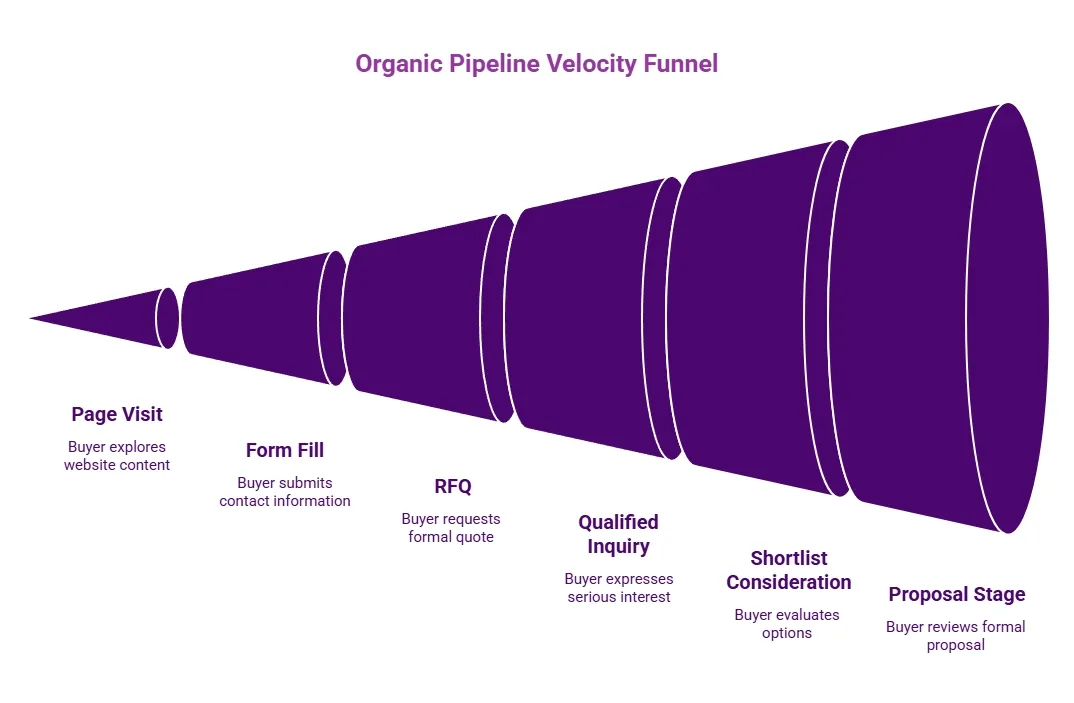
Organic Pipeline Velocity tracks whether organic search creates forward movement — from a technical search query to a meaningful commercial step. That step may be an RFQ, a qualified inquiry, shortlist consideration, or proposal-stage progress. The core idea is straightforward: presence in search is not the same as momentum in pipeline.
That distinction matters more in engineering than in many other sectors. Buyers in permitting, due diligence, remediation, and geotechnical work often research for weeks or months before making contact. They compare methods, qualifications, software familiarity, certifications, and regional relevance long before a formal opportunity appears. A page visit near the start of that journey may matter enormously. A form fill may not. A proposal later in the process may have started with a very specific technical search long before anyone on the sales team knew the account existed.
Without velocity as a lens, marketing reports activity. With it, marketing reports motion.
Why This Metric Stays Invisible on So Many Engineering Firm Dashboards
The gap isn't laziness. It's structural.
Standard marketing platforms track sessions, pageviews, and conversion events — but they are generally configured by default to define a "conversion" as a baseline lead-capture event, such as a form submission or phone call. In a typically estimated six-to-twelve-month engineering sales cycle, that form fill might be the first visible signal in a journey that started with an anonymous technical search months earlier. Everything before the form is dark. Everything after it lives in a CRM that doesn't talk to the marketing platform.
When marketing and CRM systems remain disconnected during long consideration cycles, velocity becomes invisible by default. You can see that someone visited your geotechnical drilling services page. You can't see whether that visitor became part of a shortlist review five months later.
A practical example makes this easier to see. One page may attract broad searches from students, job seekers, or low-fit prospects. Another page may attract fewer visits but consistently bring in buyers searching for a specific remediation method, compliance issue, or permitting challenge. If both pages are judged mainly by traffic volume, the wrong conclusion is easy to reach — and the page doing real commercial work gets deprioritized.
That is why Google Search Console's performance report and Google Analytics attribution guidance are useful support references. They help explain the difference between search visibility, touchpoints, and contribution. Still, the larger business principle is broader than any single platform: movement matters more than noise.
How Invisible Velocity Creates Bad Decisions Upstream
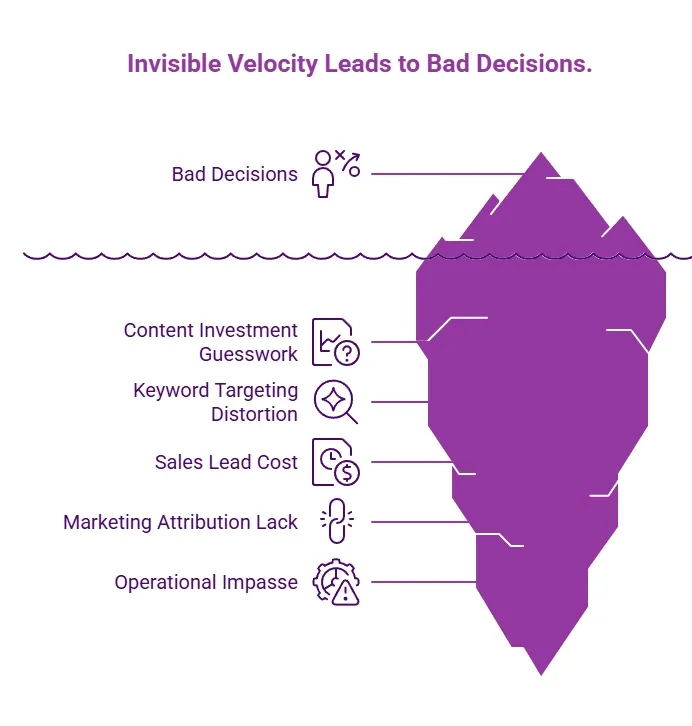
The damage spreads into operational decisions. When you can't see which topics move qualified buyers forward, every content investment becomes a guess. Should the firm publish more about RCRA corrective action or underground storage tank compliance? Without velocity data linking search topics to proposal-stage progression, the answer defaults to whichever keyword has the highest search volume — almost never the right criterion for a specialized engineering firm.
That distortion shows up in content strategy, keyword targeting, internal prioritization, and how success gets defined. A firm may continue publishing around generic category terms while underinvesting in method-specific, application-specific, or region-specific topics that better match how technical buyers actually search. That is one reason mapping permitting specs to search intent matters. Precision usually improves qualification. Broadness usually increases noise.
Meanwhile, sales absorbs the cost. Leads arrive from broad, non-specific searches. A principal spends 45 minutes on a discovery call only to learn the inquiry was for a service the firm doesn't offer in that region. Multiply that across a quarter.
Marketing lacks the attribution data to trace the lead's origin, while Sales relies on anecdotal disqualifications—leaving both teams at an operational impasse. That's the misalignment that moves beyond the form fill problem into genuine operational drag.
Where the Breakdown Usually Starts
Four root causes appear repeatedly. Broad keyword targeting without methodology-specific or regional precision attracts generic traffic that rarely converts into high-intent inquiries. Form-fill obsession bends every optimization toward volume instead of qualification. Disconnected CRM and marketing systems leave the gap between "searched" and "submitted a proposal" permanently dark — even though attribution models exist to bridge it. And most firms simply never map technical topics to pipeline movement, which is the foundation of velocity measurement.
What Healthy Organic Pipeline Velocity Looks Like
Healthy velocity doesn't mean fast closes. It means visible progression.
A firm with good organic pipeline velocity can trace a path from a specific technical query — "PFAS groundwater remediation consulting" — through a page visit, into an RFQ conversation, and toward a proposal. The chain won't always be clean. But it's visible. You know which technical topics and search terms bring the highest-quality inquiries. You can distinguish topics that attract early researchers from topics that attract buyers with active project needs.
In a strong system, that usually includes a few practical signals: technical queries tied to specific service-line or problem-type pages, pages that influence qualified RFQs rather than just raw inquiries, evidence that some topic clusters lead to stronger proposal-stage movement than others, and a way to distinguish stalling from progression over time.
Closed-loop reporting makes this possible by connecting the entire journey — from organic discovery through CRM pipeline stages — so every page and ranking has a measurable relationship to commercial outcomes.
The Minimum Signals Leadership Actually Needs
You don't need a perfect attribution system. You need a handful of signals: search queries with genuine technical specificity, page-level influence on RFQ quality, proposal-stage movement tied back to organic discovery, and signals that distinguish stalling opportunities from progressing ones. When you can show which SEO metrics connect to commercial pipeline impact, the internal conversation changes completely.
Budget defense becomes straightforward. Sales alignment improves. Content prioritization becomes data-driven. And the firm's dependence on vanity metrics — raw traffic, total impressions, keyword count — fades as everyone rallies around qualified commercial momentum.
Why Closed-Loop Reporting Changes the Internal Conversation
Closed-loop reporting gives marketing and revenue-side stakeholders a shared language. Without it, organic search is often treated as a vague awareness channel. With it, the team can start asking which topics create qualified movement, which pages support stronger commercial intent, and where sales-cycle drag is coming from.
That shift improves prioritization. It also reduces the dependence on vanity metrics that make reports look active but leave leaders unconvinced. This is the hidden commercial value of proposal pipeline measurement for engineering services SEO in long-cycle consulting firms. It doesn't just improve reporting hygiene. It improves decision quality.
A Better Next Step Than More Vanity Reporting
The danger of ignoring organic pipeline velocity isn't that marketing fails. It's that you can't tell whether it's succeeding.
Every quarter without velocity data is a quarter where leadership trust erodes, sales spends more hours on low-fit inquiries, content investment targets the wrong topics, and your real technical expertise stays invisible to the buyers who need it most. Not a dramatic failure — a slow, compounding loss of competitive positioning and internal confidence.
The cost of inaction, in practical terms: more reporting that looks busy but fails the credibility test, more low-fit demand entering long sales cycles, more difficulty proving which technical topics support real pipeline progress, and more internal doubt around organic strategy — even when the underlying opportunity is sound.
The fix isn't more dashboards. Track movement, not just presence. Connect technical queries and topic clusters to RFQ progression. Build closed-loop reporting that shows which content creates qualified commercial motion — and which just creates traffic.
For firms ready to stop reporting activity and start reporting momentum, BVM's approach to engineering services SEO is built around exactly this kind of visibility.
Our expert team uses AI tools to help organize and structure our initial drafts. Every piece is then extensively rewritten, fact-checked, and enriched with first-hand insights and experiences by expert humans on our Insights Team to ensure accuracy and clarity.
Our Editorial Process: Our expert team uses AI tools to help organize and structure our initial drafts. Every piece is then extensively rewritten, fact-checked, and enriched with first-hand insights and experiences by expert humans on our Insights Team to ensure accuracy and clarity.
About the BVM Insights Team: The BVM Insights Team translates technical SEO, search strategy, and AI-visibility concepts into practical guidance for growth-stage businesses. Every piece is reviewed for clarity, accuracy, and usefulness before publication.