
 BVM Insights Team
Your competitor just got named.
A prospect opened ChatGPT, typed a question about geotechnical remediation consulting, and three firms appeared in the synthesized answer. Yours was not one of them. No click happened. No website was visited. The shortlist formed inside a chat window — and your decades of subsurface expertise never entered the conversation.
We have the credentials. We have the project history. How are we not showing up?
That gap between what your firm knows and what AI systems can see is now a measurable business problem. Generative Engine Optimization (GEO) — structuring your firm's expertise so tools like ChatGPT and Perplexity can recognize, trust, and cite it — is what closes that gap. Think of it as placing your expertise directly into the training manuals of the world's most advanced AI assistants.
What "Missing Share of Voice" Means in AI-Assisted Research
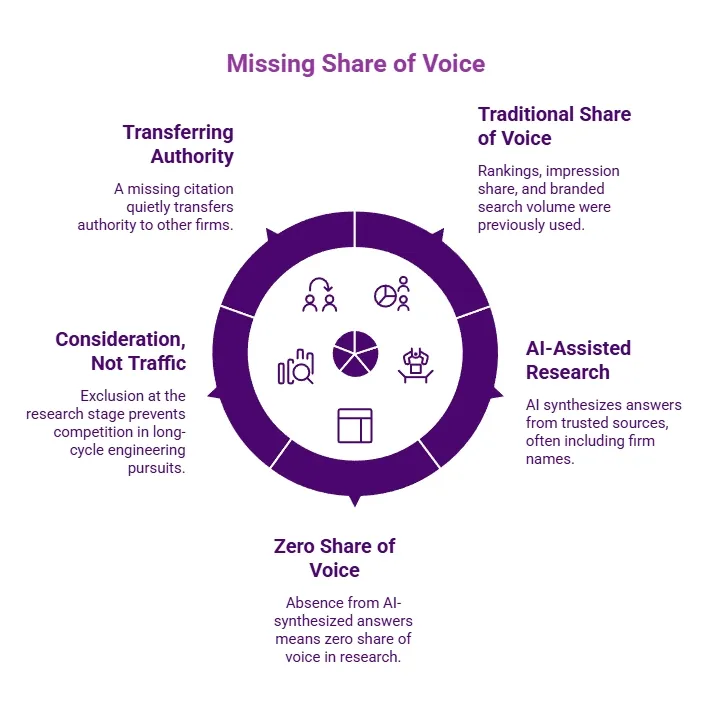
Share of voice used to mean rankings, impression share, branded search volume. A new layer has formed underneath.
When a project manager uses an AI tool to research environmental consulting capabilities, the AI synthesizes an answer from structured sources it trusts. That answer often includes firm names, methodologies, and capability summaries — delivered without a traditional results page. If your firm is absent from that synthesized answer, you have zero share of voice in the fastest-growing research channel technical buyers use. As Google's documentation on AI features confirms, modern search experiences increasingly include these AI-generated components.
This is not about traffic. It is about consideration. In long-cycle engineering pursuits where sales cycles typically stretch from several months to well over a year, getting excluded at the research stage means your team never gets the chance to compete.
A missing citation is not neutral. It quietly transfers authority elsewhere. For related context on this shift, see The Strategic Imperative of LLM Visibility Strategies for Technical Engineering Firms.
The Real Problem Starts Before Sales Ever Hears About It
Your Competitor Becomes the Cited Expert
Picture the moment. A prospect asks an AI: "Which environmental firms specialize in PFAS remediation for commercial due diligence?" The AI names two firms. One is your direct competitor. Your firm — the one that has handled dozens of these projects — doesn't appear.
That competitor didn't win a bid. They won the position of being cited as the expert before the conversation starts. The prospect carries that name into budget conversations and vendor shortlists. Your firm was never considered.
Nothing dramatic happens on the surface. No rejection email arrives. No prospect says they looked elsewhere. Yet the effect is real: the competitor becomes the visible expert in the moment that shapes first impressions. That is why this issue belongs in business-case discussions, not just marketing reviews.
Invisible Firms Don't Make the Same Shortlist
In traditional search, a firm on page two still existed in the buyer's awareness. AI-assisted research compresses that visibility window: while users can expand sources or request additional options, the primary synthesized response typically surfaces only a short, high-confidence shortlist. If the AI doesn’t name you in that initial output, you are unlikely to enter the buyer’s consideration set. For firms running trust-heavy commercial pursuits — remediation projects, permitting programs, due diligence engagements — this represents a pipeline risk, not merely a branding inconvenience.
Technical buyers often complete a large part of their research before contacting a vendor. In that environment, AI-assisted discovery changes who gets mentally grouped as credible options. Firms that appear in those answers gain an early advantage. Firms that do not appear are easier to overlook, even when their underlying expertise is strong. That broader consequence is closely related to The Cost of Invisible Expertise: Why Losing Commercial Bids Starts with Poor Engineering Firm Search Visibility.
The damage unfolds in a predictable sequence. A competitor becomes the default answer during early research. Internal stakeholders see web activity but not defensible visibility. Shortlists form around firms with clearer digital authority. Sales inherits weaker positioning later in the process — and rarely knows why.
If your firm is not cited by AI generative engines, you are excluded from modern technical vendor vetting — not because your expertise is lacking, but because it is invisible to the systems buyers now trust.
Why Traditional SEO Signals Are No Longer Enough
Ranking on Google still matters. But ranking on Google doesn't mean an AI assistant will cite your firm when a buyer asks a technical question.
A rank-first approach asks whether a page can appear for a target phrase. An AI-readable approach asks whether a system can interpret the firm as a credible answer to a specific question. That difference is significant — and it explains why firms with solid Google visibility can still be weak in AI-assisted research.
Traditional SEO focuses on keywords, backlinks, and domain authority — signals that help a page rank in a list of blue links. AI systems look for something different: entity relationships, structured connections between your firm, your specific capabilities, your credentials, and your proof assets. This is precisely why traditional tactics erase firms from AI searches.
A firm might rank well for "environmental consulting" on Google. But if the site uses broad category language and offers no structured evidence, the AI has nothing specific to cite. The shift is from keyword placement toward structured knowledge, explicit entities, and trustworthy proof architecture.
What Makes a Firm Legible to AI Systems
Three areas make the difference between AI-visible and AI-invisible.
Clear Service-Page Architecture
AI systems work better when capabilities are separated clearly. Pages that bundle six capabilities under one heading give AI nothing specific to reference. If one page tries to explain remediation, due diligence, permitting support, and geotechnical work all at once, the result is too broad to signal specific authority.
Each core capability deserves its own page with specific language and relevant credentials. Clear architecture gives each capability a defined place — and that helps both buyers and systems understand what the firm actually does.
Explicit Expertise Areas and Entity Relationships
Your firm's knowledge must be reflected as clear connections — firm name to specific methodologies, to regulatory frameworks, to project types. A firm becomes easier to cite when its services, expertise areas, project types, and credentials are connected coherently. This is how firms secure citations through knowledge graph optimization.
Proof Assets AI Can Interpret
Project summaries, case outcomes, and certifications must be structured visibly — not buried in PDFs or hidden behind vague labels. A firm with a published project outcome is more citable than one with a generic "Our Experience" paragraph. General claims about experience carry less weight than clearly described project work, defined specialties, and pages that connect expertise to real service contexts.
If a buyer cannot quickly understand why the firm is credible, an AI system will struggle too.
The Cost of Inaction if Your Competitors Become the Cited Experts
| Risk | What It Looks Like | Why It Matters |
|---|---|---|
| Competitor becomes the default expert | AI names a rival in response to your capability queries | Prospects carry that name — not yours — into budget discussions |
| Absent from AI-generated shortlists | Zero mentions in ChatGPT, Perplexity, or Google AI for your services | You never enter the consideration set |
| Leadership sees traffic, not defensible visibility | Analytics show visits but no evidence of AI citation | Marketing cannot demonstrate future-proof positioning |
| Broad pages hide real expertise | One page covers five service lines generically | AI cannot extract a specific, citable claim |
| Search behavior outpaces content structure | Buyers adopt AI research before your site adapts | The gap widens every month |
The invisible tax of ignoring Generative Engine Optimization is a steadily declining pipeline as search behavior evolves.
What to Do First if You Want AI to Recognize Your Firm
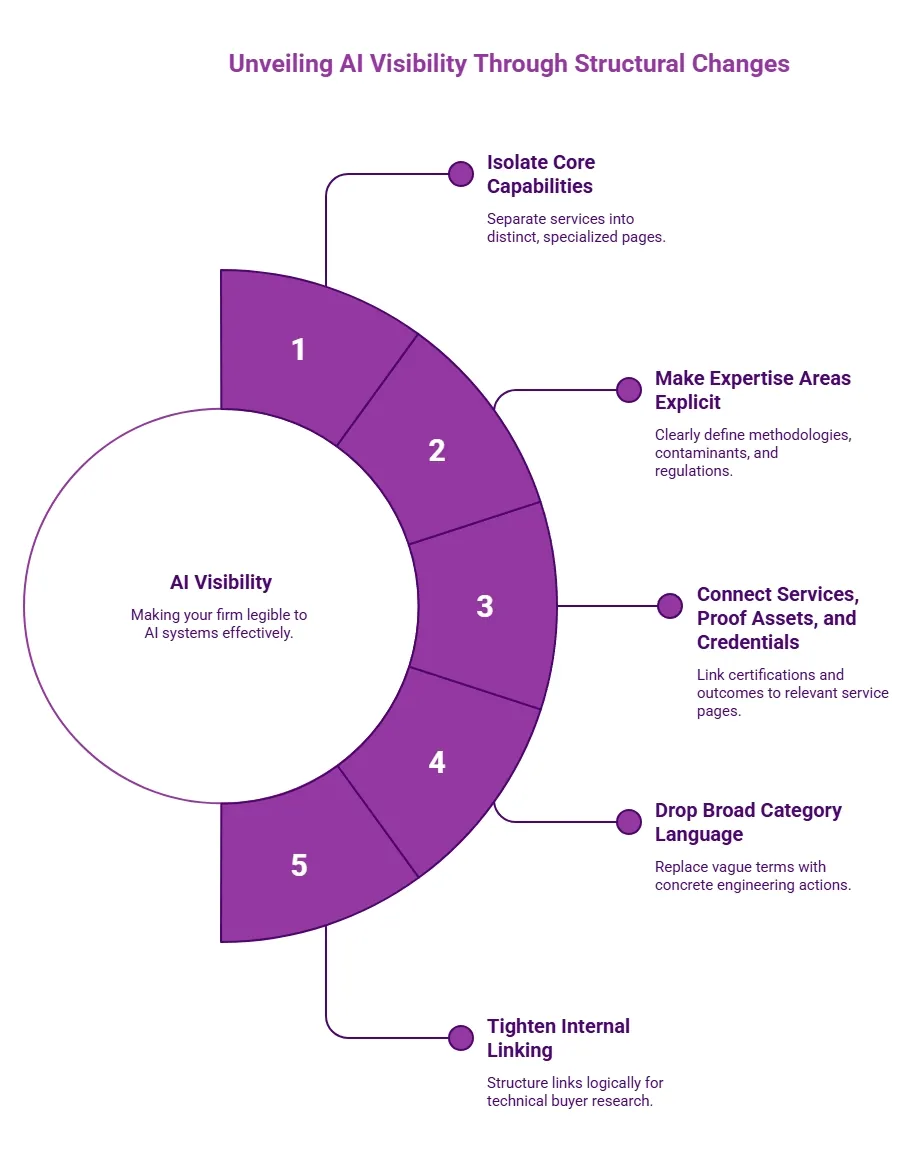
Start with structure, not volume. Five structural changes make existing expertise legible:
- Isolate core capabilities into distinct pages. Separate remediation, geotechnical, and compliance services so each has its own specific page.
- Make expertise areas explicit. Replace "environmental services" with the specific methodologies, contaminant types, and regulatory frameworks you actually work in.
- Connect services, proof assets, and credentials. Certifications and project outcomes should link to the service pages they support.
- Drop broad category language. "Comprehensive solutions" tells AI nothing citable. Describe what your engineers actually do.
- Tighten internal linking. Your site architecture should follow the logic a technical buyer uses during vendor research — not a flat brochure structure.
For a detailed walkthrough, preparing your firm for Generative Engine Optimization is the practical next step. Firms that need a broader service-level view can also explore Engineering Services SEO.
Your Visibility Is a Pipeline Decision
The scenario from the opening is happening right now across environmental consulting, geotechnical engineering, and every technical vertical where buyers research before they call. Your expertise is real. But if AI systems cannot find and cite it, the market behaves as if it doesn't exist.
If AI does not know your firm, your firm loses share of voice before the shortlist is ever formed. That is not a cosmetic SEO problem. It is a market-visibility problem.
Frequently Asked Questions
Our expert team uses AI tools to help organize and structure our initial drafts. Every piece is then extensively rewritten, fact-checked, and enriched with first-hand insights and experiences by expert humans on our Insights Team to ensure accuracy and clarity.
Our Editorial Process: Our expert team uses AI tools to help organize and structure our initial drafts. Every piece is then extensively rewritten, fact-checked, and enriched with first-hand insights and experiences by expert humans on our Insights Team to ensure accuracy and clarity.
About the BVM Insights Team: The BVM Insights Team turns complex AI-first SEO and technical search topics into clear, evidence-first guidance for growth-stage B2B firms. Every piece is reviewed for clarity, usefulness, and strategic accuracy before publication.