
 BVM Insights Team
Sort before you write.
The shared spreadsheet is open, and one column already mixes “Phase I ESA,” “Phase II ESA,” “lender due diligence,” “site assessment,” “environmental investigation,” and remediation-adjacent terms. The page draft has not started yet, but the mistake is already taking shape.
You know the firm needs clearer service pages. You also know the team has limited SME review time, a BD pipeline to support, and a leadership group that does not want another traffic report with no proposal-quality story behind it. Which page is this even for?
Before you write, separate the searches. Phase I and Phase II searches do not always represent the same buyer situation, service scope, proof need, or next step. A simple due-diligence search mapping worksheet can help you decide what page should exist, what proof belongs there, and who should review the page before it goes live.
Why Phase I and Phase II Search Buckets Must Stay Separate Before Page Drafting
A broad environmental due diligence page can look complete because it mentions every relevant term. That does not mean it answers the right buyer question.
Someone searching for Phase I ESA information may be trying to understand lender due diligence, transaction timing, report scope, or All Appropriate Inquiries context. The EPA’s All Appropriate Inquiries material is useful for terminology and due diligence context, but your service page still has to translate that context into clear buyer-facing service fit.
A Phase II search often signals a different situation. The buyer may be trying to understand investigation, sampling, technical confirmation, or follow-up after a Phase I finding. ASTM’s E1527-21 Phase I ESA standard and E1903-19 Phase II ESA standard can help distinguish terminology, but they should not be used to make SEO performance claims.
A page that blends those intents can feel vague to everyone who matters. The buyer cannot see the next step. The environmental PM may see missing scope boundaries. The BD manager cannot tell whether the inquiry fits the service line. AI systems may also struggle to identify which capability the page actually proves.
The better unit is not keyword volume alone. The better unit is buyer situation plus service scope plus proof need.
How to Build a Phase I/II Search Bucket Worksheet
Start with a worksheet before opening the page draft. Not after the draft is already bloated.
The worksheet does not need to be complex. It only needs to force the team to answer the questions that usually get skipped when keywords are grouped too broadly.
| Search Phrase | Phase or Scope | Buyer Situation | Property or Project Context | Service Fit | Proof Needed | Recommended Page Type | Owner or Reviewer | Tracking Field |
|---|---|---|---|---|---|---|---|---|
| Phase I environmental site assessment lender requirements | Phase I / lender due diligence | Buyer or lender trying to clarify requirements | Commercial property transaction | Phase I ESA / transaction support | Process clarity, qualifications, report scope | Phase I ESA service page or lender due diligence section | Environmental PM + BD | Service line / inquiry source / property type |
| Phase II environmental site investigation after Phase I | Phase II / follow-up investigation | Buyer trying to understand next steps after findings | Site-specific investigation | Phase II ESA or environmental site investigation | Scope boundaries, sampling context, technical process | Phase II ESA page or supporting explainer | Environmental PM | Phase II inquiry / project trigger |
| environmental due diligence for commercial property acquisition | Mixed due diligence | Developer, lender, or buyer assessing risk | Commercial acquisition | May require Phase I, Phase II, or advisory support | Service definitions and decision path | Parent due diligence page with links to specific services | Practice lead + BD | Buyer situation / page path |
These examples are illustrative. They are not client data, performance benchmarks, or universal lender workflows.
The point is simple: a broad phrase is not automatically a service-page target. If the proof need is different, the page plan may need to be different too.
Start With the Search Phrase, Not the Page
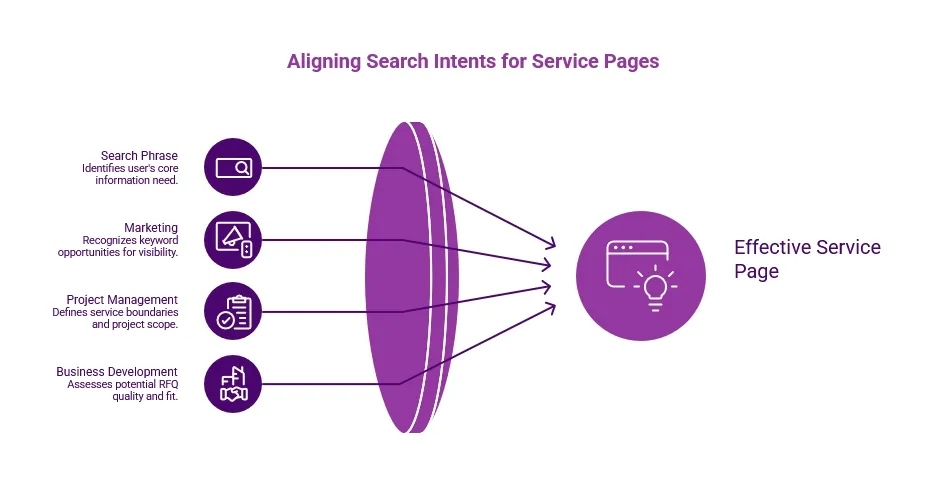
Ask one question first: what is this person trying to clarify?
That question slows the team down in the right place. A phrase like “Phase I ESA requirements” may need a page section that explains scope, process, environmental professional qualifications, and transaction relevance. A phrase like “Phase II environmental site assessment cost” may involve budgeting questions, but pricing can vary by site, scope, location, contaminants, and investigation needs.
Do not force both into one generic page just because they share environmental due diligence language. Technical search intent is more specific than the service category.
This is where marketing and PM review need to work together. Marketing may see a keyword opportunity. The PM sees service boundaries. BD sees whether the phrase could lead to a qualified RFQ or a weak-fit inquiry.
Sort by Scope, Buyer Role, Context, and Proof Need
Use four lenses before assigning the page.
First, sort by service scope. Is the search about Phase I ESA, Phase II ESA, lender due diligence, site assessment, environmental site investigation, remediation planning, or broader transaction support?
Second, sort by buyer role. A lender-driven search may need reassurance around due diligence expectations. A developer may need project timing and risk context. A property buyer may need a plain-English explanation of next steps.
Third, sort by property or project context. Commercial acquisitions, redevelopment sites, industrial properties, and post-finding investigations do not always need the same page structure.
Fourth, sort by proof need. Some searches need service definitions. Others need process explanation, credentials, report scope clarity, relevant project context, or safely publishable proof assets.
This is the difference between a keyword list and a technical shortlist map. The list says what people search. The map shows which page should answer, what proof belongs there, and who should validate it.
What to Do When a Search Phrase Fits More Than One Due Diligence Bucket
Ambiguous phrases are normal. They are not a failure of the worksheet.
When a search phrase could fit more than one bucket, do not solve it by stuffing every term into the same service page. Use decision rules.
- If the phrase implies a required service, assign it to the service page that best matches the scope.
- If the phrase implies education, assign it to a supporting explainer and link it to the relevant service page.
- If the phrase could attract weak-fit traffic, do not prioritize it simply because it has volume.
- If the phrase has technical or regulatory nuance, send it to an SME reviewer before drafting.
- If the proof need differs from the main page, consider a separate supporting page or section.
For example, “environmental site assessment” can be too broad by itself. It may point to Phase I education, Phase II investigation, or general due diligence. The worksheet should flag that ambiguity before a writer turns it into vague copy.
That small pause protects the page. It also protects SME time.
Run This Sorting Review Before You Write the Service Page
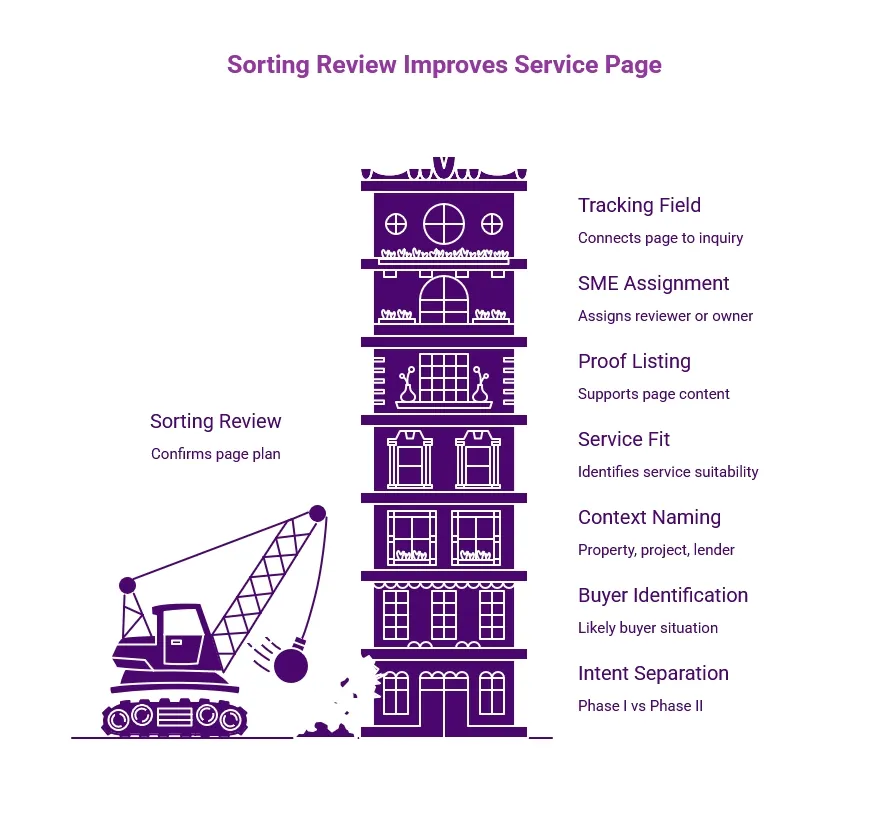
Before drafting, confirm that the page plan can answer seven questions:
1. Have you separated Phase I and Phase II intent instead of blending them?
2. Have you identified the likely buyer situation?
3. Have you named the property, project, or lender context where relevant?
4. Have you identified the service fit?
5. Have you listed the proof needed to support the page?
6. Have you assigned an SME reviewer or owner?
7. Have you defined a tracking field that can connect the page to inquiry quality later?
The tracking field matters. A page should not stop at rankings or broad traffic. For engineering services SEO, better reporting connects search behavior to service-line fit, shortlist visibility, qualified RFQs, and proposal-quality inquiries where that information is available.
BVM’s resource on mapping search intent to engineering specs goes deeper into this qualification logic. For teams dealing with broad keyword pressure, the related discussion of exact-match keyword traps is also useful.
When It Is Not a Phase I or Phase II Keyword Problem
Sometimes the keyword list is not the real issue.
The problem may be practice-area architecture. One page may be trying to serve environmental due diligence, geotechnical investigation, remediation, compliance support, and lender-facing education at the same time.
The problem may be buried proof. A firm may have strong project experience, but the website hides that proof in PDFs, proposal language, or internal folders that buyers and AI systems cannot easily interpret.
The problem may be page ownership. If no one knows whether a phrase belongs to a Phase I ESA page, a Phase II ESA page, a parent due diligence page, or a supporting article, the site can create overlap and confusion.
The problem may be reporting. Organic search data may show traffic while BD still cannot tell which searches contributed to useful conversations.
For broader page-planning context, BVM’s resource on engineering service page architecture can help teams think beyond isolated keywords and toward a clearer service-line structure.
Resources
If your team is planning Phase I, Phase II, or broader due diligence content, start with the worksheet. Then use these resources to refine the next layer:
A shared spreadsheet can either become another place where broad terms pile up, or it can become the first draft of a better service-page strategy. Sort the search. Name the buyer situation. Match the proof to the page.
Clear scope. Better fit. Less rework.
Disclaimer:
This article is for educational SEO and content strategy purposes only. It is not legal, engineering, environmental consulting, or regulatory compliance advice. Phase I ESA, Phase II ESA, All Appropriate Inquiries, ASTM standards, lender due diligence, and site investigation requirements should be interpreted with help from qualified environmental professionals, legal counsel, and the applicable standards or regulatory authorities.
Editorial Process:
Our content is developed through a structured editorial process that combines source review, audience-intent analysis, practical SEO strategy, and human editorial oversight. We prioritize clear explanations, evidence-backed claims, and practical guidance that helps readers make better content and search visibility decisions. When a topic involves technical, legal, financial, medical, regulatory, or other specialized subject matter, readers should verify details with qualified professionals before acting on the information.
About the BVM Insights Team
Brazos Valley Marketing is an AI-powered SEO and content strategy agency focused on helping technical, professional, and service-driven businesses turn expertise into search-visible authority. BVM’s approach emphasizes high-intent keyword mapping, deep content architecture, AI-readable proof, and practical SEO strategy that connects visibility to qualified business opportunities.