The Pipeline Advantage of Spec-Level SEO Mapping for Enterprise Engineering Firms
Last Updated: 1 February 2026 • 12 min read
📌 Key Takeaways
Matching your website structure to how buyers actually search brings better leads, not just more traffic.
- Generic Keywords Attract the Wrong People: Broad terms like "environmental engineering services" pull in students, competitors, and mismatched projects—wasting your sales team's time on calls that go nowhere.
- Organize Around How Buyers Think: Enterprise buyers search by specific methods, regulations, and problems—so your site should separate services into distinct sections that match these precise needs.
- Better Fit Means Shorter Sales Cycles: When visitors find pages that speak directly to their exact technical problem, they arrive with clearer expectations and need less convincing.
- This Is Pipeline Quality, Not Just SEO: The goal shifts from counting website visits to tracking qualified conversations—changing how marketing proves its value internally.
- Structure Comes Before AI Optimization: Getting found by AI search tools only works after your site clearly defines what you do, where you work, and what credentials you hold.
Websites that filter demand before sales calls save engineering hours and build internal trust.
Marketing directors and practice leads at engineering firms will find a clear framework for explaining this shift to skeptical technical teams, preparing them for the implementation details that follow.
~ ~ ~ ~ ~ ~ ~ ~ ~ ~ ~ ~ ~ ~ ~ ~ ~ ~
Spec-level SEO mapping improves pipeline quality for enterprise engineering firms by aligning site structure and content to the exact technical, methodological, and compliance terms serious buyers use before outreach. Instead of generating broad traffic, it helps the right service pages attract better-fit commercial conversations—transforming search from a volume game into a strategic filter for qualified RFQs.
Generic SEO often creates motion without clarity for engineering firms. Rankings may rise, sessions may increase, and reporting may look active, yet the commercial outcome still feels wrong. Industry research indicates that enterprise engineering buyers typically do not search like casual researchers. B2B procurement data suggests they generally search by practice area, methodology, application, compliance requirement, certification, and problem context. When site architecture ignores that reality, marketing metrics detach from commercial reality.
Why Generic Engineering SEO Creates the Wrong Pipeline
The quarterly marketing review tells a frustrating story. Traffic is up. Form submissions are steady. But the sales team keeps flagging the same problem: most inquiries don't match what the firm actually does.
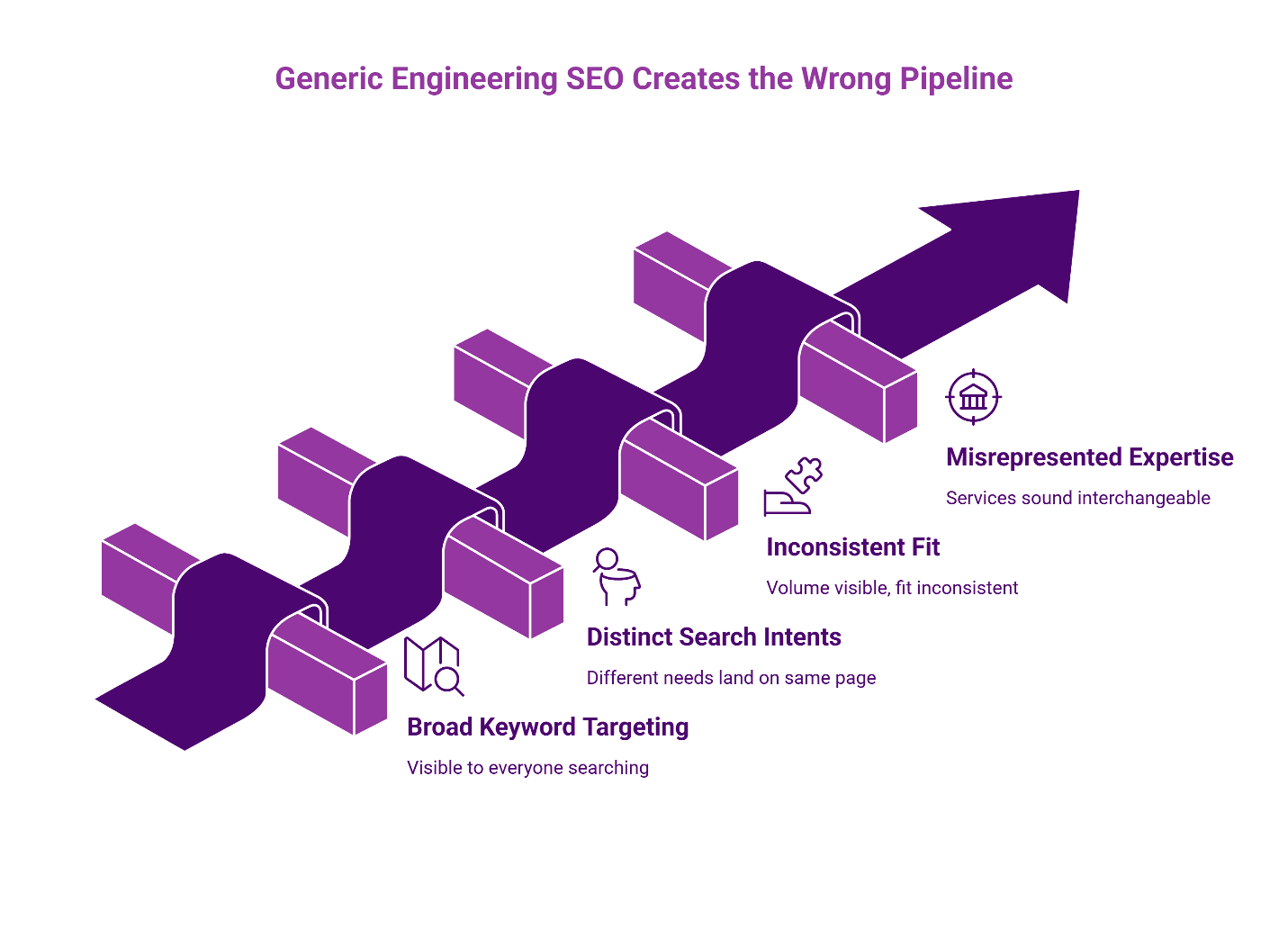
This is the predictable failure mode of generic engineering SEO. When site architecture targets broad terms like "environmental engineering services" or "geotechnical consulting," the firm becomes visible to everyone searching those phrases—including students, competitors researching the market, and buyers whose projects fall outside the firm's core capabilities.
The result is what practitioners call "traffic without pipeline." Sessions increase, but qualified commercial conversations do not. Technical staff spend time on discovery calls that go nowhere. Marketing loses credibility internally because volume metrics fail to translate into the conversations that actually matter.
The root cause is structural. Generic keyword targeting treats all engineering services as interchangeable. But enterprise buyers searching for PFAS remediation consulting have fundamentally different needs than those searching for Phase I ESA services or slope stability analysis. When those distinct intents land on the same generic page, conversion quality suffers.
This confusion creates two internal problems at once. Marketing leadership struggles to defend the quality of search-sourced demand because the volume may be visible, but the fit is inconsistent. Technical leaders lose trust because the website does not reflect the real structure of the firm's expertise. Services start sounding interchangeable, terminology gets generalized, and specialized teams feel misrepresented.
What Better Pipeline Quality Actually Looks Like
Better pipeline quality does not mean more traffic. It means more of the right visitors arrive with clearer expectations, stronger intent, and a better match to the firm's actual service lines.
When spec-level mapping is in place, the inquiries that reach sales carry more context. Buyers arrive having already seen content that reflects the firm's actual methodologies and compliance expertise. They reference specific service capabilities in their initial outreach. The first conversation starts further down the path toward a real project.
For marketing directors, this changes the success metric from sessions to qualified pipeline influence. For technical directors and practice leads, it means fewer calls that waste engineering bandwidth and more conversations with buyers who understand what they are asking for.
The firm's online presence begins functioning as an intelligent qualification system—routing highly-qualified commercial intent to the appropriate technical leads before a discovery call is ever scheduled.

Broad Keyword Targeting
Spec-Level SEO Mapping
Attracts mixed-intent visits
Attracts buyers with clearer technical intent
Relies on category-level language
Uses methodology, application, and compliance language
Sends multiple intents to the same page
Matches distinct intents to distinct pages
Makes traffic the main success story
Makes fit, clarity, and conversation quality the main success story
Encourages generic content
Encourages engineer-level specificity and trust signals
How Spec-Level SEO Mapping Changes Search-to-Pipeline Fit
The mechanism is architectural. Spec-level mapping restructures site hierarchy around distinct practice areas, then maps content within each area to specific technical intents. Instead of treating the website like a flat brochure, it treats the site as a structured decision environment.
The Practice-Area Foundation
Instead of a single "Services" page carrying all commercial burden, the site separates geotechnical engineering, environmental remediation, and compliance consulting into distinct practice-area silos. Each silo becomes its own topical hub with dedicated pages for specific methodologies, applications, and regulatory contexts.
This separation matters because enterprise engineering buyers search with precision. A project manager evaluating remediation firms for a PFAS liability searches differently than one scoping a standard Phase II assessment. When site architecture mirrors these distinctions, the right content surfaces for the right intent.
A simple architecture often follows this pattern:
Practice area
Service
Application or problem
Compliance or methodology
That structure matters because enterprise buyers do not evaluate firms in one step. They move through layered questions: Does this firm work in my problem domain? Do they offer the exact capability I need? Do they understand the compliance or methodological context? Do they show the credentials, technical rigor, and specificity that reduce risk?
What "Spec-Level" Actually Means
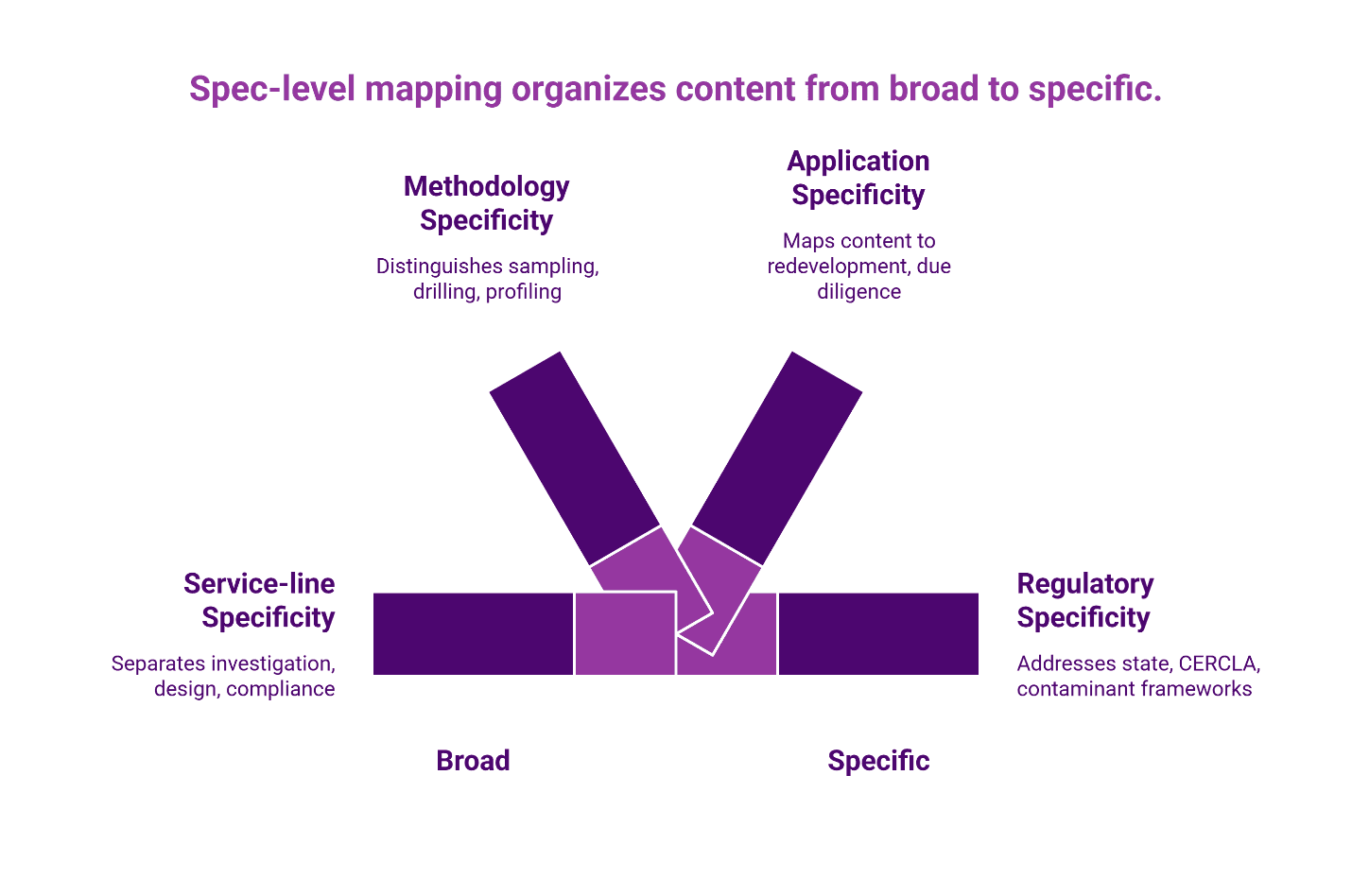
Spec-level mapping goes deeper than service categories. It organizes content around four dimensions:
Service-line specificity: Separating subsurface investigation from remediation design from regulatory compliance support
Methodology specificity: Distinguishing direct-push sampling from hollow-stem auger drilling from CPT profiling
Application specificity: Mapping content to use cases like brownfield redevelopment, due diligence support, or litigation consulting
Regulatory specificity: Addressing state program requirements, CERCLA obligations, or emerging contaminant frameworks
This granularity reflects how enterprise buyers actually research. Engineers and project managers search tolerances, certifications, and compliance frameworks—not broad category terms.

How This Changes Sales Conversations
When architecture aligns with buyer intent, the sales conversation shifts. Buyers who found the firm through a specific remediation methodology page arrive with clearer expectations. They have already seen the credentials that matter to their project. The qualification process shortens because the content has already done preliminary filtering.
According to the BVM framework, this is where spec-level mapping delivers its strategic value: it predictably attracts enterprise buyers actively seeking specific solutions rather than casting a wide net and hoping the right buyers happen to surface.
Why Practice-Area Silos Matter in Environmental and Geotechnical Engineering
Consider the practical consequences of flattening distinct practice areas into generic pages.
A firm with deep PFAS remediation expertise might rank for "environmental engineering services." But that page must now serve everyone searching that phrase—including buyers looking for wetland delineation, air quality permitting, or services the firm does not prioritize. The page becomes too general to convert the high-value remediation buyer and too unfocused to demonstrate the technical depth serious prospects require.
Practice-area silos solve this by ensuring each category of intent has a dedicated home. The geotechnical practice area carries geotechnical commercial burden. The remediation practice area speaks directly to remediation buyers. Neither dilutes the other.
Take a PFAS-related remediation query. That buyer is not looking for a generic geotechnical overview. They are usually signaling a specific commercial need: a contamination problem, a regulatory context, a treatment pathway, a site condition, or a remediation partner with relevant methodology. If that query lands on a broad drilling, soil testing, or general geotechnical page, the page may attract the click, but it will not support the next step in the buying process.
That mismatch creates three losses at once. The buyer gets less confidence. The technical team gets a weaker lead conversation. And marketing gets blamed for attracting the wrong demand.
Practice-area silos give each area the space to reflect its own language, applications, and proof points. They also create room for the trust signals that technical buyers actually care about: visible credentials, certifications, methodology detail, software expertise, regulatory familiarity, and evidence that the firm understands the working context—not just the keyword category.
Dimension
Generic Approach
Spec-Level Mapped Approach
Pipeline Consequence
Keyword targeting
Broad category terms
Methodology and compliance-specific phrases
Higher-intent visitors
Page architecture
Flat service list
Practice-area silos with application-specific pages
Better search-to-service alignment
Technical credibility
Generic capability claims
Visible certifications, methodologies, and project types
Stronger technical trust
Lead quality
Mixed intent, high filtering burden
Pre-qualified by content alignment
More productive conversations
Stakeholder alignment
Marketing owns traffic metrics
Shared pipeline quality metrics
Reduced internal skepticism
How to Explain the Strategic Shift Internally
Marketing leaders often face skepticism when proposing architectural changes. Technical directors worry about oversimplification. Practice leads question whether marketing understands the nuances that matter commercially. The shift sounds like "SEO work" on the surface, but its real value is operational.
Stakeholder
What They Need to Hear
Why It Matters
Marketing Director
"This is fit-and-clarity work, not just traffic work."
It protects the team from vanity-metric reporting.
Technical Director
"We are restructuring around how buyers search, not flattening how services actually differ."
It preserves technical accuracy and service differentiation.
Practice Lead
"The goal is fewer wasted conversations and better-fit inquiries."
It connects architecture to day-to-day commercial burden.
Executive Team
"This improves how demand is filtered before sales and technical resources engage."
It turns SEO from a cost center narrative into a pipeline-quality narrative.
Three phrases often help bridge internal conversations:
We are restructuring around how buyers search, not how the org chart happens to look.
The goal is not more visitors. The goal is more relevant technical conversations.
The website becomes digital infrastructure—a capital asset that filters and qualifies demand—rather than a brochure that generates undifferentiated leads.
Where GEO Fits After the Architecture Is in Place
Generative Engine Optimization becomes relevant once practice-area architecture establishes clear entity relationships. AI systems that summarize and cite sources rely heavily on structured content—while also parsing unstructured semantic text—to unambiguously define what a firm does, where it operates, and what credentials it holds.
Spec-level mapping creates the foundation for this visibility. When content is organized around distinct practice areas with explicit methodology and compliance specificity, AI systems can accurately represent the firm's capabilities in generated responses.
GEO is the second step, not the first. If your practice areas are blurred, your service taxonomy is weak, and your pages do not clearly express applications, methodologies, and credentials, then AI visibility will inherit the same confusion. Machine-readable signals do not fix unclear architecture; they amplify whatever structure already exists.
Once the site has clear internal linking, distinct service pathways, and consistent entity language, additional layers such as structured data, knowledge graph alignment, and AI-readable formatting become more valuable. For teams exploring that next step, Google's SEO Starter Guide, guidance on crawlable links, and introduction to structured data, along with the Schema.org Organization vocabulary, provide useful technical references.
Next Reading
For deeper exploration of the concepts covered here:
Engineering Services SEO
Part/Spec/Application Intent Mapping: The Secret to Capturing Engineering Buyers
Why 'Bad Leads' Are Killing Your Sales Team's Morale
The Invisible Expert Syndrome
Digital Infrastructure: Treating Your Website as a Capital Asset
Stop Marketing Fluff: How to Use Governance Workflows to Prevent Intent Drift
Beyond the Form Fill: Engineering a Lead Generation System That Delivers Qualified RFQs
For additional brand context, see About BVM and Brazos Valley Marketing on LinkedIn.
This content is for informational purposes and reflects general principles of technical SEO architecture. Specific implementation should account for your firm's unique service mix, competitive landscape, and business objectives.
Our Editorial Process:
Our expert team uses AI tools to help organize and structure our initial drafts. Every piece is then extensively rewritten, fact-checked, and enriched with first-hand insights and experiences by expert humans on our Insights Team to ensure accuracy and clarity.
By: The BVM Insights Team

About the Author
Dustin Ogle
Dustin Ogle is the Founder and Head of Strategy at Brazos Valley Marketing. With over 9 years of experience as an SEO agency founder, he specializes in developing the advanced AI-driven strategies required to succeed in the new era of search.