
 BVM Insights Team
- UTMs Solve Last-Click Attribution Only: Standardized UTM parameters (utm_source=gbp, utm_medium=local, utm_campaign=[community]) capture direct click-throughs from Google Business Profile to booking, but they don't track multi-touch journeys where prospects see the map pack, later search the brand name, and then convert.
- Speed-to-Response Determines Conversion: Map-pack leads - direction requests, calls from the profile - represent prospects physically near the model center or actively comparing options, requiring 5-minute response times for calls and 15-minute response for forms to prevent competitive displacement.
- Shared CRM Statuses Create Attribution Visibility: A universal status progression (Inquiry → Tour Booked → Tour Held → Design-Center Appointment → Contract) enables both teams to trace how GBP impressions flow through the pipeline and identify exactly where conversion stalls.
- Profile Conflation Kills Proximity Rankings: Multiple communities sharing similar business names, phone numbers, or categories cause search engines to treat them as duplicate entities rather than distinct locations, preventing each community from ranking independently for its relevant affluent ZIP codes.
- Weekly KPI Loops Surface Bottlenecks Before They Cost Pipeline: Comparing GBP impressions and profile actions against CRM tour bookings and holds every Monday reveals whether issues stem from landing page friction, sales follow-up delays, or traffic quality problems.
Visibility becomes revenue when marketing's map-pack signals connect directly to sales' booking workflows.
Luxury homebuilder marketing and sales teams will find the operational framework here, preparing them for the detailed 7-step workflow and dashboard specifications that follow.
Now that your communities are showing up for affluent ZIP and city searches, let's connect those map-pack signals to a sales workflow that books tours on schedule.
Sales-marketing alignment for tours represents the systematic coordination between visibility metrics (map-pack impressions, direction requests, profile clicks) and conversion outcomes (booked appointments, tours held, design-center visits). In local search, visibility lives in the Map Pack and Google Business Profile; victory is a booked, held tour at the model center.
Think of marketing as the site superintendent for demand - responsible for making sure the “jobsite” (profiles, pages, and paths) is clearly marked and easy to navigate. Sales is the crew that turns that prepared site into a finished home, guiding visitors through, answering questions, and getting signatures on the final plans. When marketing and sales work from different blueprints, foot traffic appears, wanders, and leaves. When they share the same spec, more prospects become homeowners.
Consider a common scenario: A prospective buyer searches “luxury homes near [Neighborhood]” on their mobile device. Your community's Google Business Profile appears in the local pack. They tap “Directions,” drive to the model center, and call from the parking lot. Without proper instrumentation, marketing sees the impression and click. Sales takes the call and books the tour. But neither team can trace the full path from search visibility to booked appointment, making it difficult to attribute marketing's impact on pipeline or optimize the handoff for better conversion rates.
The practical application of this framework is a seven-step operational workflow that standardizes how marketing's local visibility metrics flow into sales' booking and pipeline systems. This ensures every map-pack signal - whether it's a direction request, phone call, or website click - connects to a trackable CRM status and ultimately to revenue outcomes.
Why Visibility Isn't Victory Without a Tour Handoff
Distinct location profiles per community prevent profile conflation. Unique Name-Address-Phone (NAP) data and category assignments separate proximity signals across affluent ZIP codes, ensuring each community ranks independently for its relevant geo-modified searches.
The fundamental misalignment stems from tracking different metrics. Marketing typically monitors leading indicators: map-pack impressions, direction requests, calls initiated from the profile, and website clicks. These measure visibility and initial engagement. Sales, however, focuses on lagging indicators: tours booked, tours held, design-center appointments scheduled, and ultimately contracts signed. These measure conversion and revenue.
Leading indicators are proactive signals that suggest what is likely to happen if nothing changes; lagging indicators are the outcomes already realized. In sales performance frameworks, leading indicators surface potential pipeline issues early, while lagging indicators measure the revenue impact of past decisions. This distinction forms the foundation of modern sales management methodology.
Without a unified framework, three persistent problems emerge:
The Attribution Gap: Marketing invests resources to improve local pack rankings for “[City] luxury homes” and drives measurable increases in profile actions. Sales receives more inquiries and books more tours. However, neither team can definitively connect a specific map-pack impression to a specific booked tour, making it difficult to prove marketing's contribution to pipeline or identify which communities need optimization.
The standard UTM tracking approach addresses last-click attribution - capturing the direct path from map-pack click to website landing to form submission. This solves the immediate visibility problem: when someone clicks “Website” from the Google Business Profile and books a tour in the same session, that conversion can be traced. But it doesn't capture multi-touch scenarios. A prospect might see the community's map listing on Monday, search the builder's brand name directly on Wednesday, and book a tour Friday. The map pack influenced the decision, but the UTM framework attributes the conversion to direct/branded traffic. This limitation doesn't invalidate the workflow - it simply means attribution should be interpreted as directional rather than absolute.
The Handoff Delay: A prospect taps “Call” from your Google Business Profile at 2:47 PM on a Tuesday. The call routes to a general line, gets transferred twice, and finally reaches a sales representative 11 minutes later. By that time, the prospect has already called a competitor. Speed-to-response directly correlates with booking rates, but without service-level agreements tied to map-pack lead sources, response times remain inconsistent.
The Optimization Blindspot: Marketing increases map-pack visibility by 40% for a specific community. Profile actions (clicks, calls, directions) increase proportionally. However, booked tours remain flat. Without visibility into which actions convert to appointments, marketing cannot determine whether the issue is traffic quality, page experience, booking friction, or sales follow-up.
The solution requires connecting marketing's visibility metrics to sales' booking outcomes through shared data infrastructure. This means instrumenting every touchpoint from map pack to CRM with consistent tracking parameters, establishing clear handoff protocols with measurable SLAs, and creating a unified dashboard that surfaces the full conversion path from impression to contract.
When properly implemented, this alignment transforms how both teams operate. Marketing can demonstrate direct pipeline contribution by showing how local visibility improvements drive booked appointments. Sales can provide feedback on lead quality by geography, enabling marketing to refine targeting. Leadership gains a unified view of the entire customer acquisition funnel, from initial local search to signed contract, making resource allocation decisions more data-driven.
The 7-Step Map Pack → Booking Workflow
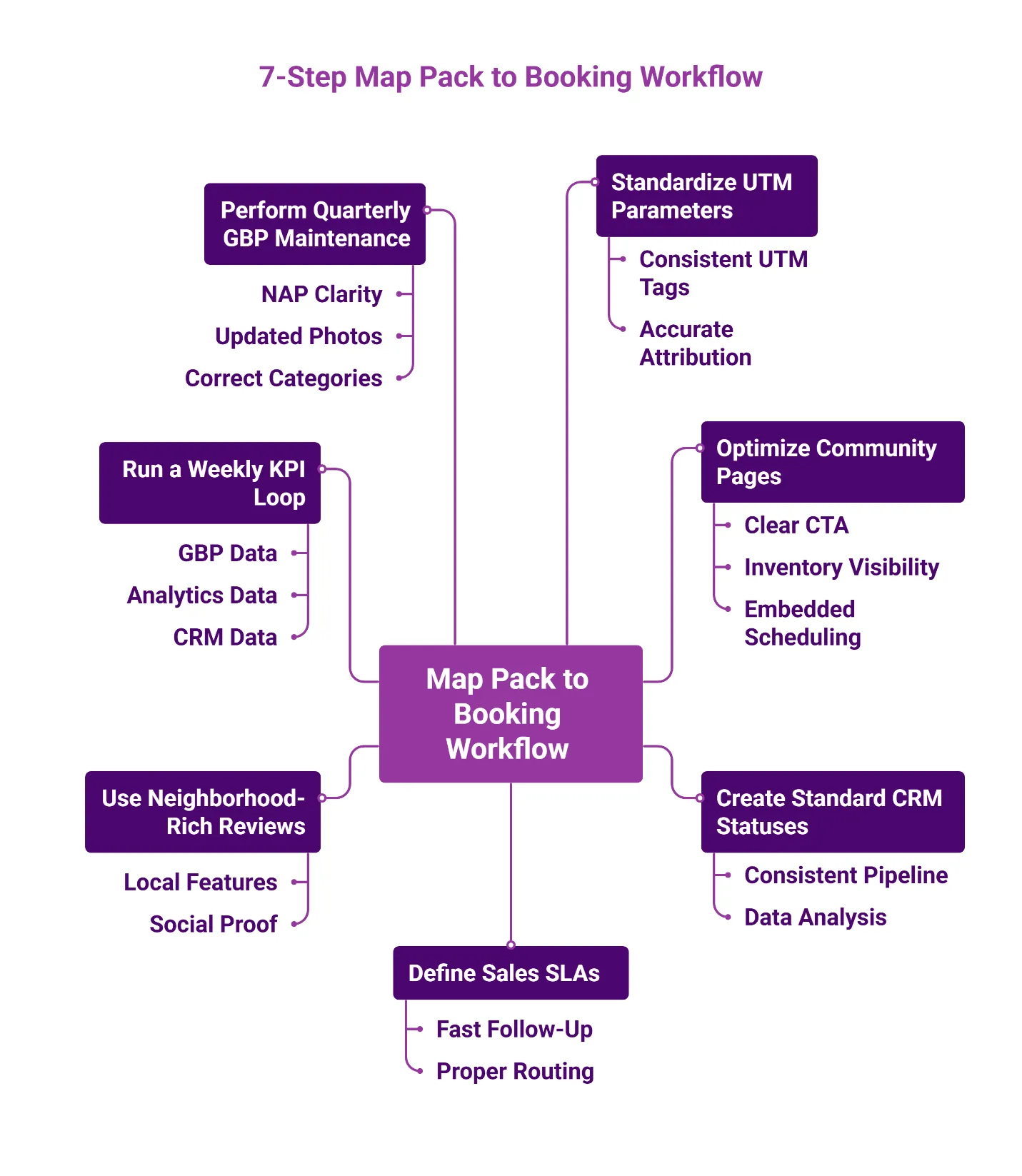
This systematic framework operationalizes the handoff between marketing's local visibility efforts and sales' tour booking process. Each step builds on the previous one to create a traceable path from map-pack impression to booked appointment.
Step 1: Standardize UTM Parameters on Every GBP Link
Every clickable element in your Google Business Profile - the Website button, Appointment link, and Menu/Services URLs - must include consistent UTM tracking parameters. The standardized format is:
- utm_source=gbp
- utm_medium=local
- utm_campaign=[community-name]
For example: https://yourdomain.com/communities/riverside-estates?utm_source=gbp&utm_medium=local&utm_campaign=riverside-estates
This tagging structure ensures that when a prospect clicks through from your profile, their session in Google Analytics is properly attributed to the specific community's local presence. Google's platform documentation confirms that utm_source, utm_medium, and utm_campaign parameters can be used to attribute website traffic to specific campaigns and sources when set on URLs.[1] Without these parameters, GBP traffic appears as direct or referral traffic, making it indistinguishable from other sources and impossible to connect to downstream booking behavior.
Use community-specific campaigns - one per community - so marketing and sales can compare “GBP → [Community]” performance across locations. Mirror the campaign name in the CRM campaign or tracking field, so traffic and opportunities can be reconciled.
Step 2: Instrument Community Pages for Tour Conversion
Each community landing page must be optimized for the tour booking action. At minimum, this includes:
- A prominent, above-the-fold call-to-action: “Book a Tour at [Community]” with clear availability indicators
- Available inventory widgets showing current home status (available, under construction, sold)
- Embedded appointment scheduling that pre-populates the community name and passes UTM data to the CRM
- Event and special promotion hooks that align with posts published in the GBP
The page must serve two functions: educate prospects on community features and amenities, and convert qualified visitors to booked tours with minimal friction. Treat each community page as a “Perfect Page” for local intent - aligning with your Perfect Page Blueprint framework ensures consistent on-page optimization.
Consider implementing event tracking (via GA4 tags) to measure tour form starts and completions, clicks to call from mobile, and clicks to the appointment scheduler. This granular data helps identify exactly where prospects drop off in the booking process.
Step 3: Define Standardized CRM Statuses
Establish a universal status progression that both marketing and sales teams understand and use consistently:
- Inquiry - Initial contact made (form, call, chat)
- Tour Booked - Appointment scheduled with confirmed date/time
- Tour Held - Prospect attended the scheduled appointment
- Design-Center Appointment Booked - Next-stage consultation scheduled
- Appointment Held - Design consultation completed
- Contract - Purchase agreement signed
Each status transition should trigger automated notifications to relevant team members and update reporting dashboards. This creates a shared language for pipeline movement and enables attribution analysis connecting initial source (map pack) to final outcome (contract).
These statuses should be visible to both marketing and sales so weekly pipeline reviews can track how local leads progress. Map the statuses to GA4/UTM data wherever possible via campaign fields, source/medium fields, or opportunity-level attributes. Create standard fields for lead source (“GBP - [Community]”) and first touch UTM so analytics can be reconciled with the CRM later.
The specific CRM field names and automations will vary by platform (Salesforce, HubSpot, industry CRMs), but the status sequence above provides a conceptual spec that Sales Ops can translate into native picklists and workflows.
Step 4: Establish Service-Level Agreements
Define explicit expectations for sales response to map-pack leads:
- Speed-to-Response: Initial contact within 5 minutes for calls, 15 minutes for form submissions during business hours
- Call Handling Protocol: Direct routing to community-specific sales representatives; no more than one transfer
- No-Show Contingency: Automated follow-up sequence when scheduled tour is missed; attempt to reschedule within 24 hours
- Documentation Requirement: All prospect interactions logged in CRM with notes on next steps
These SLAs create accountability and ensure that marketing's investment in local visibility translates to consistent sales follow-through. Response times should be measured in minutes during business hours, particularly for calls and contact forms that originate from “near me” or ZIP-based local searches. Treat Map Pack leads as “hotline” leads - someone close enough to request directions is significantly further along than a general web visitor.
Define “business hours” and “week” boundaries in the operating time zone (for example, Monday-Sunday in your local time zone) so reporting remains consistent. After-hours behavior should be clearly specified: call routing, voicemail handling, and next-business-day follow-up protocols.
Step 5: Leverage Neighborhood-Rich Reviews
Encourage satisfied homeowners to mention specific neighborhood and amenity details in their reviews: “We love being minutes from [Neighborhood] and having access to the resort-style pool and fitness center.” Then surface these reviews prominently on community pages.
Reviews containing geo-specific and amenity-specific terms serve dual purposes. They strengthen topical authority for location-modified searches, and they provide social proof that addresses common buyer questions about lifestyle and location benefits. Neighborhood content clusters increase topical authority for geo-modified terms by demonstrating deep contextual relevance to search engines.
Use micro-templates in post-tour follow-ups: “If you'd like, mention what you thought about the commute from [Neighborhood] or nearby amenities in [City].” Display a small carousel of location-rich testimonials near the “Book a Tour at [Community]” CTA to reassure prospects that others like them chose the same route.
Step 6: Run a Weekly KPI Loop
Every Monday, pull the previous week's data across three systems:
- From Google Business Profile: Impressions, direction requests, calls, website clicks (by community). Google Business Profile's Performance reporting provides views, calls, direction requests, and website clicks at the profile level.[2]
- From Web Analytics: Sessions with utm_source=gbp, goal completions (tour booking form submissions), pages per session. Use GA4's acquisition reports to isolate utm_source=gbp traffic and tour events.[3]
- From CRM: New inquiries, tours booked, tours held, progression to design-center appointments
Compare these metrics to identify conversion bottlenecks. For example, if [Community A] shows 250 profile clicks but only 3 booked tours, while [Community B] shows 180 clicks and 12 booked tours, investigate [Community A]'s landing page experience, booking friction, or sales follow-up process.
Annotate CRM records with notes on performance patterns: “Tour scheduled from GBP mobile search - arrived 10 minutes early, highly engaged.” Use a recurring meeting or asynchronous dashboard review where marketing owns top-of-funnel GBP and web data, and sales owns CRM pipeline data and qualitative feedback about tour quality, fit, and no-show reasons.
If Map Pack impressions and direction requests are rising but Tour Booked remains flat, focus on landing-page clarity and SLA adherence. If community sessions and “Book a Tour” clicks are strong but tours held are weak, review scheduler friction, reminder flows, and no-show pipeline automation.
Step 7: Quarterly Profile Maintenance
Every 90 days, conduct a comprehensive audit:
- Fix Profile Conflation: Ensure each community has a distinct GBP with unique NAP data, not shared listings that blur proximity signals
- Refresh Visual Content: Update photos to reflect current model availability, seasonal amenities, completed construction phases
- Verify Operational Details: Confirm hours, phone numbers, special hours for holidays
- Re-validate Categories: Ensure primary and secondary business categories accurately reflect community type
- Quality-Assurance UTMs: Click through every link to confirm tracking parameters remain intact and properly formatted
This maintenance prevents data quality decay that undermines attribution accuracy over time. Use this tune-up to spot cannibalization: are certain affluent ZIP searches consistently surfacing the wrong community? If so, adjust routing rules and profile content. Document changes so the impact on leading and lagging indicators can be measured in subsequent quarters.
Routing Rules That Stop Brand Cannibalization
When multiple communities compete for the same affluent ZIP code searches, improper profile structure creates internal competition that confuses prospects and dilutes each community's ranking potential.
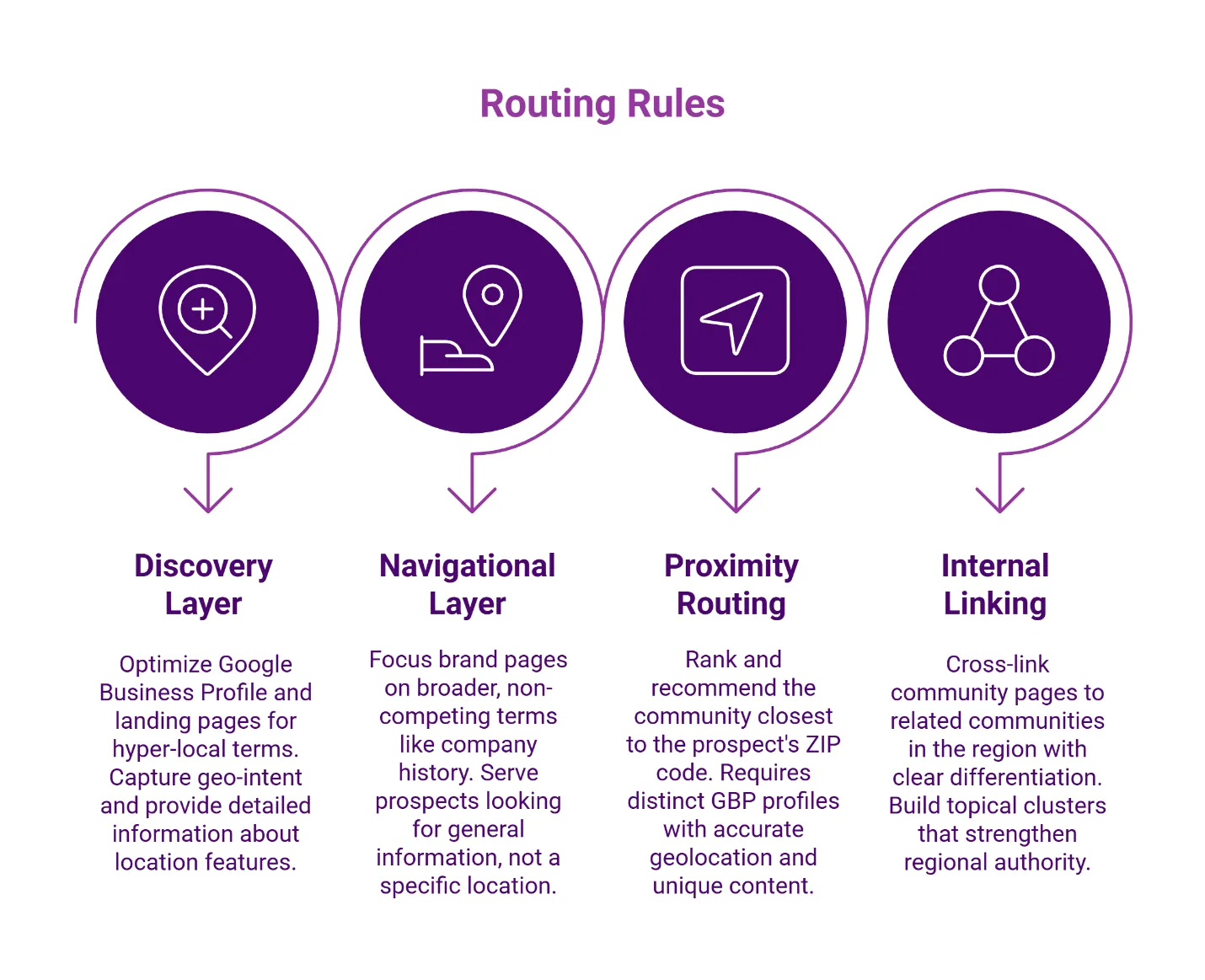
The principle is straightforward: Use neighborhood and ZIP-level content for discovery; route to the closest relevant community page; keep brand pages navigational. This means:
Discovery Layer (GBP + Community Pages): Each community's Google Business Profile and landing page should be optimized for hyper-local terms: “[Neighborhood] new homes,” “luxury homes in [ZIP],” “[City] master-planned community.” These pages capture geo-intent and provide detailed information about that specific location's features, available inventory, and amenities.
Navigational Layer (Brand Pages): Corporate or regional brand pages should focus on broader, non-competing terms: company history, builder philosophy, portfolio overview, corporate contact information. These pages serve prospects who already know the brand name and are looking for general information, not shopping for a specific location. Brand pages and the main GBP listing should serve prospects who search “[Builder Name]”, “[Builder Name] [City]”, or “[Builder Name] reviews”.
Proximity Routing Logic: When a prospect searches from a specific ZIP code, the community closest to that ZIP should rank and be recommended. This requires distinct GBP profiles with accurate geolocation and unique content that prevents conflation. Avoid creating a single profile for “All [City] Communities” that tries to rank for every local search. Search engines interpret this as a single entity and cannot properly surface it for varied proximity queries.
For queries with geo-modifiers (for example, “near [ZIP]”), route clicks to the closest relevant community page, not a generic brand page. This can be implemented as internal logic in location finders (“closest community to [ZIP]”) or clear suggestions on brand pages: “Looking near [ZIP]? Start at [Community] first.”
Internal Linking Strategy: Community pages should cross-link to related communities in the region (“Explore other [City] neighborhoods”) but always with clear differentiation. This builds topical clusters that strengthen regional authority without creating ambiguous signals about which location is most relevant for a specific search. Align routing and content patterns with your Deep Content Architecture framework to keep search engines and visitors from getting mixed signals.
When a new community opens near an affluent ZIP, update GBP categories and descriptions for both the brand and communities, plus Schema and internal linking so the new community is clearly positioned as the primary option for that ZIP.
When properly structured, this routing framework ensures that every geo-modified search surfaces the most relevant community, the prospect lands on a page optimized for their specific location interest, and the booking action is clearly defined, creating a frictionless path from discovery to appointment.
Dashboard Spec - From Visibility to Booked Tours
A unified reporting framework must surface the complete conversion path from initial map-pack impression to signed contract. The following KPI structure creates accountability and enables both teams to identify optimization opportunities.
Leading Indicators (Marketing-Owned)
- Map Pack Impressions: Total views of your GBP in local search results (by community)
Owner: Marketing Ops
Cadence: Weekly
Source: Google Business Profile Insights
Notes: Segment by search type (discovery vs. direct) to understand brand awareness vs. local shopping behavior - Map Actions: Directions, calls, website clicks: Engagement with GBP elements
Owner: Marketing Ops
Cadence: Weekly
Source: Google Business Profile Insights
Notes: Calculate action rate (actions/impressions) to measure profile effectiveness - Sessions from GBP: Website traffic attributed to utm_source=gbp
Owner: Marketing Ops
Cadence: Weekly
Source: Google Analytics 4
Notes: Track landing page distribution to ensure clicks reach intended community pages
Middle-Funnel Indicators (Shared Ownership)
- Tour Booking CTA interactions: Form submissions or scheduler interactions
Owner: Marketing Ops + Sales Ops
Cadence: Weekly
Source: Google Analytics 4 events + Appointment scheduler API
Notes: Measures page conversion effectiveness; compare across communities - Inquiries Created: New lead records in CRM attributed to GBP source
Owner: Sales Ops
Cadence: Weekly
Source: CRM (filtered by utm_source)
Notes: First touchpoint where sales gains visibility; critical handoff metric
Lagging Indicators (Sales-Owned)
- Tours Booked: CRM status = “Tour Booked”
Owner: Sales Ops
Cadence: Weekly
Source: CRM pipeline report
Notes: Measures sales follow-through on marketing-generated inquiries - Tours Held: CRM status = “Tour Held”
Owner: Sales Ops
Cadence: Monthly
Source: CRM pipeline report
Notes: Calculate show rate (tours held / tours booked) to identify no-show patterns - Design-Center Appointments: CRM status = “Design-Center Appointment Booked” or “Held”
Owner: Sales Ops
Cadence: Monthly
Source: CRM pipeline report
Notes: Indicates progression beyond initial tour to serious consideration - Contracts: CRM status = “Contract”
Owner: Sales Ops
Cadence: Quarterly
Source: CRM closed deals report
Notes: Ultimate conversion metric; calculate time-to-close from initial GBP source
This laddered structure - leading indicators predicting middle-funnel engagement predicting lagging indicators - enables proactive optimization. If map actions increase but inquiries remain flat, investigate landing page experience. If inquiries increase but tours booked remain flat, investigate sales response times and SLA adherence.
For teams implementing this dashboard, treat the 7-step workflow as HowTo structured data with each step clearly labeled, and mark the FAQ section as FAQPage schema. Maintain consistent entity naming (community, builder brand, Google Business Profile) so any future retrieval or AI-powered search can interpret sections without ambiguity.
Frequently Asked Questions
Make Tours the Spec That Aligns Every Trade
The parallel to construction is precise. A site superintendent doesn't measure success by lumber deliveries or electrical rough-ins. The measure is substantial completion, the moment when all trades' work integrates into a finished, inspectable structure. Similarly, marketing's map-pack impressions and sales' initial inquiry calls are necessary phases, but the meaningful milestone is the booked and held tour, where visibility converts to genuine purchase consideration.
This seven-step framework - standardized UTMs, instrumented pages, shared CRM statuses, agreed SLAs, review leverage, weekly loops, and quarterly maintenance - creates the operational cadence for that conversion. When marketing and sales share a tours-first blueprint, Map Pack visibility is no longer a vanity metric; it becomes the upstream indicator of how many qualified households will walk through a model center in a given week.
One adjacent consideration beyond this framework's scope: how to extend these principles to broker and realtor partnerships when co-marketing luxury communities. The same attribution logic applies, but the data handoff points involve third-party CRM systems and MLS feeds, requiring additional integration planning.
Looking forward, mature implementation of this alignment framework enables two expansion strategies. First, systematically replicating the workflow across every community in the portfolio creates benchmarking opportunities - identify which locations convert visibility to appointments most efficiently, then reverse-engineer their practices for broader application. Second, layering event-based sprints onto the steady-state workflow - grand opening weekends, seasonal promotions, inventory clearance events - requires intensified coordination between marketing's amplified local visibility tactics and sales' capacity planning for tour volume surges, but the underlying handoff mechanics remain identical.
The tour is the milestone where potential becomes measurable progress. Making it the specification that governs both marketing's visibility work and sales' conversion work transforms local SEO from a technical exercise into a revenue operation.
Ready to connect your map-pack visibility to booked appointments? Book a Tour-First KPI Review to build your customized handoff framework, or explore how our Deep Content Architecture approach and Perfect Page Blueprint methodology support local visibility and conversion optimization.
For additional insights on aligning marketing strategy with revenue outcomes, visit our Resources library.
References
[1]: Google Analytics Help - Collect campaign data with custom URLs
[2]: Google Business Profile Help - Get started with Performance reporting in Business Profile
[3]: Google Analytics Help - Traffic acquisition report
[4]: Google Analytics Help - Collect campaign data with custom URLs
[5]: Google Business Profile Help - Tips to improve your local ranking on Google
Our Editorial Process: Our expert team uses AI tools to help organize and structure our initial drafts. Every piece is then extensively rewritten, fact-checked, and enriched with first-hand insights and experiences by expert humans on our Insights Team to ensure accuracy and clarity.
About the Brazos Valley Marketing Insights Team: The Brazos Valley Marketing Insights Team is our dedicated engine for synthesizing complex topics into clear, helpful guides. While our content is thoroughly reviewed for clarity and accuracy, it is for informational purposes and should not replace professional advice.