
Part/Spec/Application Intent Mapping: The Secret to Capturing Engineering Buyers
Last Updated: 2 February 2026 • 12 min read
📌 Key Takeaways
Engineers search with tolerances, standards, and part numbers - not broad category terms - so your content architecture must match their fit-validation mindset.
- Three Intent Buckets Drive Discovery: Part searches use identifiers, spec searches combine technical requirements, and application searches seek use-case proof - each needs distinct page types.
- Proof Assets Validate Fit Fast: Datasheets, CAD files, certifications, and test reports let engineers confirm compatibility in minutes rather than forcing them to dig or click away.
- Start Small to Prove the Method: Mapping 5–10 high-priority SKUs first demonstrates ROI before expanding systematically across your catalog.
- Governance Prevents Intent Drift: Technical specificity erodes when marketing rewrites remove standards language and precise tolerances - quarterly SME reviews catch this before qualified inquiries drop.
- Measure Fit Signals, Not Traffic: Datasheet downloads, spec-table engagement, and sales feedback on inquiry quality reveal whether you're attracting buyers with purchase authority.
Structure your pages around how engineers actually search, and RFQs follow.
Technical marketing managers at industrial manufacturers will gain a systematic framework for capturing engineering buyers, setting up the mapping workflow that follows.
Friday, 4:55 PM. An engineer types "±0.0005 tolerance" and "ASTM" into a search bar. They can't risk a material mismatch - the spec review meeting is Monday morning.
This is how engineers actually search. Not "industrial components" or "precision parts." They search with tolerances, standards, certifications, and part numbers because they need to validate fit before they can even consider a supplier.
And here's the disconnect: your site probably targets broad category terms while engineers are searching with surgical precision. The result? You rank for researchers and students instead of buyers with purchase authority and urgent technical requirements.
This gap between how manufacturers market and how engineers search is the root cause of the "vanity metric trap" - traffic that looks good in reports but generates unqualified inquiries that waste your sales team's time.
The solution is a systematic approach called Part/Spec/Application Intent Mapping. It restructures your keyword research and content architecture around the three specific ways engineering buyers actually search.
Why Engineers Don't Search Like Shoppers
The Fit-Validation Mindset
Engineers aren't browsing. They're de-risking a specification decision that could shut down a production line, delay a project, or create a liability.
When a procurement specialist searches "316L stainless steel tubing 0.5 OD seamless ASTM A269," they're not gathering general information. They're building a shortlist of suppliers who can prove - with documentation - that they meet exact requirements.
This mindset drives search behavior that looks nothing like consumer searches:
- Part number searches to find exact replacements or equivalents
- Specification searches combining material, tolerance, standard, and certification requirements
- Application searches to confirm a component works in their specific environment or use case
Each search type signals a different stage of validation and requires different proof on your pages.
The Visibility Failure Mode
Broad category pages can't prove fit fast. When your product page targets "industrial valves" but an engineer searches "API 6D ball valve 4 inch 150 class," your generic page - if it ranks at all - makes them work to find whether you're a match.
Engineers won't dig. They'll click back and try the next result.
The failure compounds because traditional keyword research tools prioritize search volume over technical specificity. They'll suggest "industrial valves" (high volume, impossible to rank, wrong intent) over "API 6D ball valve class 150" (lower volume, achievable ranking, buyer intent).
Sourcing platforms like GlobalSpec/Engineering360 exist precisely because engineers need structured, spec-driven search environments. Your site must emulate this structural logic.
What Is Part/Spec/Application Intent Mapping?
Part/Spec/Application Intent Mapping is a keyword and site-structure method that groups searches into three buckets - part identifiers, technical specifications, and real-world applications - so engineering buyers land on pages that prove fit quickly with spec tables, standards references, drawings, and use-case context.
In practice, this means:
- Part intent queries land on pages with clear identifiers, compatibility notes, and downloadable assets
- Spec intent queries land on pages with specification tables, standards references, and certification documentation
- Application intent queries land on pages with use-case context, selection criteria, and environment-specific proof
A Note on AI Search Visibility
The same structural clarity that helps engineers validate fit also optimizes your content for the emerging generation of retrieval-augmented AI search tools. Clear headings, explicit entities (standards, materials, tolerances), and tight definitions are critical for tools like Google’s AI Overviews and SearchGPT to accurately parse, retrieve, and attribute your specifications in response to technical queries. This structural discipline ensures your data is machine-readable for both traditional crawlers and Large Language Model (LLM) retrieval systems. This doesn't require new technology - just disciplined structure and language.
The Three Intent Buckets: Query Patterns and Page Requirements
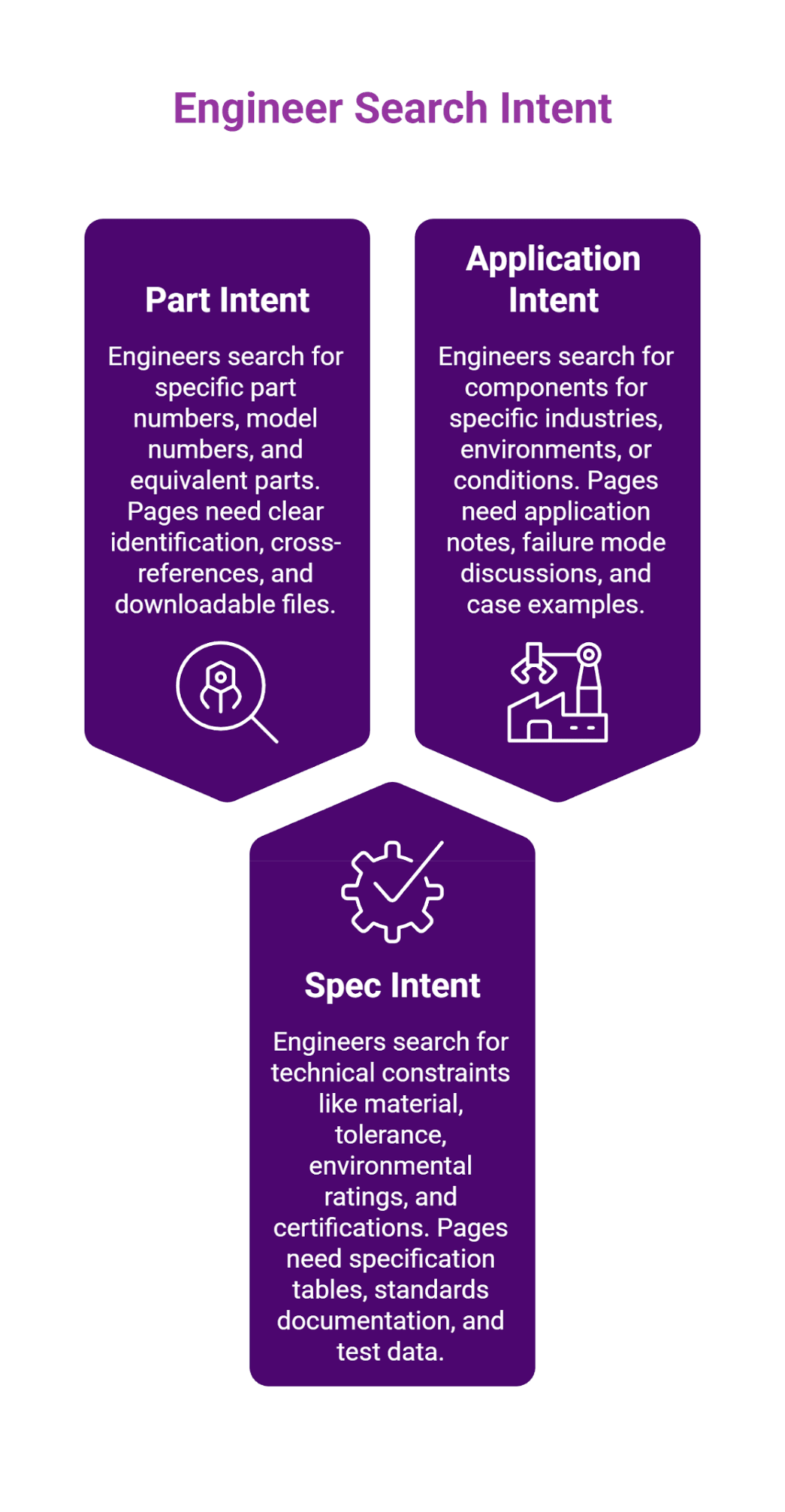
Part Intent (Identifiers)
What engineers search:
- Part numbers, model numbers, series designations
- SKU or drawing numbers
- "Equivalent to [competitor part]" or "replacement for [legacy part]"
- OEM cross-references
Example queries:
- "Parker O-ring 2-212 Viton"
- "equivalent to SKF 6205-2RS"
- "Honeywell ST3000 replacement"
What these pages need:
- Clear part identification in the page title and H1
- Compatibility and cross-reference tables
- Downloadable CAD files, drawings, and datasheets
- Related parts and accessories
- Stock status and lead time indicators
Spec Intent (Technical Constraints)
What engineers search:
- Material combined with standard (e.g., "316L stainless ASTM A276")
- Tolerance requirements (e.g., "±0.001 ground rod")
- Environmental ratings (e.g., "IP67 enclosure NEMA 4X")
- Certifications (e.g., "ISO 9001 precision machining" or "AS9100 aerospace fasteners")
Example queries:
- "EPDM gasket FDA compliant -40F"
- "titanium grade 5 ASTM B348 round bar"
- "explosion-proof motor Class I Div 2"
What these pages need:
- Specification tables with sortable/filterable attributes
- Standards and certification documentation (or clear statements of compliance)
- Test data and material certifications
- Technical datasheets in downloadable format
- Clear statements of what you can and cannot supply
For context on certification language buyers recognize, the ISO overview of ISO 9001 explains the quality management standards engineers frequently reference in searches.
Application Intent (Use-Case Environments)
What engineers search:
- "[Component] for [industry]" (e.g., "pressure transducer for food processing")
- "[Component] in [environment]" (e.g., "bearings for high-temperature applications")
- "[Component] resists [condition]" (e.g., "coating resists saltwater corrosion")
- Selection criteria for specific applications
Example queries:
- "seals for pharmaceutical clean room"
- "vibration dampening mounts for CNC machines"
- "corrosion-resistant fasteners marine environment"
What these pages need:
- Application notes explaining why your solution fits
- Failure mode discussions (what happens if wrong component is selected)
- Selection criteria and decision frameworks
- Case examples or proof photos from similar applications
- Links to relevant specs and part options
The Mapping Workflow: Start This Week
You don't need to map your entire catalog. Start with a pilot scope of 5–10 high-priority SKUs or product lines, prove the method works, then expand systematically.
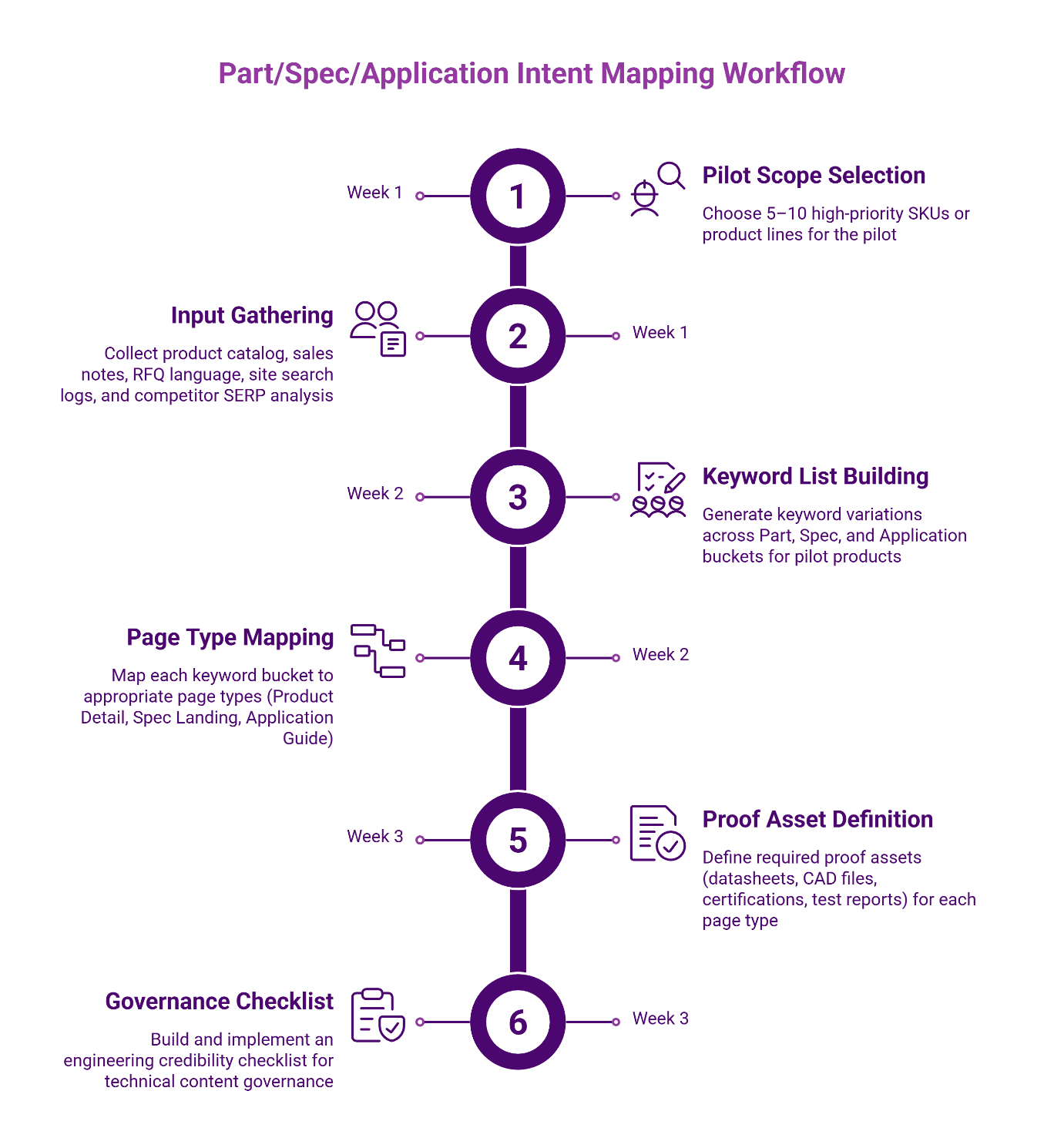
Step 1: Choose Your Pilot Scope
Select products where you have the strongest technical differentiation or where sales has flagged inquiry quality issues. Ideal candidates:
- Products with clear certification or standard requirements
- Items where you compete on precision or specialty materials
- Lines where you're getting traffic but not qualified inquiries
Step 2: Gather Your Inputs
Pull together the raw material for keyword discovery:
- Product catalog and datasheets
- Sales call notes (what specs do prospects mention?)
- RFQ language from recent qualified inquiries
- Site search logs (what are visitors actually looking for?)
- Competitor SERP analysis (what terms do they rank for?)
Step 3: Build Keyword Lists by Bucket
For each pilot product, generate keyword variations across all three buckets:
Part bucket: List every identifier - part numbers, model numbers, series names, OEM equivalents, legacy part cross-references.
Spec bucket: Combine your key specifications into search patterns. If you sell precision ground shafting, your spec keywords might include tolerance ranges, material grades, surface finishes, and relevant ASTM or ISO standards.
Application bucket: Identify the industries, environments, and use cases where your product is specified. What problems does it solve? What conditions does it withstand?
Step 4: Map Each Bucket to Page Types
Different intent buckets need different page architectures:
| Intent Bucket | Primary Page Type | Secondary Options |
|---|---|---|
| Part | Product detail page | Cross-reference landing page |
| Spec | Specification landing page | Filterable product category |
| Application | Application guide page | Industry-specific landing page |
The key insight: you may need multiple entry points to the same product, each optimized for different search intent.
Step 5: Define Proof Assets Per Page
Engineers look for specific documentation to validate fit. Map the required proof assets for each page type:
- Datasheets: Technical specifications in downloadable PDF format
- CAD files: 2D drawings and 3D models for design integration
- Certifications & Registrations: ISO 9001 and AS9100 certificates, ITAR registration statements (where permitted), and FDA compliance documentation
- Test reports: Material certifications, performance test data
- Dimensional drawings: Detailed measurements and tolerances
- Application notes: Technical guidance for specific use cases
If you don't have an asset, be clear about it. "Request datasheet" is better than no mention at all - it signals the documentation exists.
Step 6: Add Governance to Prevent Intent Drift
Technical content degrades over time. Marketing rewrites remove specificity. Product updates invalidate specs. New team members don't understand why certain terms matter.
Build an engineering credibility checklist as your governance gate:
- SME review before any technical page goes live or gets edited
- Spec table or clearly structured spec section present
- Standards and certification references confirmed current (no overclaims)
- Proof asset links tested and documents up to date
- Acronyms defined the first time used
- Internal linking between Part ↔ Spec ↔ Application pages maintained
Schedule quarterly reviews for your highest-traffic technical pages. Intent drift usually starts when technical terms get replaced with generic marketing phrasing - the checklist catches this before it costs you qualified inquiries.
The Keyword Intent Mapper Template
Use this template to systematically map your pilot products. Here's the structure with an example row:
| Column | Example Entry |
|---|---|
| Product/SKU | Precision Ground Shaft – PGS-0500-12-303 |
| Part intent query pattern | PGS-0500, 0.500 diameter shaft 303 SS |
| Spec attributes | 303 stainless, ±0.0002 tolerance, centerless ground, ASTM A582 |
| Spec intent query pattern | 303 stainless precision shaft ASTM A582, ground shaft ±0.0002 |
| Application/use-case | Linear motion systems, medical device components |
| Application intent query pattern | precision shaft for linear bearings, stainless shaft medical devices |
| Recommended page type | Product page (Part), Spec landing page (Spec), Application guide (Application) |
| Required proof assets | Datasheet PDF, material cert, dimensional drawing |
| Primary micro-conversion | Datasheet download, Request for Quote (RFQ) |
| Internal links (to/from) | Link from linear motion application page; link to material grade comparison |
Priority scoring: Use simple High/Medium/Low labels based on:
- Search volume indicators (even rough estimates help)
- Sales feedback on inquiry quality for this product
- Competitive gap (are competitors ranking where you're not?)
For related guidance on selecting which products to prioritize, see our SKU-first manufacturing SEO framework.
Common Mistakes That Break Intent-Match
Mixing buckets on one page without structure. A page that tries to serve part, spec, and application intent simultaneously usually serves none of them well. If you must combine, use clear sections with defined anchor links so engineers can jump directly to what they need.
Hiding proof assets behind unnecessary forms. Gating a standard datasheet frustrates engineers and signals you don't understand their workflow. Reserve forms for high-value assets or custom documentation requests - not basic spec sheets.
Skipping standards and certification language. Engineers include "ASTM," "ISO," "API," and certification acronyms in searches because these aren't optional - they're requirements. If your pages don't mention the standards you meet, you're invisible to these searches.
Publishing marketing copy that removes technical specificity. This is intent drift in action. A product page starts with precise specifications, then gets "cleaned up" to be more "readable," and suddenly it no longer matches how engineers search. The governance checklist prevents this.
Assuming one page serves all three intents. The engineer searching your part number has different needs than the one searching for a material specification or an application fit. Build the architecture to serve each pathway.
What to Measure: Fit-Validation Signals
Traditional traffic metrics don't tell you whether you're attracting the right engineers. Focus on signals that indicate fit validation:
Engagement with proof assets:
- Datasheet and CAD file downloads
- Time spent on specification tables
- Scroll depth on technical pages
Navigation patterns:
- Movement from spec pages to RFQ or contact forms
- Internal navigation between Part ↔ Spec ↔ Application pages
- Return visits to the same technical pages (indicates active evaluation)
Inquiry quality feedback:
- Sales team assessment: are inquiries more spec-formed?
- Reduction in "just browsing" or mismatched inquiries
- Shorter qualification cycles (prospects arrive pre-informed)
This manufacturing SEO lead generation framework details these KPIs.
Frequently Asked Questions
Next Steps
Intent mapping isn't a one-time project. Start with your pilot scope of 5–10 products, build the first version of your Keyword Intent Mapper, and create or optimize pages for each bucket. Measure the fit-validation signals. Then expand to additional product lines using the same systematic approach.
The goal is a content architecture where engineers can validate fit in minutes - because when they can, your pages earn their trust, their time, and eventually their RFQs.
For broader context on technical search architecture, see our industrial manufacturing SEO overview. Explore our guides for related frameworks on technical content strategy.
Our Editorial Process: Our expert team uses AI tools to help organize and structure our initial drafts. Every piece is then extensively rewritten, fact-checked, and enriched with first-hand insights and experiences by expert humans on our Insights Team to ensure accuracy and clarity.
By the BVM Insights Team
The BVM Insights Team publishes practical, engineering-grade guidance for industrial manufacturers. We focus on building clear, spec-accurate content systems that help technical buyers validate fit quickly and take the next step with confidence.

About the Author
Dustin Ogle
Dustin Ogle is the Founder and Head of Strategy at Brazos Valley Marketing. With over 10 years of experience as an SEO agency founder, he specializes in developing the advanced AI-driven strategies required to succeed in the new era of search.
Be the answer your buyers find first.
Book a call. Your free SEO blueprint lands in your inbox within 24 hours.