
 BVM Insights Team
- SKU-First Beats Blog-First: Treating your product catalog as the foundation of organic visibility captures qualified RFQs instead of unqualified traffic from generic educational content.
- The Buyer Language Trifecta: Engineers search using three dimensions - part numbers, technical specifications, and application contexts - requiring distinct page types and conversion paths for each intent.
- Tolerance-Fit Over Volume: A search for “AS9100 certified titanium machining +/-0.0005 tolerance” reveals three qualification criteria in one query, while “precision machining services” reveals nothing about buyer readiness.
- Pilot-First Proves ROI: Starting with fewer than 10 strategically selected SKUs generates clear performance signals within 3-6 months, enabling proof before enterprise-scale investment.
- GA4, CRM, Revenue Attribution: Connecting organic sessions through RFQ disposition to closed revenue lets Finance evaluate SEO using the same metrics applied to trade shows and other demand channels.
Prepared intent maps convert search visibility into measurable pipeline. Manufacturing decision-makers evaluating SEO vendors to drive RFQs will find this framework here, preparing them for the detailed methodology and implementation checklist that follows.
A SKU-first manufacturing SEO strategy maps actual product lines - down to parts, specifications, and applications - to the page types and calls-to-action that engineers expect. The goal is not traffic for its own sake but tolerance-fit demand capture that converts qualified searchers into RFQs and measurable pipeline.
Stop chasing traffic. Engineers don't buy on keyword volume - they buy on spec-fit.
Picture the VP of Marketing staring at another monthly analytics report. Organic traffic climbed 40% last quarter, yet the sales team still complains about an empty pipeline. The disconnect is stark: thousands of visitors reading generic “what is CNC machining” blog posts, while engineers searching for “ISO 9001 certified precision turning services for medical devices” land on competitor sites that actually list those capabilities.
This is the tolerance problem in manufacturing SEO. When your catalog doesn't speak the language of part numbers, specifications, and application requirements, search visibility becomes noise rather than signal. The solution requires treating your product catalog as an indexable system engineered for RFQ generation, not a blog farm optimized for traffic vanity metrics.
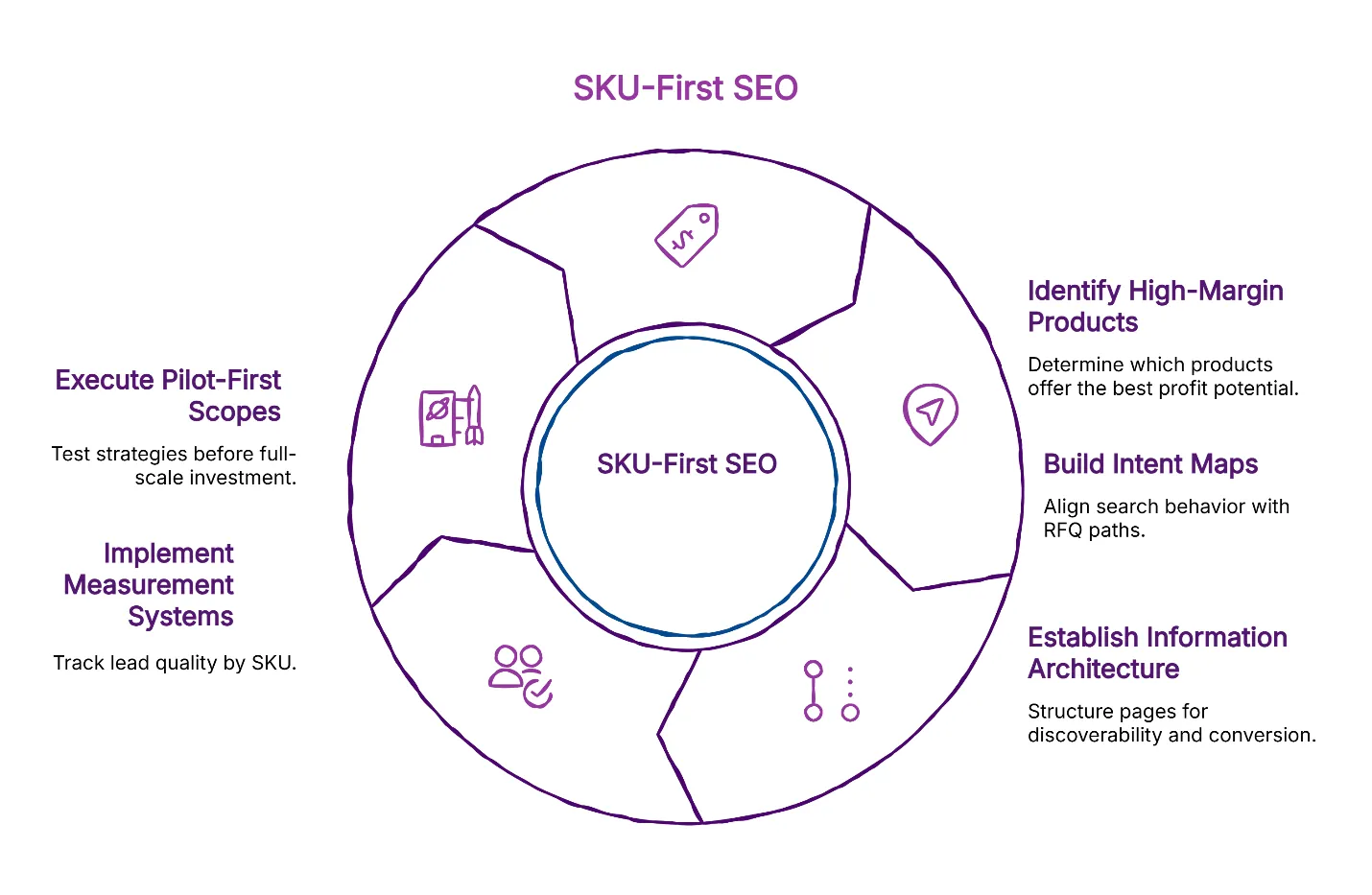
SKU-first SEO is a lead-generation framework that prioritizes actual product lines and maps their part/spec/application search intents directly to conversion paths. Rather than building content around educational keywords, this approach structures pages around how engineers actually search when they need to source components - by material grade, tolerance range, certification requirement, or specific application constraint.
This article walks through the complete SKU-first methodology: from identifying high-margin product lines to building intent maps that align search behavior with RFQ paths, establishing the information architecture that supports both discoverability and conversion, implementing measurement systems that track lead quality by SKU, and executing pilot-first scopes that generate proof before requiring enterprise-scale investment.
Overview: what “SKU-first” means (and why it beats generic SEO)
The distinction between traffic-first and SKU-first approaches becomes clear when examining what actually drives manufacturing purchase decisions. Generic SEO strategies treat industrial websites like consumer publishing platforms: build a blog, target high-volume keywords, accumulate backlinks, measure success by organic sessions. This model fails in B2B manufacturing because the buyer journey doesn't mirror consumer behavior.
Engineers and technical buyers conduct structured sourcing processes. Research on how engineers evaluate vendors consistently shows a bias toward technical detail, self-serve evaluation, and supplier selection based on perceived capability and documented proof rather than promotional content. They search for specific capabilities, certifications, and material specifications because procurement requirements demand precise matches. A search for “precision machining services” might generate traffic, but it reveals nothing about buyer intent. That same engineer searching for “AS9100 certified titanium machining +/-0.0005 tolerance” has communicated three critical qualification criteria in a single query.
The SKU-first framework inverts the traditional content hierarchy. Product and capability pages become the foundation of organic visibility rather than an afterthought buried three clicks deep in the site architecture. Each product line or service capability receives dedicated optimization focused on the technical language buyers use during active sourcing.
Consider the difference in business outcomes. A blog post about “5-axis machining benefits” might rank well and generate considerable traffic from students, competitor research, and casual browsers. A properly optimized page for “5-axis simultaneous machining for aerospace components” with clear capability specifications, material compatibilities, and certification displays captures engineers actively building vendor shortlists. The first generates metrics; the second generates RFQs.
This distinction matters because manufacturing sales cycles operate on lead quality rather than lead volume. Sales teams don't benefit from 100 unqualified form submissions - they need five conversations with prospects who have actual projects, approved budgets, and timeline pressure. The SKU-first model optimizes for this reality by focusing on tolerance-fit between search intent and commercial capability.
The framework delivers three core advantages over blog-first approaches. First, it creates natural alignment between organic visibility and revenue-generating products. High-margin offerings receive optimization priority rather than being relegated to thin catalog pages. Second, it dramatically improves lead qualification rates because searchers self-select based on technical requirements before ever submitting an inquiry. Third, it enables precise attribution from keyword to SKU to RFQ disposition, allowing Finance and Operations teams to evaluate SEO performance using the same metrics applied to other demand-generation channels.
The buyer language trifecta: part, spec, and application
Manufacturing search behavior follows predictable patterns rooted in how technical buyers think about sourcing. Understanding these patterns transforms keyword research from guesswork into systematic intent mapping.
How engineers actually search
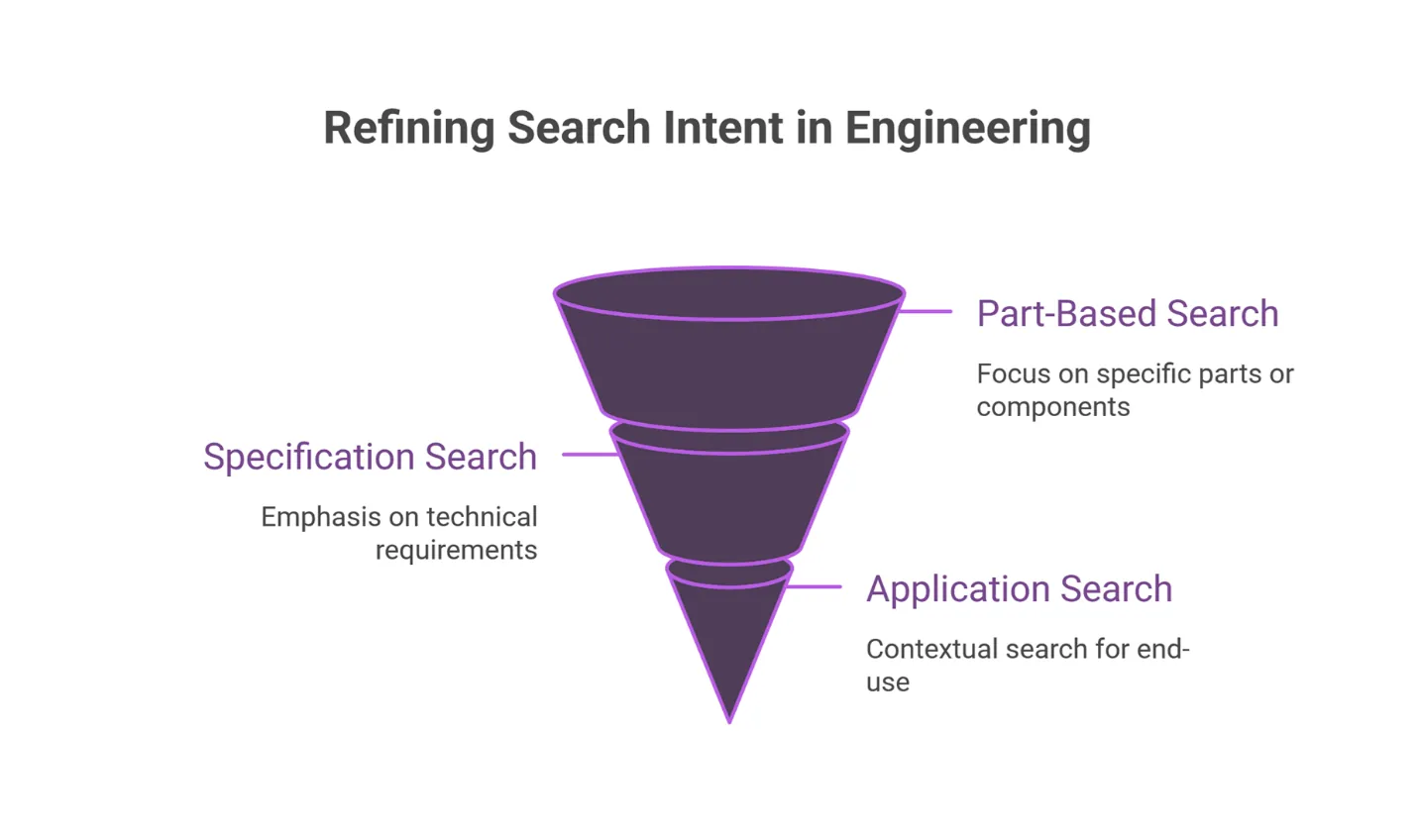
Technical buyers construct search queries around three primary dimensions: the part or component itself, the specifications that define acceptable tolerances and properties, and the application or use case that creates the sourcing requirement. These dimensions often combine within single queries, creating multi-faceted intent signals.
Part-based searches use industry nomenclature, model numbers, or component categories. An engineer might search “butterfly valve 6 inch” or reference a competitor's part number when seeking alternative suppliers. These queries indicate high purchase intent because the searcher has already defined their need with specificity.
Specification searches center on technical requirements: material grades, tolerance ranges, surface finish requirements, or certification standards. Terms like “316 stainless steel passivation” or “ASTM A36 steel plate” reveal sourcing criteria without necessarily identifying the final component. Engineers use spec searches during the vendor qualification phase when building shortlists of capable suppliers.
Application searches describe the end-use context: “hydraulic fittings for mobile equipment” or “food-grade conveyor belting.” These queries help buyers discover suppliers who understand their industry's unique requirements, from regulatory compliance to environmental conditions.
The implications for keyword research extend beyond simple term collection. Each dimension requires different page types and content structures. Part searches demand clear product catalogs with robust filtering. Spec searches need detailed capability pages that explicitly list certifications, equipment, and quality systems. Application searches benefit from industry-specific landing pages that demonstrate domain expertise.
Glossaries and synonyms to reduce ambiguity
Manufacturing terminology suffers from systematic ambiguity that complicates search optimization. The same component might be called different names by manufacturers, distributors, engineers, and purchasing agents. Regional variations, industry-specific jargon, and evolving standards compound this challenge.
Vendor terminology rarely matches buyer language. A manufacturer might call their product “precision-ground shafting,” while engineers search for “turned and ground bar stock.” Distributors use different category names than end-users. OEMs reference parts by internal model numbers that have zero search volume. This semantic gap creates visibility problems when pages optimize for internal vocabulary rather than external search behavior.
The solution requires building comprehensive synonym maps that bridge terminology differences. These maps should capture manufacturer names versus generic terms, brand names versus commodity descriptions, abbreviated forms versus full technical names, regional variations, and industry-specific alternatives. Creating and maintaining these glossaries requires cross-functional input from sales teams who hear how customers describe products, engineering teams who know proper technical terminology, and customer service teams who track the questions buyers actually ask.
Building the SKU-first intent map
The intent mapping process connects product capabilities to search behavior through systematic analysis. This methodology transforms broad keyword lists into actionable content and page-type specifications. Treat this as a controlled, versioned process that gets revisited quarterly as product lines evolve, and search patterns shift.
Step 1 - Prioritize product lines
Not all SKUs deserve equal optimization attention. Strategic prioritization focuses resources on products where SEO can deliver the highest business impact, measured as the intersection of margin contribution and search discoverability.
Begin by segmenting the product catalog along two dimensions: profitability and organic opportunity. Profitability incorporates both gross margin and total revenue contribution. A low-volume specialty product with 60% margins might justify optimization investment comparable to a high-volume commodity item with 15% margins if the absolute dollar contribution aligns.
Organic opportunity assesses whether meaningful search demand exists for the product category and whether current search results reveal competitive gaps. Some product lines generate strong demand but face entrenched competitors with dominant visibility. Others show moderate search volume with fragmented, low-quality results that create openings for well-optimized entries.
Pilot scopes deliberately constrain the initial focus to fewer than 10 SKUs. This limitation generates clear performance signals quickly, enabling proof-of-concept without requiring complete catalog coverage. Choose products that represent different opportunity types: an established category with strong existing demand, an emerging application with growing search interest, and a differentiated capability where the company holds unique advantages.
Step 2 - Translate features into search intents
Product features don't map directly to search queries. Engineers search for outcomes, capabilities, and specifications rather than features per se. This translation step converts internal product descriptions into external buyer language.
Start with the complete technical specification sheet for each prioritized SKU. List every dimension: material composition, physical dimensions and tolerances, performance characteristics, certifications and standards compliance, compatible applications, available variants or configurations. This becomes the feature inventory.
Next, conduct the translation exercise by asking for each feature: “What problem does this solve for the buyer? What language would an engineer use to search for this capability? Which specifications act as hard requirements versus nice-to-have attributes?”
Material specifications translate into multiple search intents. A product made from 316 stainless steel satisfies searches for corrosion resistance, marine-grade materials, FDA-approved food contact surfaces, and high-temperature applications. Each represents a distinct search intent that might drive relevant traffic.
The tolerance-fit concept becomes operationally important here. Some product features appeal to broad audiences but generate low-quality leads. Other features have narrow appeal but attract highly qualified prospects. A general capability like “CNC machining” generates enormous search volume with minimal qualification. “5-axis simultaneous machining for turbine blades” indicates precise buyer need and likely strong project fit.
Step 3 - Assign page types to intents
Different search intents require different page architectures. The page-type assignment ensures each intent receives appropriate content structure and conversion path design.
| Intent focus | Primary page type | Secondary support | RFQ pathway notes |
|---|---|---|---|
| Part/Model | Catalog listing with filters; comparison tables | Spec detail pages per part | “Add to RFQ,” quick spec view, part-match interaction |
| Spec/Tolerance | Spec detail page | Application note or comparison | Downloadable spec (PDF) plus short RFQ form |
| Application/Use case | Application page or solution page | Case snapshot and compatible parts | Case snapshot and compatible parts |
Catalog pages serve high-level navigation and filtering needs. They work well for generic part searches where buyers need to narrow specifications before identifying specific products. The optimization goal is capturing the broad intent, then facilitating self-service qualification.
Spec detail pages target engineers searching for precise technical requirements. These pages exhaustively document specifications, tolerances, material properties, test data, and compliance certifications. They answer the question “Does this part meet my technical requirements?” before the buyer needs to contact sales.
Application pages address use-case searches by demonstrating domain expertise. A page titled “Hydraulic Fittings for Construction Equipment” explains requirements specific to that application: vibration resistance, temperature range, seal compatibility, pressure ratings for mobile hydraulics.
Solution pages bundle multiple products or capabilities to address complete buyer needs. Rather than optimizing around individual SKUs, these pages target project-level searches like “clean room HVAC systems” or “industrial wastewater treatment equipment.”
Step 4 - Wire the RFQ path
Micro-conversions create low-friction engagement opportunities earlier in the evaluation process. Spec sheet downloads let engineers gather technical data for internal review without sales contact. Part-match tools allow buyers to input their requirements and receive automated recommendations. Configuration calculators help users determine which product variant fits their application. Each micro-conversion generates behavioral data about buyer intent while advancing the relationship.
Short RFQ forms reduce submission friction by requesting only essential qualification information upfront. Rather than demanding complete project details, ask for basic need identification: product interest, quantity range, timeline urgency, and contact information. Sales teams can gather comprehensive requirements during follow-up conversations once mutual fit is established.
Stateful context ensures RFQ opportunities maintain SKU and specification parameters through the conversion flow. When a user clicks “Request Quote” from a specific product page with selected options, that context should pre-populate the RFQ form, speeding the quoting process and reducing user friction.
Redundant CTA placement ensures RFQ opportunities appear at natural consideration points throughout the user journey. Place primary CTAs above the fold, after key specification sections, following application descriptions, within comparison tables, and in sticky elements that remain visible during scroll.
Ready to translate SKUs into an intent map? Book a discovery call to discuss your pilot scope.
Information architecture: from catalog to conversion
Site structure determines whether search engines can efficiently crawl product pages and whether users can navigate to relevant SKUs. Manufacturing sites face unique IA challenges due to product complexity and taxonomy depth.
Faceted navigation allows buyers to filter large catalogs by multiple attributes simultaneously: material, size range, pressure rating, end connection type, certification. This creates thousands of potential URL combinations. Without proper handling, faceted navigation generates duplicate content problems and wastes crawl budget on low-value parameter variations. Identify which facet combinations represent legitimate product categories worthy of indexation, then use rel=canonical tags to consolidate variations.
Canonicalization strategy extends beyond faceted navigation to address product relationships. When the same physical product appears in multiple categories or under different model numbers, canonical tags should point to the primary product detail page. This consolidates authority and prevents keyword cannibalization across similar pages.
Crawl hygiene ensures search engines focus on valuable pages rather than wasting resources on infinite pagination, redundant sort orders, or obsolete discontinued products. Implement reasonable pagination limits. Use noindex for filtering parameter combinations that generate thin content.
Spec PDFs versus HTML companions represents a common tension. Engineers expect downloadable PDF spec sheets, but PDFs create indexation challenges. The optimal pattern pairs each critical PDF with an HTML companion page that summarizes key specifications in crawlable format. The HTML page includes structured data, houses the primary optimization, and offers the PDF as a downloadable resource.
On-site search optimization completes the discoverability picture by ensuring internal search reliably returns the right SKU families when buyers use the site's own search function. Index the glossary terms, spec attributes, and application notes so users who land on your homepage or a category page can quickly navigate to their specific requirement.
Structured data implementation using Schema.org vocabulary helps search engines understand product attributes and relationships. Product schema documents SKUs, prices, availability, specifications, and review data. This structured approach, which aligns with quality management principles around documented and consistent information presentation, enables rich results and improves entity recognition.
Measurement: GA4 to CRM to RFQ disposition
Lead quality matters more than lead volume in manufacturing sales. Effective measurement systems track the complete path from organic session to revenue contribution, enabling optimization based on business outcomes rather than vanity metrics.
GA4 event tracking captures key micro-conversions throughout the user journey. Configure events for spec sheet downloads, part-match tool usage, RFQ form starts, RFQ form completions, and phone number clicks. Tag each event with relevant SKU or product category parameters to enable granular analysis.
CRM integration bridges the gap between anonymous website behavior and known sales opportunities. When RFQ forms submit to the CRM, pass through the GA4 client ID and relevant UTM parameters. This enables joining website session data with opportunity data.
RFQ disposition tracking classifies leads by outcome: qualified and accepted by sales, quoted but lost to competitor, quoted and won, disqualified due to requirements mismatch, disqualified due to capacity constraints, or no response. This classification reveals lead quality patterns.
SKU-level attribution connects specific product search visibility to business outcomes. Track which SKUs generate the most organic traffic, which convert traffic to inquiries at the highest rates, which produce qualified opportunities rather than tire-kickers, and which ultimately contribute to closed revenue.
Cohort analysis reveals the compounding effects of SEO investment over time. Rather than evaluating performance month-to-month, track quarterly cohorts from first visit through the complete sales cycle. Manufacturing sales cycles often span 6-18 months, so a prospect visiting in Q1 might not convert to revenue until Q3 or Q4.
The measurement framework should feed a QBR cadence where marketing, sales, and operations teams review performance jointly. This collaborative approach aligns with how B2B buying committees make consensus decisions - multiple stakeholders need shared proof and clear value articulation to advance from pilot to scale.
Pilot-first execution: prove it before you scale
Manufacturing companies rightfully approach SEO investment with skepticism given the long sales cycles and relationship-driven nature of their businesses. Pilot-first execution provides proof before requiring enterprise-scale commitment.
The pilot scope deliberately constrains focus to fewer than 10 SKUs selected based on the prioritization matrix. This limitation generates clearer performance signals by reducing confounding variables, shortens time-to-proof to enable validation within a single quarter, and reduces financial risk while proof develops.
Choose SKUs that span different opportunity types. Include at least one product where strong search demand already exists but competitive gaps create openings. Add one emerging opportunity where search interest is growing but not yet saturated. Include one differentiated capability where unique technical advantages create sustainable competitive positioning.
Time-to-proof expectations should align with realistic search engine crawl and ranking timelines. New pages typically require 4-8 weeks for initial indexation and ranking, then another 4-8 weeks for position stabilization. Plan for 3-6 months to generate meaningful performance data.
The QBR cadence during pilot should occur monthly rather than quarterly to enable faster course correction. Each session reviews the pilot KPIs, discusses what's working and what requires adjustment, identifies any blocking issues, and makes tactical decisions about content refinements.
Governance during scaling includes change control processes to prevent well-intentioned but counterproductive modifications to proven approaches. An experimentation log tracks intentional variations from the standard approach, enabling isolation of what caused performance changes when results deviate from expectations.
Case snapshot: hypothetical mid-market OEM
This example is illustrative and not a claim of specific performance outcomes.
Consider a mid-market precision machining company with $15M annual revenue, 60 employees, and a product mix spanning commercial, industrial, and aerospace applications. The company maintains ISO 9001 and AS9100 certifications, operates 20 CNC machines, and serves customers in 12 states primarily through relationship-based sales.
Baseline situation showed organic traffic concentrated on blog posts about general machining topics. Product capability pages ranked poorly. Product detail pages contained minimal content: a part number, brief description, and “contact us for quote” with no specifications. The sales team maintained full pipelines through existing relationships and trade show leads, but strategic concerns mounted about succession planning, declining trade show effectiveness, and rising customer acquisition costs.
Intervention focused on a 6-SKU pilot targeting precision turning capabilities. The team built dedicated spec detail pages documenting material options, dimensional tolerances, surface finish capabilities, inspection protocols, and certifications. They created application pages for aerospace fastener components, industrial pump shafts, and medical implant precursors. The RFQ path redesign included inline quote request forms, downloadable capability sheets, an interactive tolerance calculator, and direct phone lines to technical sales engineers.
Outcomes after six months showed qualified RFQ rate increasing from fewer than 10 per quarter to 8-12 per month. More importantly, sales confirmed that 70% of organic RFQs qualified as legitimate opportunities versus the previous 30% qualification rate. Three deals closed within the measurement period totaling $240K in new business. Time-to-quote improved because prospects arrived with clear requirements rather than needing extensive discovery.
The proof validated expansion to an additional 15 SKUs and secured a two-year roadmap for complete catalog optimization.
Common pitfalls and red flags
Chasing volume over tolerance-fit represents the most common strategic error. The temptation to target high-volume generic keywords feels compelling when reviewing keyword research data, but these terms attract unqualified visitors: students, competitors conducting research, job seekers, and overseas buyers seeking pricing far below domestic capabilities.
Thin spec pages fail to serve user needs or search engines. A product page containing only a part number, 2-sentence description, and pricing information provides insufficient content for effective ranking or user decision-making. Manufacturing SEO services succeed when product content answers every technical question a qualified buyer would ask.
Orphaned PDFs create visibility gaps when spec sheets exist only as downloadable files without HTML companions. PDFs index poorly and provide limited optimization opportunities.
Crawl waste occurs when search engine resources get consumed by low-value pages instead of focusing on important product and capability pages. Regular log file analysis identifies patterns where crawlers spend time unproductively.
Misaligned CTAs damage conversion rates when the requested action doesn't match buyer readiness. Asking users to “schedule a plant tour” on early-stage informational pages creates barriers. Micro-conversions like spec sheet downloads better serve users still in research mode.
Getting started
Implementing the SKU-first framework requires coordinated action across multiple functions.
Assemble the cross-functional team bringing together sales, product, operations, and marketing. The team should meet biweekly during pilot planning, then transition to monthly QBRs during execution.
Pick the first 5-10 SKUs using the prioritization matrix. Create a spreadsheet documenting for each selected product: current revenue contribution, margin profile, existing search visibility, competitive landscape assessment, unique differentiators, and primary applications.
Draft the measurement plan establishing baselines and defining success metrics. Document current state and define pilot success criteria including specific ranking goals, traffic targets by SKU, engagement rate benchmarks, and lead quality thresholds.
Map search intents to page types for each pilot SKU. Create a content brief template that ensures consistency while accommodating product-specific variations.
Implement conversion paths including form integration, downloadable resource hosting, and CTA placement. Test all forms to verify leads route correctly and populate CRM with SKU context.
Configure measurement systems including GA4 event setup, CRM field additions, dashboard creation, and baseline data capture.
Launch the pilot pages following SEO best practices. Submit updated sitemaps and request indexation for priority pages.
Establish the QBR rhythm with monthly review meetings. Each session evaluates performance against KPIs, reviews lead quality feedback, identifies content gaps, and makes tactical decisions.
For guidance on pilot scoping and measurement frameworks, explore our resources or review SEO pricing structures that align with measurable outcomes.
Frequently asked questions
Disclaimer: This article provides general strategic guidance for manufacturing SEO implementation. Specific results vary based on competitive landscape, product differentiation, market dynamics, and execution quality. Ranking improvements and lead generation rates depend on numerous factors including technical site quality, content depth, competitive positioning, and sales process efficiency. Companies should evaluate SEO investments using the same analytical rigor applied to other marketing channels, beginning with constrained pilots that generate proof before scaling.
Our editorial process: We fact-check claims, cite authoritative sources, and have content reviewed by a manufacturing-literate SEO strategist prior to publication.