
 BVM Insights Team
- One Profile Per Physical Location: Every model center requires unique NAP data (name, address, phone) and direct URLs to prevent Google's algorithmic conflation that dilutes all your communities' visibility.
- Category Precision Drives Query Matching: Selecting "Home Builder" or "Custom Home Builder" as your primary category directly affects which searches trigger your profile - category accuracy determines Local Pack eligibility for ZIP-specific queries.
- UTM Parameters Connect Visibility to Pipeline: Tagging your GBP website and appointment links with UTM parameters (utm_source=google&utm_medium=organic_local&utm_campaign=[community-name]) allows your CRM to prove that map visibility generates actual booked tours, not just traffic.
- Neighborhood-Rich Reviews Signal Relevance: Reviews mentioning specific schools, commute times, parks, and local amenities strengthen your relevance for ZIP-specific searches while making reviews feel like authentic neighborhood field notes rather than generic praise.
- Tour-First Measurement Validates ROI: The conversion chain from Local Pack impressions to directions requests and phone calls, through to website sessions with tracked appointments, and finally to confirmed model center tours represents the only metric structure sales teams accept.
Tour-driven visibility requires technical precision and measurement infrastructure that most homebuilders overlook. Luxury homebuilders and community developers managing multiple model centers across affluent ZIP codes will find the strategic framework here, preparing them for the ten-step implementation checklist that follows.
When a prospect searches "luxury homes near [ZIP 78738]" or "model centers in [The Woodlands]," your community's Google Business Profile needs to appear in the Local Pack - that cluster of three pinned locations at the top of search results. Getting each of your model centers into those coveted positions requires treating every community as its own distinct local entity, not a branch of your corporate brand.
Think of Local Pack visibility like intersection signage for a site superintendent. Your corporate office might handle the master plan, but each model center needs its own clearly marked entrance. Affluent buyers research neighborhoods intensively before ever scheduling a tour, and your digital presence in their target ZIP code determines whether they find you first or discover a competitor's community instead.
Consider the complete conversion path. A prospect searches "new homes [ZIP 78738]" and your community's profile appears in the Local Pack. They tap "Website" and land on a community page optimized for tours. They select "Book a Tour," choose an available time slot, and your CRM logs the source as organic local traffic from Google. This sequence - from search visibility to confirmed appointment - represents Map Pack mastery in action.
This article provides a practical, ten-step framework for earning Local Pack placement in affluent ZIP codes and converting that visibility into scheduled model center tours.
What "Map Pack Mastery" Means for Model Centers (Tour-First)
Map Pack Mastery refers to the systematic optimization of each community's local search presence to achieve three outcomes: consistent visibility in the Local Pack for ZIP-specific queries, high-intent engagement through directions requests and calls, and measurable conversion into booked model center tours.
The technical definition matters less than the practical impact. When you optimize for community local SEO correctly, prospects searching within or adjacent to affluent ZIP codes see your specific model center - not your corporate homepage - with all the contextual signals that drive their decision to visit.
Tour-First Success Criteria
Traditional local SEO focuses on impressions and clicks as primary metrics. For homebuilders, those represent leading indicators only. The measurement chain that sales teams accept flows from Local Pack impressions to directions requests and phone calls, then to website sessions with tracked appointment bookings, and finally to confirmed model center tours and design center appointments.
If a community ranks but cannot convert tours, it has not achieved Map Pack mastery. Visibility without conversion signals a breakdown in the path from discovery to appointment.
This tour-first doctrine requires instrumentation at every step. Your Google Business Profile website link must include UTM parameters (utm_source=google&utm_medium=organic_local&utm_campaign=[community-name]) to connect map visibility with booked tours in your CRM. Without this tracking infrastructure, you cannot prove that local visibility generates actual sales pipeline.
Affluent ZIP Targeting Without "Gaming" Proximity
Affluent ZIPs warrant strategic focus because they represent your highest-probability prospects. Defining "affluent" requires objective data rather than assumptions. . Use median household income by ZIP code from the U.S. Census Bureau's American Community Survey, combined with home value ranges and commute patterns into your core neighborhoods[1]. This multi-factor approach keeps your targeting defensible and avoids demographic stereotyping.
Prioritize communities in two tiers: those physically located in affluent ZIPs, and those in adjacent ZIPs that represent realistic options for buyers on the same commute corridors or within the same school districts.
For model centers and communities, you cannot move the pin - proximity is fixed by your physical location. However, you can influence three critical factors. Relevance improves through precise categories, neighborhood-rich reviews, and on-page content that reflects local context. Prominence builds through strong community pages, local links, consistent citations, and quality photos. Service-area messaging clarifies where you legitimately serve without attempting to claim relevance in ZIPs where you have no physical presence.
Service area settings should match how people actually drive and make community decisions, not create an oversized radius that tries to capture every possible ZIP code.
The 10-Step Model Center Local Pack Checklist
Each action below addresses a specific component of Local Pack eligibility and tour conversion:
1. Distinct NAP per community
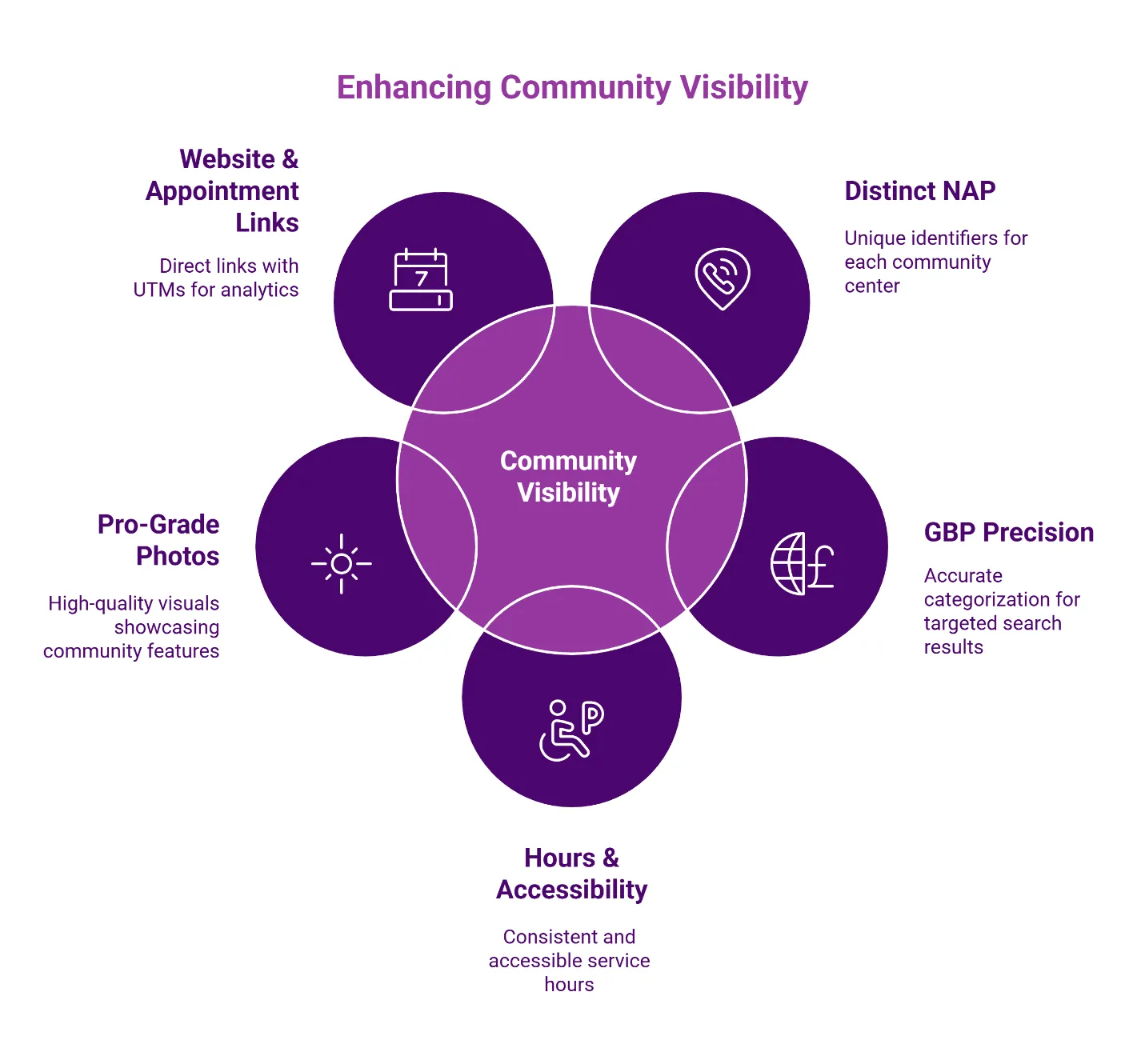
Every model center requires a unique name, address, and phone number. Shared phone lines create profile conflation that dilutes all your communities' visibility. If budget constraints limit dedicated lines, consider trackable forwarding numbers that maintain distinctness while routing to your sales team. Use unique URLs pointing directly to each community page rather than your homepage.
2. GBP category precision
Select "Home Builder" or "Custom Home Builder" as your primary category based on how your target buyers search. These are standard categories within Google's Business Profile taxonomy. Add relevant secondary categories like "Real Estate Agency" or "Real Estate Developer" only if they accurately describe services offered at that specific location. Category accuracy directly affects which queries trigger your profile, so avoid category stuffing that dilutes your primary focus.
3. Hours, attributes, and accessibility
Audit your model center hours quarterly and update immediately when schedules change. Maintain attributes like wheelchair access, parking availability, restroom facilities, and family-friendly features. When a prospect arrives to find the center unexpectedly closed, you've broken trust and damaged future conversion potential.
4. Pro-grade photos and exterior signage
Upload high-resolution images across three categories: exterior signage at the community entrance, model exteriors and interiors showcasing distinctive features, and key amenities that signal the neighborhood character - trails, parks, or architectural consistency. Include environmental markers that establish geographic context naturally without turning images into keyword billboards.
5. Website and Appointment links with UTMs
Your GBP profile supports direct links to your community page and appointment scheduler. Apply the UTM template (utm_source=google&utm_medium=organic_local&utm_campaign=[community-name]) consistently so your analytics connect map clicks to booked tours. Point the Website button to the specific community page and the Appointment button to your tour-booking experience.
6. Q&A seeding and moderation
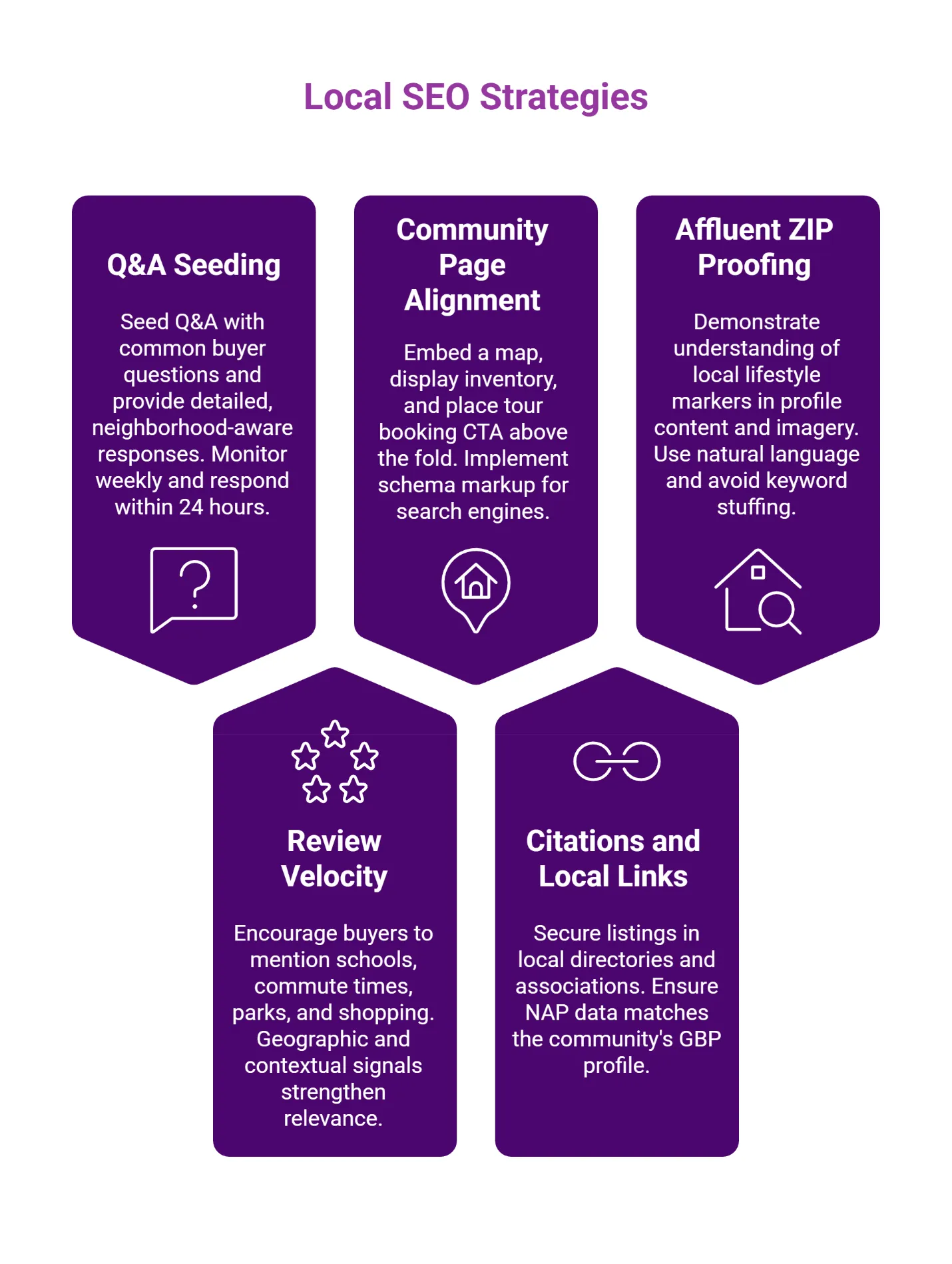
Prospects ask predictable questions about inventory, location, and logistics. Seed your Q&A section with queries buyers actually pose: "Do you have move-in ready homes in [ZIP 77494]?" or "How far is the commute to downtown?" Provide detailed, neighborhood-aware responses. Monitor weekly and respond to new questions within 24 hours to maintain engagement and accuracy.
7. Review velocity and neighborhood relevance
Recent reviews signal active sales, but content specificity matters more than volume. Encourage satisfied buyers to mention schools they considered, commute realities like "25 minutes to downtown off-peak," and the parks, trails, and shopping they appreciate. These geographic and contextual signals strengthen relevance for ZIP-specific searches while making reviews feel like neighborhood field notes rather than generic praise.
8. Community page alignment
Your community landing page must support your GBP profile with structural and semantic consistency. Embed an interactive map that matches your GBP pin location, display current inventory through a simple widget or quick-access link, and place your tour booking CTA above the fold. Implement LocalBusiness or Place schema markup so search engines can confidently connect the page to your physical community. These technical requirements form part of comprehensive on-page optimization strategies that many agencies develop for their clients.
9. Citations and local links
Secure listings in your local chamber of commerce directory, homebuilder association roster, HOA or master-planned community sites, and Parade of Homes program if applicable. Ensure NAP data matches the community's GBP profile, not just your corporate office information. These citations provide validation signals that support your local authority.
10. Affluent ZIP proofing
Review your profile content and imagery to demonstrate understanding of local lifestyle markers: relevant school districts, key commuter routes, nearby retail and medical facilities, and recreation options. Use natural language on community pages and in review responses. Avoid awkward, repetitive ZIP and neighborhood mentions that read like keyword stuffing rather than genuine local knowledge.
Preventing Cannibalization Across Communities
Profile conflation represents the most common structural failure in homebuilder local SEO. When you operate multiple communities within overlapping service areas, careful routing prevents your profiles from competing against each other.
The fundamental rule: maintain one Google Business Profile per physical model center location. Do not create location variations for the same address with different service areas. Each community requires unique NAP data and URLs so Google's systems can distinguish between them algorithmically.
Your website's internal linking architecture must route neighborhood-level content to the geographically closest community page, not your corporate homepage. When you publish content about school district rankings or commute patterns to downtown employment centers, link to the specific model center that serves that micro-market. When you create neighborhood guides for [The Woodlands], [Sugar Land], or other target areas, ensure each guide clearly signals which model center represents the best fit for that location.
This topical clustering raises the authority of individual communities without cannibalizing your brand-level visibility. Done correctly, neighborhood content clusters feed the appropriate community pages and strengthen their Local Pack relevance for ZIP-specific queries.
Measurement that Sales Accepts: From Map Views to Booked Tours
Treat Local SEO like a jobsite schedule: every task moves the project toward a completed home. Here, tasks move from visibility to tours.
Leading indicators - Local Pack impressions, directions requests, phone calls, and photo views - provide early signals of visibility health. You should monitor these weekly through Google Business Profile Insights to catch sudden drops in impressions, calls, or directions before they impact tour volume
Lagging indicators represent actual business outcomes: booked model center tours and design center appointments. Monthly analysis of tour bookings attributed to organic local sources validates whether your visibility generates real pipeline.
The measurement infrastructure requires coordination between your marketing analytics and CRM systems. Create a custom field in your CRM for "Source Detail" with the value "Organic-Local-GBP." Add a "Campaign" field populated with the community name. Track "Booked Tour" as a distinct event in your pipeline with clear stages and status tracking. This field structure allows you to prove definitively which communities convert map visibility into appointments.
Build a simple dashboard that stacks communities side by side, displays the progression from impressions to directions and calls through to tours and design center appointments, and highlights which affluent ZIPs and neighborhoods produce the highest tour yield per impression. This view provides the clarity sales teams trust and act upon.
Your weekly review should answer: Are Local Pack impressions trending upward? Do directions and call volumes reflect actual prospect interest? Your monthly analysis must answer: How many booked tours originated from Google Maps? What is the Local Pack impression-to-tour conversion rate by community?
Common Failure Modes (and Quick Fixes)
Category mismatch. Problem: Using "Real Estate Agent" instead of "Home Builder" misaligns your profile with builder-specific queries and limits ZIP-intent eligibility. Fix: Audit and tighten primary and secondary categories for each community quarterly. Verify that your selected categories exist within Google's standard taxonomy.
Shared phone lines and URLs. Problem: When multiple communities share one number or URL, Google cannot distinguish between them algorithmically, and buyers receive confusing routing. Fix: Assign unique tracking phone numbers and direct URLs per community.
Generic or thin reviews. Problem: Reviews that say "great experience" provide minimal signal for relevance or conversion. Fix: Coach teams to request reviews that mention specific schools, commute experiences, parks, and local amenities that reinforce neighborhood context.
Thin community pages and missing UTMs. Problem: Pages with three paragraphs and no map embed signal low importance to search engines. Local Pack clicks disappear into "Direct" traffic without proper attribution. Fix: Upgrade pages with embedded maps, tour CTAs, inventory widgets, and schema markup. Standardize UTM parameters on all GBP website and appointment links immediately.
What to Do Next
Map Pack visibility for each community creates the foundation for tour-driven growth, but implementation requires coordination across marketing, sales, and operations teams. Start by identifying your top affluent ZIPs and neighborhoods, then run the ten-step checklist for each priority community. Align your dashboard so marketing and sales review the Local Pack-to-tours progression together monthly.
A tour-first local SEO assessment identifies which communities have the strongest immediate opportunity and which technical gaps demand priority attention.
Book a Call to schedule your assessment.
Our Editorial Process: Our expert team uses AI tools to help organize and structure our initial drafts. Every piece is then extensively rewritten, fact-checked, and enriched with first-hand insights and experiences by expert humans on our Insights Team to ensure accuracy and clarity.
About the Brazos Valley Marketing Insights Team: The Brazos Valley Marketing Insights Team is our dedicated engine for synthesizing complex topics into clear, helpful guides. While our content is thoroughly reviewed for clarity and accuracy, it is for informational purposes and should not replace professional advice.
References
[^1]: U.S. Census Bureau, American Community Survey (ACS) - 5-Year Estimates, "Income in the Past 12 Months"