
 BVM Insights Team
The marketing dashboard looks great.
Form fills are up. Traffic is climbing. The paid campaigns are generating "leads" every week. And yet, when the quarterly review hits, leadership asks one question nobody can answer: Which of these leads actually became proposals?
The silence is familiar. For environmental and geotechnical engineering firms running 6–12 month pursuit cycles, this gap between marketing data and pipeline reality is not a minor reporting problem. It is the central failure point.
Traditional lead generation fails long-cycle consulting firms because it measures front-end activity—clicks, form fills, and inquiry volume—while ignoring the downstream commercial fit, technical qualification, and multi-stakeholder attribution that actually determine whether a pursuit results in a signed project. Many firms are not suffering from too little marketing. They are suffering from the wrong measurement model.
Traditional Lead Generation Fails Because It Measures Activity, Not Qualified Pipeline
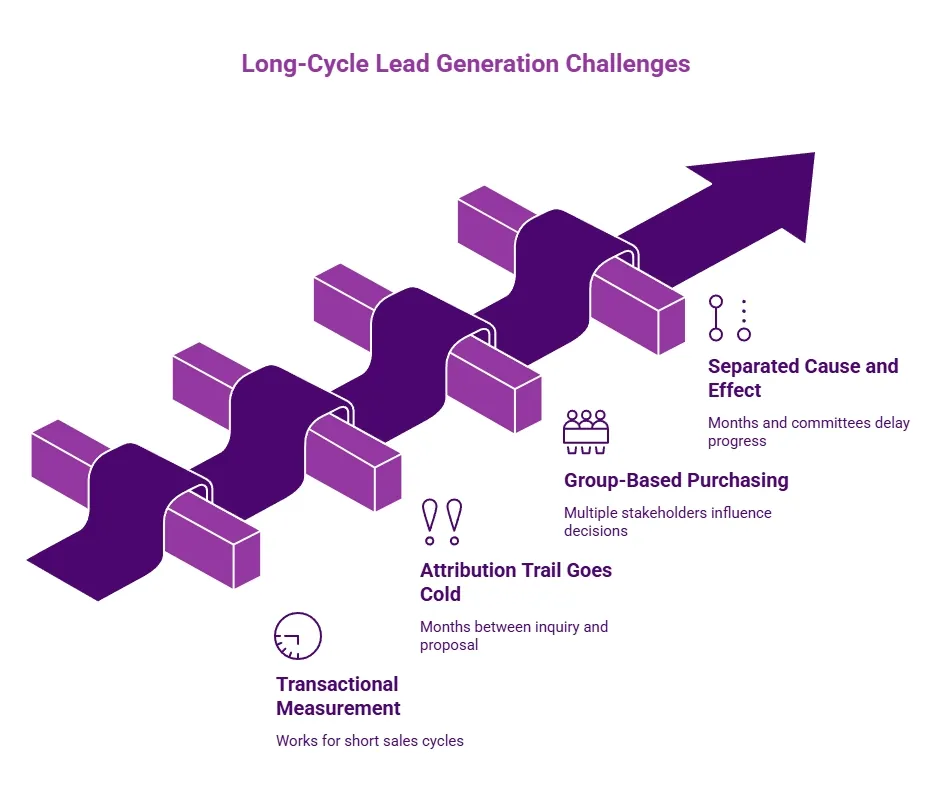
The standard playbook treats lead generation as a numbers game. More clicks produce more forms, more forms produce more "leads." In consumer services or transactional, product-led SaaS, where sales cycles generally last only days, that math can work.
In environmental consulting or multi-year program support, it does not. A pursuit that begins with an inquiry in March may not reach the proposal stage until September and may not close until the following year. The attribution trail goes cold. Marketing is left defending traffic numbers with no visible connection to revenue.
Research from Forrester confirms that B2B purchasing is increasingly group-based—multiple stakeholders typically evaluate and influence shortlists, completing a significant portion of their independent research before a vendor ever gets a call. The measurement model was built for a world where cause and effect sit close together. In long-cycle consulting, they are separated by months and by entire buying committees.
The better question is narrower and more useful: did the firm attract a buyer with the right technical problem, the right project context, and a realistic path to proposal work?
Myth 1: More Leads Means Better Marketing
Reality: Bad-Fit Leads Consume the Same Sales Bandwidth as Good Ones
When a geotechnical firm receives an inquiry from a homeowner asking about backyard drainage, someone still reads it, evaluates it, and responds. The sales team expends valuable billable hours on initial vetting and email exchanges before concluding the project is outside scope. Multiply that across dozens of bad-fit leads each quarter, and the cost is real—measured in pursuit hours, not dollars.
A dashboard can show more leads while the sales team quietly loses confidence in the entire system. The problem is not just conversion friction. It is wasted commercial attention—attention that principals, operations leads, and business development teams cannot afford to spend on inquiries that never had a realistic path to proposal work. That is where volume-first logic breaks down, and it is why understanding how broad keywords destroy pipeline quality matters as much as any traffic metric.
Reality: Long-Cycle Firms Cannot Afford Volume-First Lead Economics
In a firm where each pursuit takes months of BD effort, chasing volume produces burnout, distrust between sales and marketing, and a pipeline that looks full but carries almost no proposal-grade opportunities.
One school of thought still chases immediate paid volume because it looks efficient in a weekly report. Another still assumes referrals and reputation alone are enough. Both miss the same shift: modern technical buyers research long before outreach, and that research shapes who makes the shortlist. Relationship-based selling still matters. Search-based discovery matters too. They are not competing models. In practice, they reinforce each other—a referral often starts the conversation, but digital research often decides whether the conversation keeps moving.
Myth 2: Form Fills Prove Pipeline Value
Reality: Form Fills Only Capture the Front Edge of a Much Longer Buying Process
A form submission shows someone acted. It does not show procurement authority, technical need, or budget alignment. It does not show whether the firm made the shortlist eight months later.
In long-cycle consulting, a buyer may have already reviewed service pages, compared firms, checked technical depth, and shared options internally before reaching out. That means the visible conversion is often the final step in a much longer evaluation sequence—not the starting point most dashboards treat it as. Form fills measure the beginning of a journey that unfolds across quarters and multiple stakeholder touchpoints. Treating the form fill as the main KPI hides the real work. It also hides the real leverage.
In long-cycle consulting, a buyer may have already reviewed service pages, compared firms, checked technical depth, and shared options internally before reaching out. That means the visible conversion is often the final step in a much longer evaluation sequence—not the starting point most dashboards treat it as. Form fills measure the beginning of a journey that unfolds across quarters and multiple stakeholder touchpoints. Treating the form fill as the main KPI hides the real work. It also hides the real leverage.
Reality: The Attribution Gap Hides Marketing's True Influence
The 12-month attribution gap is where marketing accountability disappears. When a principal asks for business impact at the annual review and the only available metric is "organic sessions," the connection between investment and outcome is invisible—not because marketing had no impact, but because the model was never built to track influence across that time horizon.
What leadership actually wants to know is simpler: Which channels create qualified RFQs? Which topics influence proposal-stage opportunities? Which pages attract buyers with the right technical fit? That is the move from activity reporting to closed-loop reporting.
Myth 3: Generic Channels Can Qualify Technical Buyers
Reality: Technical Buyers Search by Specs, Methods, and Regulations
An environmental engineer evaluating remediation contractors searches for Phase II ESA requirements or RCRA corrective action consultants—not "best lead generation services." If content does not match the technical specificity of those queries, the channel generates volume without generating proposals.
Research from 6sense shows that B2B buyers complete substantial evaluation before ever contacting a vendor. For engineering firms, this means content encountered during independent research shapes shortlists long before a discovery call happens. That is why engineer-friendly specificity matters, and why understanding the failure of category keywords is such a relevant next step.
Reality: Broad Messaging Attracts Low-Context Inquiries
Generic campaigns pull in inquiries from people who do not understand the scope, timeline, or investment level of complex engineering engagements. When a page speaks in general marketing language, it invites general-interest traffic. When it speaks in technical, application-level language, it helps the right buyer self-identify.
That filtering effect matters before the form ever appears. It protects sales bandwidth upstream. It improves lead quality before the CRM gets involved. The result of getting it wrong is wasted time and a gradual erosion of sales confidence in marketing's ability to deliver qualified opportunities—a pattern covered in detail in stop attracting non-commercial inquiries.
What a Better System Looks Like
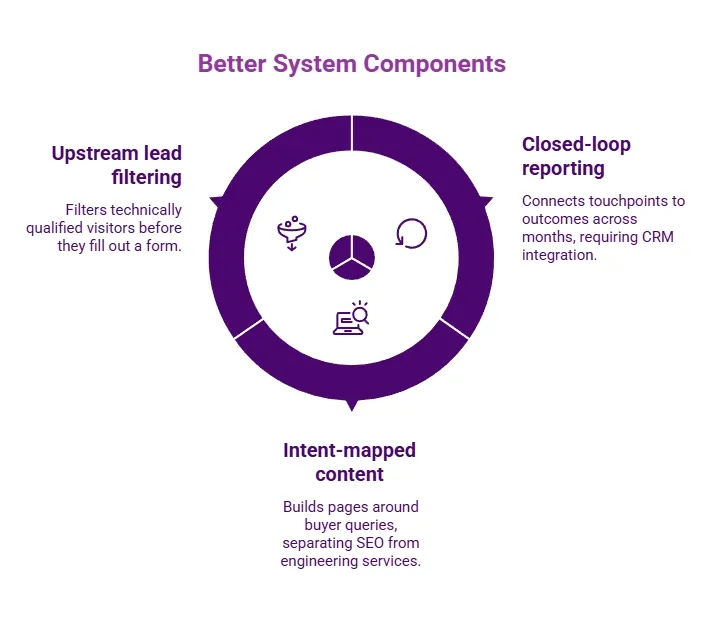
The alternative is not better lead scoring on the same broken foundation. Think of it as installing telemetry in a long-haul system rather than reading the odometer at the starting line.
A stronger model starts by treating the website as commercial infrastructure, not a promotional brochure. From that foundation, three capabilities change the equation.
Closed-loop reporting connects the first organic touchpoint to the final proposal outcome across months, not days. It requires CRM integration and produces the kind of defensible attribution that BD directors and leadership can evaluate with confidence.
Intent-mapped content architecture builds pages around the queries your buyers actually use—specific methodologies, regulatory frameworks, and technical problem types. This is what separates generic SEO from engineering-services positioning.
Upstream lead-quality filtering starts before the form. When content is precise enough to self-select technically qualified visitors, the inquiry stream changes. Sales spends less time disqualifying and more time pursuing—a shift that begins when you move from filtering after the form to filtering before the form.
Broader B2B research from Think with Google, 6sense, McKinsey, and Forrester reinforces the same general principle: B2B buyers research extensively, compare options across channels, and evaluate vendors as groups rather than as isolated individuals.
Early Warning Signs Your Current Model Is Failing
If sales routinely describes inbound leads as "junk," that is a targeting problem, not a sales problem. If marketing can report traffic growth but cannot connect a single organic page to a proposal outcome, the measurement model is too shallow. And if the firm cannot explain which content assets generate real RFQ fit versus general curiosity, there is no basis for deciding where to invest next.
That is not a reporting inconvenience. It is a strategic warning.
A Practical Reset
Audit channels by downstream outcome. Trace your last 20 proposals back to their original source. If most came from referrals and none from paid campaigns consuming significant budget, the allocation is misaligned.
Map pages to technical intent. Review top landing pages. Are they organized around services you sell, or around problems your buyers search for? Pages structured around technical intent capture commercial-grade queries that broad service pages miss.
Connect CRM stages to organic-source data. Even a simple tagging system that records the first organic page a contact visited—then tracks that contact through proposal and close—creates a feedback loop that replaces lead counting with pipeline measurement.
For a deeper walkthrough of this shift, start with Beyond the Form Fill, then review Engineering Firm SEO Metrics. If a broader strategic model is needed after that, explore Engineering Services SEO.
Clearer measurement changes the conversation. Better-fit demand changes the pipeline.
Frequently Asked Questions
Explore how BVM approaches engineering services SEO for firms navigating long-cycle pursuits and complex technical markets.
________________
Our Editorial Process: Our expert team uses AI tools to help organize and structure our initial drafts. Every piece is then extensively rewritten, fact-checked, and enriched with first-hand insights and experiences by expert humans on our Insights Team to ensure accuracy and clarity.
By: The BVM Insights Team: The BVM Insights Team is our dedicated engine for synthesizing complex topics into clear, helpful guides. While our content is thoroughly reviewed for clarity and accuracy, it is for informational purposes and should not replace professional advice.