
 BVM Insights Team
Long-cycle organic pipeline attribution breaks when the first 30 days of CRM setup are sloppy — and by the time proposals are issued, the original source trail is already inconsistent. The fix is not a bigger dashboard. It is a cleaner operating system for source capture, field ownership, and milestone discipline.
A common pattern surfaces inside growth-stage engineering firms: the business development team spends 6 to 12 months nurturing an opportunity from initial technical research to a submitted proposal, yet marketing still can't draw a clean line between organic search behavior and that proposal-stage movement. The reporting gap isn't caused by missing tools. It's caused by a missing foundation. You can fix that. With a focused first-month setup, you'll preserve the attribution integrity that makes closed-loop reporting possible later.
Here's the operating guide.
What Organic Pipeline Tracking Actually Means for a 6–12 Month Engineering Sales Cycle
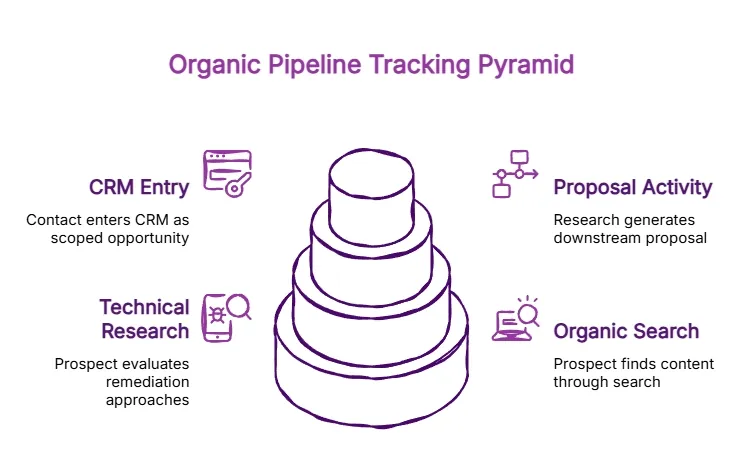
Organic pipeline tracking connects early technical research behavior — a prospect evaluating remediation approaches or comparing geotechnical investigation methodologies — to the downstream proposal activity that research eventually generates. The goal is not more reporting or another dashboard. It's a clean, reliable bridge between the moment a qualified visitor finds your content through organic search and the moment that same contact enters your CRM as a scoped opportunity.
That matters in environmental and geotechnical engineering because the first useful touchpoint often happens long before a proposal is issued, and vanity metrics alone cannot show commercial impact. That is why form fills alone are not enough, and why your website should be treated as part of your firm's digital infrastructure — not as a separate reporting silo.
Setting up this kind of tracking requires aligning marketing inputs with CRM outputs. That alignment is especially fragile in engineering consulting, where the gap between first visit and proposal submission can stretch across two or three quarters. Without deliberate first-month discipline, source fields decay, naming conventions drift, and the data becomes too unreliable to support pipeline-level conclusions.
What You Need in Place Before You Touch Your CRM
Before configuring a single field, settle four prerequisites. Skipping any one of these creates the inconsistencies that make later attribution unreliable.
Milestone clarity. Your team needs to agree on which stages represent genuine pipeline progress — not every inbound inquiry qualifies as a real opportunity. Define those stages before you build anything around them.
Naming discipline. Labels like "website" or "inbound" tell you nothing at the proposal stage. You need a naming convention granular enough to distinguish organic search from referral traffic, and specific enough to separate service-line intent — Phase I ESA inquiries from remediation system design queries, for example.
Source-field ownership. One person — whether that's the marketing director, a CRM administrator, or an ops lead — needs to own the source fields. When three people can edit how a lead's origin is recorded, consistency collapses within weeks.
Form and routing awareness. Every form, call-to-action, and routing path on the site must preserve the original source data as it flows into the CRM. If even one form strips the UTM parameters or defaults the source to "manual entry," the attribution thread breaks.
Your exact field names, routing rules, and lifecycle stages may vary by CRM and firm structure. That is normal. What should not vary is the operating principle: set definitions first, then configure the system.
The 5-Step First-30-Day Setup
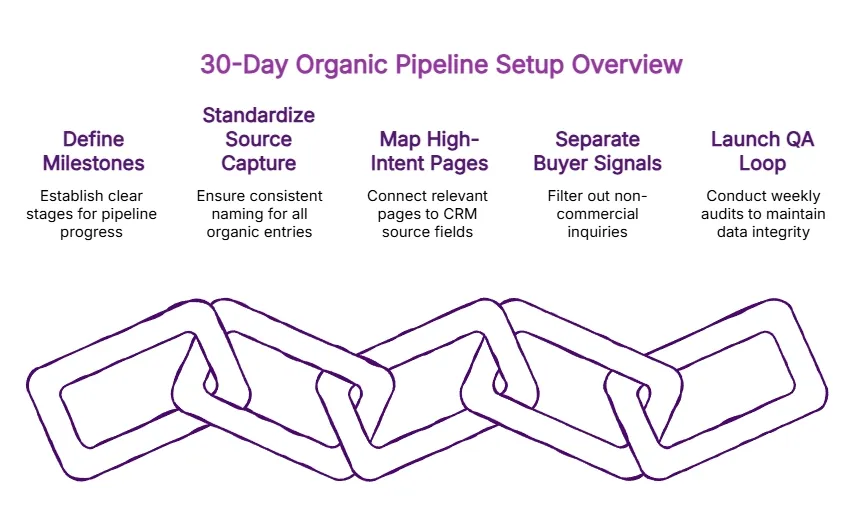
This is the operational center of the entire process. Each step can be assigned, completed, and verified within the first month — before data decay sets in.
Define the Proposal-Stage Milestones You Will Treat as Real Pipeline Progress
List the stages your firm actually uses to advance an opportunity: initial qualified inquiry, technical scoping conversation, formal proposal issued, shortlisted, and awarded are common starting points. Your firm may use different labels. What matters is that each milestone is concrete enough for any team member to record it consistently. If a stage is subjective — "seems interested" — it doesn't belong on this list.
Reporting falls apart when marketing and operations use different definitions. If one team celebrates any form submission while another only counts proposal-stage movement, the data never becomes defensible. Clean tracking begins when everyone agrees which milestones actually matter.
Standardize Source Capture for Every Organic Entry Point
Create one naming convention and enforce it across every entry point — forms, gated assets, contact paths, and any workflow that sends a record into the CRM. A useful convention covers three elements: one source taxonomy (e.g., "organic-google"), one landing-page grouping logic (e.g., "service-environmental-remediation"), and one service-line intent framework (e.g., "phase-ii-esa").
When one team member tags a lead as "Google" and another uses "organic-search," those become two separate source categories in the CRM. Closed-loop reporting breaks before it begins. If you use tagged URLs for controlled campaigns or resource distribution, follow the naming discipline outlined in Google's GA4 URL builders documentation, then review how those visits appear in the GA4 Traffic acquisition report.
Map High-Intent Pages and Queries to CRM-Friendly Source Fields
Not all organic traffic carries the same commercial signal. Your practice-area pages — the ones targeting queries like "geotechnical investigation services" or "RCRA corrective action consulting" — should feed CRM source categories that reflect genuine buyer intent. Use the Search Console Performance report to identify which queries drive technically qualified visitors, then map those pages to CRM-visible source fields.
If one page tries to serve too many buyer intents, the tracking layer gets muddy. A cleaner service page architecture makes the measurement layer cleaner too.
RFQ tracking must begin at the point of technical research, not at the proposal stage. By the time a prospect submits a formal request, the organic entry point that started the relationship is already three or four months old. If you haven't captured it by then, you won't.
Separate Technical-Buyer Signals From Junk Demand
Students researching homework topics, homeowners looking for soil tests, and vague non-commercial inquiries will muddy the dataset if left unfiltered. Build simple qualification rules into your forms: a required company-name field, a project-type dropdown, or a budget-range qualifier. These small friction points keep non-commercial demand from polluting pipeline data.
The GA4 Traffic acquisition report can also help identify traffic segments that consistently convert to junk rather than qualified inquiries — useful for refining which organic sources deserve CRM-level attention. If that problem already shows up in your pipeline, review why broad keywords damage pipeline quality and how tightening intent categories at the page level creates better reporting downstream.
Launch a 30-Day QA Loop Before Data Decay Sets In
Run a weekly audit during the first month. Check for broken source fields, inconsistent naming ("Organic - Google" alongside "organic-google" is a common early failure), and records where the source defaulted to blank. Once naming conventions drift, they're difficult to repair — especially across a 12-month sales cycle where the original visit happened three quarters ago.
Proper setup in the first 30 days prevents this kind of data decay from compounding over the full pursuit cycle. If you publish the checklist as an on-site tutorial, structured data such as HowTo can still help organize step-based content for machines; however, since Google reduced support for HowTo rich results in 2023, it should not be relied upon as a primary SEO tactic. Prioritize clear on-page formatting and consider broader Article schema for consistent baseline visibility.
What Not to Overcomplicate in Month One
Resist the urge to build a multi-touch attribution model, a weighted scoring dashboard, or a cross-channel data warehouse right now. Those capabilities depend on clean foundational data. If the source fields are inconsistent, a sophisticated model just processes unreliable inputs faster.
Defer weighted attribution modeling, marketing-sourced revenue dashboards, and third-party analytics integrations until month two at the earliest. Month one is about discipline, not sophistication.
What Comes After Day 30
Once the foundation is stable — milestones defined, naming locked, source fields verified — the next step is connecting organic search data to actual engineering proposals. That means tracking which entry points produce RFQs, which service-line queries correlate with scoped opportunities, and where pipeline velocity accelerates or stalls.
For a closer look at the metrics that connect search visibility to commercial pipeline outcomes, explore what BD directors should track to measure pipeline impact. If you're ready to build the full execution plan around this foundation, the 12-week engineering SEO implementation roadmap maps the complete sequence from strategy to measurable results. And if your team is still tightening practice-area visibility and service-line structure, Engineering Services SEO can serve as a contextual reference.
Clean tracking. Clear milestones. Consistent naming. That's the entire first month. Get those right, and every reporting question that comes later has an answer — not perfect, but defendable. And in a long-cycle consulting business, defendable beats impressive every time.
Our Editorial Process: Our expert team uses AI tools to help organize and structure our initial drafts. Every piece is then extensively rewritten, fact-checked, and enriched with first-hand insights and experiences by expert humans on our Insights Team to ensure accuracy and clarity.
About the BVM Insights Team: The BVM Insights Team is our dedicated engine for synthesizing complex topics into clear, helpful guides. While our content is thoroughly reviewed for clarity and accuracy, it is for informational purposes and should not replace professional advice.